

Cooling Systems in Plastic Tube Extrusion
Advanced cooling technologies for optimal product quality and production efficiency
Cooling in Plastic Tube Extrusion
The cooling stage represents one of the most critical phases in plastic tube extrusion processes, directly influencing product quality, dimensional stability, and production efficiency. After passing through the cooling and sizing device, extruded tubes have not been completely cooled below their heat deformation temperature, necessitating continued cooling to prevent deformation and ensure product quality.
Modern plastic tube extrusion operations require sophisticated cooling systems that can effectively manage temperature gradients and minimize internal stresses while maintaining high production speeds.
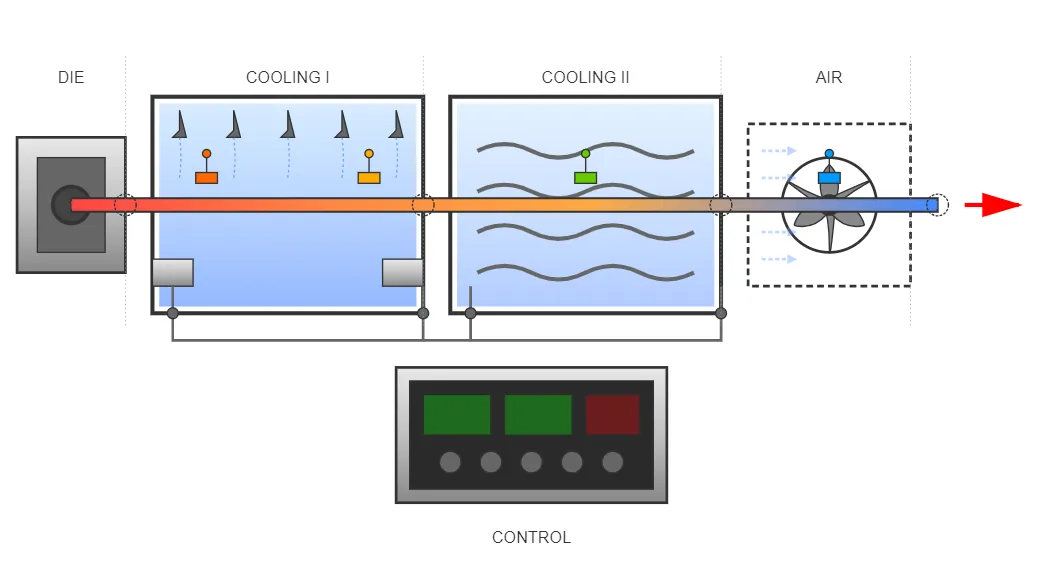
Fundamental Principles of Cooling in Plastic Tube Extrusion
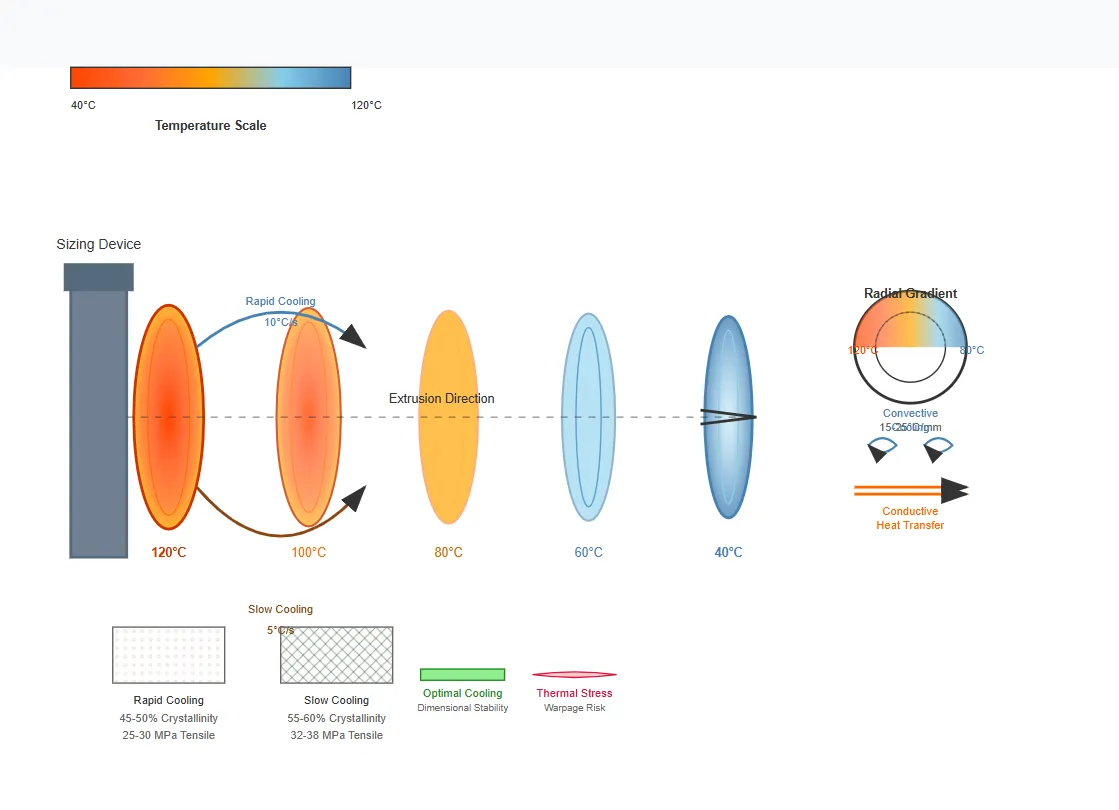
The cooling process in plastic tube extrusion involves complex heat transfer mechanisms that must be carefully controlled to achieve optimal results. When tubes exit the sizing device, they typically maintain temperatures ranging from 80°C to 120°C, depending on the material and wall thickness. The radial temperature gradient across the tube wall can reach 15-25°C/mm in thick-walled applications, creating significant thermal stresses that may lead to warpage or dimensional instability if not properly managed.
Crystallinity Effects
Research indicates that the cooling rate in plastic tube extrusion significantly affects the crystallinity of semi-crystalline polymers. For instance, polyethylene tubes cooled at rates of 10°C/s show crystallinity levels of 45-50%, while those cooled at 5°C/s exhibit 55-60% crystallinity.
This variation in crystallinity directly impacts mechanical properties, with slower cooling rates generally producing higher tensile strength (25-30 MPa for rapid cooling versus 32-38 MPa for slow cooling) but potentially compromising dimensional accuracy.
Temperature Distribution Equation
The temperature distribution within the tube wall during cooling follows an exponential decay pattern, described by the equation:
T(r,t) = T₀ + (Ti - T₀)exp(-ht/ρcp)
Where:
T₀ is the cooling water temperature (typically 15-20°C)
Ti is the initial tube temperature
h is the heat transfer coefficient (500-2000 W/m²K)
ρ is the material density
c is the specific heat capacity
p is the wall thickness
Temperature Gradients
Radial temperature gradients across tube walls can reach 15-25°C/mm in thick-walled applications, creating significant thermal stresses that must be carefully managed.
Cooling Rates
Cooling rates significantly affect material properties, with rates ranging from 5°C/s to 10°C/s producing measurable differences in crystallinity and tensile strength.
Heat Transfer
Heat transfer coefficients vary by cooling method, ranging from 500-2000 W/m²K, directly impacting cooling efficiency and required system length.
Classification and Design of Cooling Systems
1. Immersion-Type Water Tanks
Immersion cooling tanks remain the most fundamental cooling method in plastic tube extrusion, particularly suitable for small to medium diameter tubes ranging from 16mm to 250mm. These open-design tanks maintain water levels that completely submerge the extruded tube, with tank lengths typically ranging from 2 to 8 meters, divided into 2-4 sections for optimal temperature control.
| Parameter | Typical Value | Application |
|---|---|---|
| Diameter Range | 16mm - 250mm | Small to medium tubes |
| Tank Length | 2 - 8 meters | Depending on speed/thickness |
| Water Flow Rate | 8 - 12 m³/h | 110mm PVC tube @ 15 m/min |
| Heat Transfer Coefficient | 800 - 1200 W/m²K | Standard conditions |
The design parameters for immersion tanks in plastic tube extrusion include water volume calculations based on heat removal requirements. For a typical PVC tube with 110mm diameter and 3mm wall thickness running at 15 m/min, the required cooling water flow rate is approximately 8-12 m³/h to maintain a temperature rise of less than 5°C. The countercurrent water flow, moving opposite to the tube direction, creates a temperature gradient that gradually reduces tube temperature from entry (typically 85-95°C) to exit (25-30°C).
However, buoyancy forces in immersion cooling present significant challenges for plastic tube extrusion of large-diameter tubes. The upward force can be calculated as Fb = ρwater × g × V, where V is the displaced volume. For a 400mm diameter tube with 10mm wall thickness, the buoyancy force can reach 120-150 N/m, potentially causing deflection of up to 15-20mm over a 6-meter tank length without proper support systems.

Immersion Cooling Design
Tank construction typically employs stainless steel 316L with thickness of 3-4mm for corrosion resistance. Water circulation systems include pumps with capacities of 15-25 m³/h.
Key Consideration
Immersion cooling provides excellent surface quality (Ra 0.5-1.0 μm) due to uniform water contact but requires longer cooling lengths and proper support systems to counteract buoyancy forces in large-diameter applications.
2. Spray-Type Cooling Systems

Spray Cooling Configuration
Enclosed chambers with uniformly distributed spray nozzles around the tube circumference, with nozzle densities from 4-8 per meter.
Spray cooling systems represent an advanced approach in plastic tube extrusion technology, offering superior heat transfer efficiency compared to immersion methods. These fully enclosed chambers feature uniformly distributed spray nozzles around the tube circumference, with nozzle densities ranging from 4-8 nozzles per meter length for standard applications to 12-16 nozzles per meter for thick-walled tubes exceeding 15mm wall thickness.
The spray pattern optimization in plastic tube extrusion requires careful consideration of nozzle angle (typically 15-30° from perpendicular), spray pressure (2-4 bar for standard applications, up to 6 bar for rapid cooling), and water droplet size (0.5-2mm diameter for optimal heat transfer). The spray intensity near the sizing device inlet is typically 30-50% higher than at the outlet, creating a graduated cooling profile that minimizes thermal shock while maximizing cooling efficiency.
Performance data from industrial plastic tube extrusion lines demonstrate that spray cooling can achieve heat transfer coefficients of 1500-2500 W/m²K, compared to 800-1200 W/m²K for immersion cooling. This enhanced efficiency translates to shorter cooling lengths, with spray systems requiring 30-40% less space than equivalent immersion tanks. For example, a 110mm diameter HDPE tube with 5mm wall thickness running at 20 m/min requires only 4-5 meters of spray cooling versus 6-8 meters of immersion cooling to reach the target temperature of 30°C.
3. Mist Cooling Technology
Mist cooling represents the most advanced cooling technology currently employed in plastic tube extrusion, combining water and compressed air to create ultra-fine droplets that maximize evaporative cooling effects. This system replaces traditional spray heads with specialized misting nozzles that produce water particles ranging from 10-50 microns in diameter, creating a fog-like atmosphere around the extruded tube.
Operating Parameters
4-7 bar
Compressed Air Pressure
2-3 bar
Water Pressure
10:1 - 20:1
Air-to-Water Ratio
"Mist cooling systems in plastic tube extrusion demonstrate heat transfer coefficients exceeding 3000 W/m²K under optimal conditions, representing a 40-60% improvement over conventional spray cooling. The enhanced cooling efficiency enables production rate increases of 25-35% while maintaining dimensional tolerances within ±0.1mm for tubes up to 400mm diameter."
- Zhang et al. (2023), Journal of Polymer Engineering
Performance metrics from industrial implementations of mist cooling in plastic tube extrusion show remarkable efficiency gains. A comparative study of 160mm diameter PE100 tubes with 14.6mm wall thickness revealed that mist cooling reduced the required cooling length from 6 meters (spray cooling) to just 3.5 meters while maintaining the same production speed of 8 m/min. The tube surface temperature was reduced from 95°C to 28°C within this shorter distance, with maximum temperature gradients not exceeding 8°C/mm.

Mist Cooling Technology
Ultra-fine water droplets (10-50 microns) create a fog-like atmosphere around the extruded tube, maximizing evaporative cooling effects.
Vacuum-Assisted Variant
By maintaining chamber pressure at 0.3-0.5 bar absolute, water vaporization occurs at 70-80°C instead of 100°C, enhancing the cooling rate by an additional 20-30%.
This configuration requires vacuum pumps with capacities of 500-1000 m³/h and specially designed chamber seals capable of maintaining the required vacuum levels during continuous operation.
Temperature Profile Management and Control Strategies
Effective temperature management in plastic tube extrusion requires sophisticated control systems that monitor and adjust cooling parameters in real-time. Modern installations employ arrays of infrared pyrometers positioned at 1-meter intervals along the cooling section, providing continuous temperature feedback with accuracy of ±1°C. These sensors interface with programmable logic controllers (PLCs) that adjust water flow rates, spray pressures, and cooling zone temperatures to maintain optimal cooling profiles.
Critical Temperature Thresholds by Material
| Material | Critical Temperature | Key Considerations |
|---|---|---|
| PVC | Below 80-85°C (Tg) | Prevent deformation while avoiding excessive internal stresses |
| Polyethylene (LDPE) | Below 60°C | Moderate sensitivity to cooling rate variations |
| Polyethylene (HDPE) | Below 60°C | Higher sensitivity to cooling rates due to crystallinity potential |
| Polypropylene | Below 65-70°C | Requires controlled cooling for optimal crystallinity development |
Data logging systems in modern plastic tube extrusion lines record temperature profiles at intervals of 1-5 seconds, creating comprehensive thermal histories for quality control purposes. Analysis of these profiles reveals that optimal cooling strategies involve maintaining temperature differentials between inner and outer tube surfaces below 15°C to minimize residual stresses that could lead to long-term dimensional changes.
Temperature Monitoring Systems

Infrared pyrometers at 1-meter intervals
±1°C measurement accuracy
1-5 second data logging intervals
PLC integration for real-time adjustments
Water Treatment and Recirculation Systems
The water quality in cooling systems significantly impacts the efficiency and product quality in plastic tube extrusion operations. Cooling water parameters must be carefully controlled, with pH maintained between 6.5-7.5, total dissolved solids below 500 ppm, and bacterial counts under 100 CFU/ml to prevent biofilm formation that could impair heat transfer or contaminate products intended for potable water applications.
Recirculation systems in plastic tube extrusion facilities typically incorporate multiple treatment stages. Primary filtration removes particles larger than 50 microns, while secondary sand or cartridge filters capture particles down to 5-10 microns. Chemical treatment with biocides (typically 2-5 ppm chlorine or 10-20 ppm hydrogen peroxide) prevents biological growth, while corrosion inhibitors protect system components.

Water Treatment Process Flow
Collection & Primary Filtration
Cooling water is collected from the cooling system and passed through primary filters to remove particles larger than 50 microns.
Equipment: Screen filters, centrifugal separators
Secondary Filtration
Equipment: Sand filters, cartridge filters, bag filters
Chemical Treatment
Biocides, corrosion inhibitors, and pH adjusters are added to maintain water quality and protect system components.
Chemicals: 2-5 ppm chlorine, 10-20 ppm hydrogen peroxide, corrosion inhibitors
Temperature Regulation
Heat exchangers or cooling towers reduce water temperature to the required set point for optimal cooling efficiency.
Equipment: Plate heat exchangers, cooling towers, chillers
Distribution
Treated and temperature-controlled water is pumped back to the cooling system for reuse.
Equipment: Variable-speed pumps, flow meters, pressure regulators


Advanced Cooling Technologies and Future Developments
Computational Fluid Dynamics (CFD) Modeling
CFD has become instrumental in optimizing cooling system designs for plastic tube extrusion. Advanced simulations incorporating conjugate heat transfer, turbulence modeling, and phase change phenomena enable engineers to predict temperature distributions within ±2°C accuracy, reducing the need for extensive physical prototyping.
These models reveal that optimal spray nozzle arrangements follow logarithmic spiral patterns that maximize coverage while minimizing interference between adjacent spray cones. CFD analysis also helps identify potential dead zones where cooling is insufficient, allowing for design modifications before physical implementation.

CFD Cooling Simulation
Computational fluid dynamics modeling allows precise prediction of temperature distributions and cooling efficiency before system construction.
Technology Readiness Levels
Immersion Cooling TRL 9 (Commercialized)
Spray Cooling TRL 9 (Commercialized)
Mist Cooling TRL 8 (System Complete)
Ultrasonic Cooling TRL 6 (Demo System)
Cryogenic Cooling TRL 5 (Component Validation)
Quality Control and Dimensional Stability
The relationship between cooling parameters and final product quality in plastic tube extrusion is well-documented through extensive industrial data. Dimensional stability, measured as percentage change after 24 hours at 23°C, correlates strongly with cooling uniformity. Tubes cooled with temperature variations exceeding 10°C around the circumference show dimensional changes of 0.3-0.5%, while those maintained within 5°C variation exhibit changes below 0.15%.
Residual Stress Reduction
Residual stress measurement using the slit-ring method reveals that optimized cooling in plastic tube extrusion can reduce hoop stresses from 8-10 MPa (rapid cooling) to 3-4 MPa (controlled gradient cooling).
This stress reduction translates to improved long-term performance, with creep rates reduced by 30-40% and stress crack resistance improved by 50-60% in standardized testing protocols.
Surface Quality Comparison
Immersion Cooling Smoothest
Ra 0.5-1.0 μm
Mist Cooling Balanced
Ra 0.8-1.5 μm
Spray Cooling Good Control
Ra 1.0-2.0 μm
Dimensional Stability
Cooling uniformity directly impacts dimensional stability. Temperature variations around the tube circumference lead to differential shrinkage and ovality issues.


Energy Efficiency and Sustainability Considerations
Energy consumption in cooling systems represents 15-25% of total energy use in plastic tube extrusion operations. Modern variable-speed pumps with efficiency ratings exceeding 85% can reduce pumping energy by 30-40% compared to constant-speed systems. Integration of variable frequency drives (VFDs) allows precise matching of cooling water flow to production requirements, eliminating energy waste during speed changes or product transitions.
Heat Recovery Systems
Heat recovery systems in plastic tube extrusion facilities can capture 40-60% of the thermal energy removed from tubes for use in other processes. Pre-heating of raw materials, space heating, or hot water generation for plant facilities represent common applications.
A typical installation processing 1000 kg/h of tubes can recover 100-150 kW of useful thermal energy, providing annual energy savings of $30,000-50,000 depending on local energy costs.
Water conservation strategies in plastic tube extrusion have evolved significantly with environmental regulations and sustainability goals. Advanced filtration systems using ultrafiltration membranes (0.01-0.1 micron pore size) enable water reuse rates exceeding 95%, reducing fresh water consumption to less than 0.05 m³ per ton of produced tubes. Closed-loop systems with zero liquid discharge are becoming increasingly common, particularly in regions with water scarcity or strict environmental regulations.
Energy Consumption Breakdown

Water Conservation Metrics
Conventional Systems 0.5-1.0 m³/ton
Advanced Recirculation 0.1-0.2 m³/ton
Ultrafiltration Systems <0.05 m³/ton
Process Integration and Automation

Modern plastic tube extrusion lines integrate cooling system control with overall process management through sophisticated SCADA systems. Real-time optimization algorithms adjust cooling parameters based on multiple inputs including extruder output rate, melt temperature, ambient conditions, and product specifications.
Machine learning algorithms trained on historical production data can predict optimal cooling settings with 90-95% accuracy, reducing setup times for new products by 40-50%.
Key Automation Benefits
40-50% reduction in setup times for new products
25-35% reduction in unplanned downtime
10-15% improvement in overall productivity
Reduction in dimensional variations by 30-40%
Predictive Maintenance
Implementation of Industry 4.0 concepts enables predictive maintenance strategies that reduce unplanned downtime by 25-35%. Vibration sensors on pumps, pressure transducers in spray systems, and flow meters provide continuous condition monitoring.
Anomaly detection algorithms identify potential failures 48-72 hours before critical failure, allowing scheduled maintenance during planned production breaks.
Remote Monitoring
Remote monitoring capabilities allow centralized control of multiple production lines from a single control room. Cloud-based data storage and analysis platforms aggregate production data from multiple facilities, enabling benchmarking and best practice sharing.
This connectivity has demonstrated productivity improvements of 10-15% through optimization of cooling parameters based on cross-facility learning.
Adaptive Control
Advanced adaptive control systems continuously adjust cooling parameters in real-time based on feedback from multiple sensors. These systems maintain optimal cooling conditions despite variations in ambient temperature, material properties, and production rates.
Self-tuning algorithms ensure consistent product quality even as system components degrade over time.
Troubleshooting Common Cooling Issues
Systematic approaches to resolving cooling-related problems in plastic tube extrusion require understanding of root cause relationships. The following sections outline common cooling issues, their causes, and recommended solutions based on industry best practices.
Ovality Issues
Problem
Tubes exhibit elliptical cross-sections rather than perfect circles, with deviations exceeding specified tolerances.
Cause
Non-uniform cooling causing differential shrinkage around the tube circumference. Typically results from uneven water distribution or blocked nozzles.
Solution
Adjust spray nozzle alignment, with angular adjustments of 2-3° often sufficient to restore roundness to within ±0.5% of nominal diameter. Clean or replace clogged nozzles.
Wall Thickness Variations
Problem
Inconsistent wall thickness around the tube circumference, with variations exceeding ±5% of nominal thickness.
Cause
Often correlates with cooling asymmetry. Areas with less effective cooling experience less shrinkage, resulting in thicker walls.
Solution
Use ultrasonic wall thickness measurements at 45° intervals to identify patterns. Install additional spray nozzles in under-cooled areas to reduce variations from ±8% to ±3%.
Surface Defects
Problem
Water marks, streaking, or uneven surface finish that affects product appearance and may compromise performance.
Cause
Often trace to cooling water quality issues, spray pattern irregularities, or mineral deposits from hard water.
Solution
Implement deionized water systems (conductivity <10 μS/cm) to eliminate mineral deposits. Regular nozzle inspection and cleaning every 100-150 operating hours.
|
Component
|
Maintenance Task
|
Frequency
|
|---|---|---|
|
Spray Nozzles
|
Clean or replace
|
100-150 operating hours
|
|
Filters
|
Inspect and clean
|
200-300 operating hours
|
|
Temperature Sensors
|
Calibrate
|
Monthly
|
|
Pump Seals
|
Inspect for leaks
|
Weekly
|
|
Chemical Treatment
|
Test and adjust
|
Daily
|
