

Process introduction
Extrusion moulding is a continuous manufacturing process in which thermoplastic material is melted inside a heated barrel by a rotating screw and then forced through a shaped die to produce a profile with a constant cross-section. Unlike injection molding, which fills a closed mold cavity to create discrete parts, extrusion molding delivers an uninterrupted length of product-pipes, tubes, channels, strips, sheets-that is sized, cooled, and cut downstream. The process is valued for its high throughput, low per-meter cost, and ability to handle a broad range of polymers from commodity PVC to engineering-grade polycarbonate.
Extrusion molding is a molding processing method with many changes, high productivity, strong adaptability, wide application and the largest proportion in the field of plastic material processing.
Extrusion molding is to continuously shape the polymer melt or viscous fluid through a certain shape die under the extrusion action of the screw or plunger of the extruder. The resulting parts are continuous profiles with constant section shape.
The polymer extrusion process can be broken down into a sequence of tightly controlled stages, each of which affects final part quality. Raw resin-pellets, granules, or powder-is loaded into a gravity-fed hopper mounted above the extruder barrel. From there, the material enters the feed throat and is conveyed forward by a rotating screw. As the resin travels along the barrel, external band heaters and internal shear friction raise the temperature progressively until the material reaches a fully molten state. The screw design-its flight depth, compression ratio, and L/D ratio-directly influences how uniformly the melt is plasticized, which is why plastic extruder design is often considered the starting point of any DFM review for extrusion projects.
Once the melt exits the barrel, it is pushed through a breaker plate fitted with screen packs that filter out contaminants and build back-pressure for better mixing. The filtered melt then enters the extrusion die design principles, where the flow channel geometry shapes it into the target cross-section. After leaving the die, the still-soft extrudate passes through a sizing and cooling station-typically a vacuum calibration tank for hollow profiles, or chilled rollers for flat sheet-before a downstream puller draws it at a controlled speed. Finally, a flying-saw or rotary cutter sections the continuous profile to length, completing the extrusion process steps from raw material to finished part.
A plastic extruder is the core machine in any extrusion line. It consists of a hopper for material feeding, a heated barrel, and one or more screws that convey, compress, and plasticize the resin. Single-screw extruders are the most common configuration for profile and pipe production; they offer simple operation, low maintenance, and consistent output for most thermoplastics. Twin-screw extruders provide superior mixing and are preferred for compounding, color masterbatch dispersion, and processing heat-sensitive materials like rigid PVC. The screw diameter-ranging from 20 mm on lab-scale units to over 200 mm on large pipe lines-determines the maximum throughput. When evaluating a plastic extruder for a new project, key specifications to compare include the screw L/D ratio, motor torque, barrel zone count, and maximum operating pressure.

Not all thermoplastics can be processed by extrusion.
Common base materials include hard materials and elastic materials.
Hard materials: PVC, PC, PETG, ABS, PP, hips, PMMA, LDPE, HDPE, POM, ASA, PA, as, EVA, PC + ABS, etc
Elastic materials: PVC, TPU, TPE, Poe, TPR, TPV, TPEE, etc
Choosing the right resin goes beyond matching a material abbreviation to a product category. Each polymer brings its own melt behavior, shrinkage rate, and post-extrusion dimensional stability, all of which feed back into the DFM analysis for the extruded plastic part. Rigid PVC, for example, requires precise temperature control and a fully streamlined die because it is highly sensitive to thermal degradation; a poorly designed flow channel can lead to material stagnation and black specks on the profile surface. The complete PVC extrusion process guide also demands specific screw geometries-typically a low-compression-ratio, barrier-flight screw-to avoid overheating the resin.
In contrast, polyolefins like HDPE and PP are far more forgiving in terms of processing window, but they exhibit higher die swell and greater crystallization shrinkage, so wall-thickness uniformity and cooling rate become the dominant design concerns. Engineering resins such as PC and PMMA deliver optical clarity and impact strength for lighting diffusers and display covers, though their higher melt viscosity calls for stronger extruder drive systems and hardened die steel. For applications requiring both rigidity and a soft seal in a single profile, co-extrusion PVC profiles pair a structural substrate (often rigid PVC or ABS) with an elastomeric overmold (TPE or TPV) to create a dual-durometer extruded plastic part in one pass.
Die and Tooling Design
The extrusion die translates a 2-D profile drawing into a physical flow channel that must deliver molten polymer at a uniform velocity across the entire cross-section. Achieving this balance is the central challenge of plastic extrusion die design. Two parameters matter most: land length and flow-channel depth. The land is the final parallel section of the die opening; it imparts "memory" to the melt, stabilizing the extrudate shape as it exits. A general starting rule is a land-length-to-wall-thickness ratio of at least 10 : 1-meaning a 2 mm wall calls for roughly 20 mm of land. Shorter land lengths make the process more sensitive to temperature and speed fluctuations, while excessively long land lengths can generate uneven cooling and residual stress.
Flow balancing comes next. Where a profile has both thick and thin sections, the thicker areas will naturally move faster through the die. Tooling engineers compensate by lengthening the land in fast-flow regions or by inserting flow restrictors upstream. For round or annular geometries-such as those found in plastic pipe extrusion tooling-mandrel pins are placed inside the die to form the hollow bore, and spider legs or spiral distributor channels keep the melt evenly distributed around the pin. Maintaining full compression throughout the die, adaptors, and transition plates is critical; any dead zone where material can stagnate will eventually degrade and contaminate the extrudate, a particularly serious issue when running rigid PVC or polycarbonate.
As with the design of injection molded parts and aluminum extruded parts, uniform wall thickness is very important.
If the wall thickness of the plastic extrusion part is uneven, some parts are thick and some parts are thin, which makes the flow velocity of the plastic extruded in the die uneven, resulting in different cooling rates and eventually deformation of the part.
If the deformation needs to be controlled, additional cooling processes need to be added to reduce the efficiency of the production line and increase the production cost.
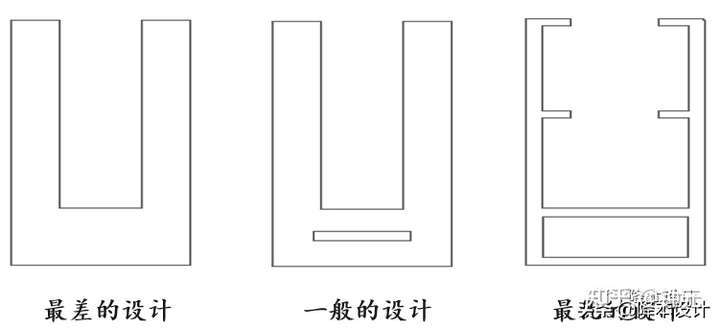
Because plastic extrusion is a continuous process, the strength of the extruded part is low when it is just extruded, and it needs to be supported by air pressure and mandrel to maintain its shape and avoid deformation, while the hollow part cannot provide support, and the complex hollow structure can only be realized by opening the section.
Pipe, Tube, and Corrugated Tubing Tooling
Plastic pipe extrusion tooling and tubing represent one of the highest-volume applications of extrusion, and their tooling requirements differ significantly from solid or open profiles. A plastic pipe extrusion tooling design guideline typically starts with the annular die and mandrel assembly. The mandrel creates the inner bore while a concentric outer ring defines the outer diameter; the gap between them sets the wall thickness. After the melt leaves the die, the still-soft tube enters a vacuum sizing sleeve that holds the outer diameter to specification while a slight internal air pressure keeps the tube from collapsing.
For smooth-wall tubing-medical lines, pneumatic hose, cable conduit-wall concentricity is the primary quality metric, so the mandrel must be centered within microns and the melt distribution must be spiral or coat-hanger type to avoid weld lines. Corrugated plastic tubing adds another layer of complexity: a set of traveling mold blocks (or corrugator) downstream of the die opens and closes around the extrudate in sequence, forming the alternating peaks and valleys that give the tubing its axial flexibility and crush resistance. The design guideline for corrugated extrusion tooling must account for the mold-block pitch, the vacuum timing at each corrugation, and the resin's ability to stretch into the mold cavity without thinning excessively. Both single-wall corrugated conduit and double-wall corrugated drain pipe rely on this tooling concept, though wall-structure design and resin selection (typically HDPE or PP) differ between the two.
Small-diameter plastic tubing extrusion-say, below 10 mm OD-demands tighter tolerances on the die gap and more responsive cooling, because any temperature or pressure fluctuation represents a larger percentage of the wall cross-section. When specifying tooling for these applications, it is worth consulting the extrusion supplier's design guidelines handbook to confirm their standard capability on wall eccentricity, ovality, and cut-length accuracy before committing to production.
The sharp corner on the extrusion will become a weak point of the extrusion due to stress concentration, which is prone to cracking or failure, and will reduce the impact resistance of the extrusion.
In extruded parts, sharp corners should be avoided as much as possible, and rounded corners should be added at the sharp corners. The fillet radius is equal to the wall thickness of the product, which helps the material flow more smoothly in the extrusion process and reduces the stress at the contour corners.
The sharp corner on the extrusion will become a weak point of the extrusion due to stress concentration, which is prone to cracking or failure, and will reduce the impact resistance of the extrusion.
In extruded parts, sharp corners should be avoided as much as possible, and rounded corners should be added at the sharp corners. The fillet radius is equal to the wall thickness of the product, which helps the material flow more smoothly in the extrusion process and reduces the stress at the contour corners.
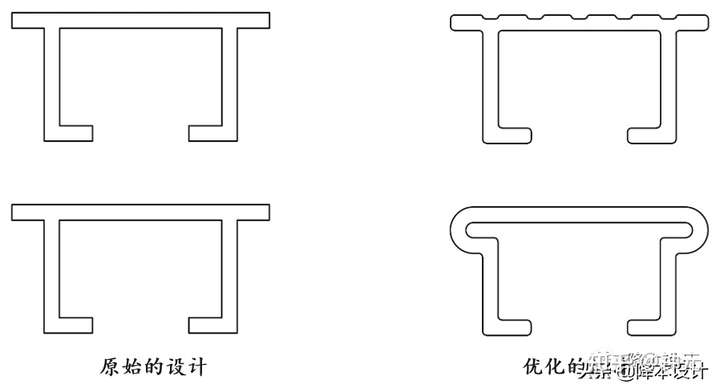
At the intersection of multiple walls, areas with thick wall thickness are usually generated, so it is easy to produce shrinkage and poor appearance on the outer surface of the extrusion, which is very similar to injection molding.
If the extrusion is an appearance part, the shrinkage can be avoided or covered up by the optimization design shown in the figure below.
DFM Strategies for Reducing Extrusion Cost
Applying DFM principles early in the design cycle is one of the most effective ways to drive cost out of an extruded plastic profile without sacrificing performance. A few practical strategies are commonly overlooked.
First, consolidate parts. If an assembly currently uses two or three separate profiles fastened together, evaluate whether a single co-extruded section could replace them. Fewer parts means fewer dies, fewer secondary operations, and reduced assembly labor-a direct win from a DFM plastics engineering perspective.
Second, minimize the enclosed area of hollow sections. Every enclosed void requires a mandrel and complicates die balancing. Where a fully enclosed channel is not structurally necessary, consider converting it to a C-channel with a snap-in cap; this simplifies tooling and shortens die lead time.
Third, design for standard downstream equipment. If the intended cut length can be achieved with a standard flying saw rather than a precision servo cutter, the per-unit cost drops. Likewise, designing snap features and mounting holes that can be punched inline-rather than CNC-machined offline-keeps the process continuous and the labor content low.
Finally, share drafts with your extrusion supplier before freezing the design. Experienced tooling engineers can often suggest small geometry tweaks-adding a draft angle here, shifting a radius there-that dramatically improve die balancing and first-pass yield. This kind of early-stage DFM review for plastic parts is what separates a profile that runs smoothly from one that requires constant operator intervention.
Where possible, strict tolerances in the length direction shall be avoided as far as possible. Thermoplastics shrink and expand with temperature, and cutting plastic extrusions to critical lengths may unnecessarily increase costs.
In general, the tolerance is + / - 5 mm on 1000 mm long extrusions. Of course, the tolerance accuracy is related to the length. The shorter the length, the higher the accuracy can be achieved.
Where possible, strict tolerances in the length direction shall be avoided as far as possible. Thermoplastics shrink and expand with temperature, and cutting plastic extrusions to critical lengths may unnecessarily increase costs.
In general, the tolerance is + / - 5 mm on 1000 mm long extrusions. Of course, the tolerance accuracy is related to the length. The shorter the length, the higher the accuracy can be achieved.
Common Defects in Extruded Plastic Parts
Even with a well-engineered die and an optimized extrusion molding process, defects can surface if process parameters drift. Understanding the root causes saves downtime and scrap.
Melt fracture appears as a rough, sharkskin-like texture on the profile surface. It is caused by excessive shear stress at the die lip and is most common in high-viscosity resins like HDPE and linear LLDPE. Reducing line speed, raising die temperature, or widening the die gap can bring shear below the critical threshold. Die lines-thin, continuous streaks running in the extrusion direction-usually trace back to scratches or buildup on the die land; periodic polishing of the die lips is the standard fix.
Warpage after cutting is often the result of asymmetric cooling. If one side of the profile sees more airflow or water contact than the other, residual stress builds up unevenly and the part bows once it relaxes. Checking the alignment of cooling spray nozzles and calibrator vacuum ports is the first step. For complex profiles with both thick and thin walls, adding localized cooling jets on the thicker side can equalize the shrinkage rate.
Voids and bubbles inside the wall section typically point to moisture in the resin or inadequate venting in the extruder barrel. Pre-drying hygroscopic materials (PA, PC, PETG) to their recommended moisture content-usually below 0.02 %-before feeding is essential. If bubbles persist, the barrel vent port may be plugged, or screw speed may be too high for the barrel's decompression zone to degas effectively.
Post-Extrusion Operations and Finishing
The extrusion line produces a continuous length of constant cross-section, but most end-use applications require additional processing before the profile is ready for assembly. Common secondary operations include precision cutting to length, CNC routing of notches and slots, drilling or punching of mounting holes, and hot stamping or pad printing for branding. Some plastic extruded parts also undergo bending-either cold bending for gentle curves or heat bending for tight radii-to conform to the geometry of the final product.
Surface finishing options depend on the polymer. ABS and rigid PVC accept paint and adhesive bonding well, while polyolefins typically need flame or corona treatment to improve surface energy before printing or gluing. For lighting and display applications, PC and PMMA light diffuser covers may receive a matte texture via inline embossing rolls rather than post-process sandblasting, which keeps the operation within the extrusion line and avoids handling damage. Planning for these downstream steps during the initial profile design-leaving clearance for clamp fixtures, adding locating datums for CNC operations-is a straightforward DFM practice that prevents costly rework later.
The plastic extrusion process is a five-stage operation: (1) raw resin is gravity-fed from a hopper into the extruder barrel; (2) the rotating screw conveys and melts the material through progressively hotter barrel zones; (3) the molten polymer is filtered and forced through a precision die that defines the profile shape; (4) the extrudate is cooled and dimensionally stabilized in a vacuum calibration tank or on chill rolls; and (5) a puller draws the solidified profile at a controlled speed before it is cut to the required length. Process variables such as barrel temperature profile, screw RPM, melt pressure, and haul-off speed must be coordinated to ensure the finished extrusion meets dimensional tolerances and surface quality standards. This polymer extrusion process applies equally to simple round tubing, complex multi-cavity window frames, and thin-wall lighting diffuser covers.