

If you searched for packaging plastic extrusion expecting a film converter or a thermoforming line, this guide probably is not what you came for, and that mismatch is exactly where most sourcing mistakes begin. The phrase covers two manufacturing worlds that share almost nothing on the shop floor. One produces flexible film, sheet, and the thermoformed trays and clamshells you picture when someone says "plastic packaging." The other produces rigid, constant-cross-section profiles and components that get built into packaging, retail fixtures, and point-of-sale displays. We run the second kind.
So this is written for a specific reader: the buyer sourcing a rigid extruded part, such as a shelf-edge ticket holder, a display channel, a clear protective cover, or a structural edge trim, who needs to settle three things before sending an RFQ. Is extrusion even the right process for this part? What should it actually cost? And how do you tell a capable extrusion partner from a cheap quote that turns into a tooling rework six weeks later?

Two Very Different Things Get Called "Plastic Extrusion"
Extrusion is a continuous process: resin is melted and forced through a shaped die so the material exits with a fixed cross-section, then it is cooled, pulled, and cut to length (British Plastics Federation). What separates one extrusion business from another is the die on the line, and that single choice splits the packaging field cleanly in two.
Film and sheet extrusion use flat or annular dies to produce thin, wide webs. That output becomes flexible pouches, lidding, shrink sleeves, and the sheet that gets thermoformed into trays and blisters. Profile extrusion uses a custom-cut die to produce a rigid linear shape, such as a strip, channel, tube, U-trim, or clear cover, that holds the same cross-section down its entire length. When the rigid-profile category and packaging plastic extrusion overlap, the result is rarely the pouch or the tray itself; it is the hardware that frames, holds, protects, or displays the product on a shelf.
There is a third variant worth flagging because buyers conflate it with film: coextrusion. Profiles can be built from multiple layers too, but coextruded and multi-layer profiles follow different rules than film, and a supplier who is fluent in barrier film is not automatically fluent in a rigid two-material profile. If a vendor cannot tell you which world they live in within the first conversation, that is information.
Where Extruded Profiles Actually Show Up in Packaging
Once you stop picturing the package and start picturing the fixture around it, the case for rigid plastic extrusion packaging components gets specific. The most common extruded plastic profiles for retail packaging are shelf-edge label and price-ticket holders: the transparent data strips that clip onto retail shelving. After those come display channels and sign holders, rigid edge trim and capping for cartons and corrugated displays, clear protective covers and light-guide or diffuser elements on illuminated point-of-sale stands, and the rigid tubes and structural inserts that give a premium box or a refill system its shape.
The common thread is geometry, not industry. If you can describe the part by drawing one end of it, and that drawing stays true along the whole length, you are almost certainly in the sweet spot for custom plastic extrusion for packaging and display parts. The moment the geometry has to change along its length, with a varying wall, a 3D feature, or a closed end, extrusion stops being the obvious answer, which brings us to the decision most buyers get stuck on.
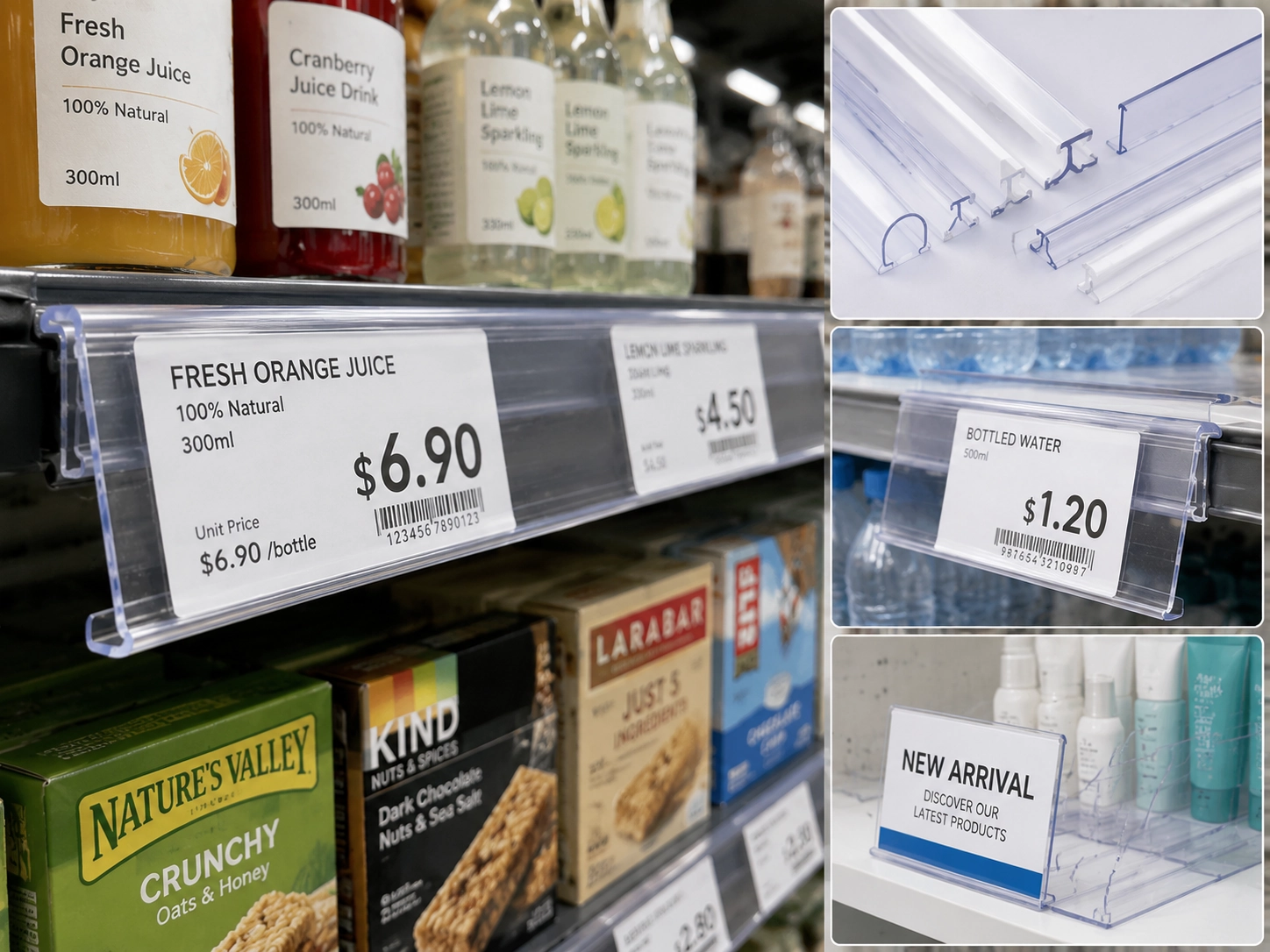
Key Overlap Areas:
Extrusion, Thermoforming, or Injection: How to Decide for a Rigid Part
Here is the comparison that vendors tend to skip because it occasionally argues against their own process. For a rigid part, the realistic candidates are extrusion, thermoforming, and injection molding, and they sort cleanly by part geometry, tooling economics, and volume.
| Decision factor | Profile extrusion | Thermoforming | Injection molding |
|---|---|---|---|
| Best-fit geometry | Constant cross-section: strips, channels, tubes, trims | Shallow open shapes: trays, clamshells, blisters | Complex 3D parts: caps, closures, hinged boxes |
| Tooling cost | Lowest: a profile die is a fraction of an injection mold | Low to moderate (formed/aluminium molds) | Highest: multi-cavity steel tooling |
| Cost behaviour by volume | Falls steadily with length produced | Falls with cavitation and sheet yield | Lowest per part only at high volume |
| Practical low-volume access | Strong: short runs stay viable | Moderate | Weak: tooling has to amortize |
| Typical packaging use | Shelf hardware, trims, channels, rigid tubes | Trays, blisters, clamshells | Caps, closures, rigid containers |
The honest decision rule is shorter than the table: if the part has a constant cross-section, extrusion almost always wins on tooling cost; the instant it needs varying wall thickness or 3D features, that advantage evaporates and you should be talking to a molder, not us. A profile die typically costs a fraction of a comparable injection mold. But that headline number hides the variable that actually sets your unit cost, and it only surfaces once you put real annual volume, scrap rate, and changeover against the die rather than comparing quoted piece prices in isolation.
It also depends on which program you are running, and these split apart fast. A one-off custom display run rewards extrusion's low tooling barrier: you get a real part without amortizing a steel mold. A high-volume recurring retail program changes the math, because at scale the per-part gap between processes narrows and secondary factors, such as changeover frequency, color changes, and finish consistency, start to dominate total cost. And a tight-tolerance structural component sits in its own category, where the question is less about price and more about whether the supplier can hold dimension batch to batch, which most quotes say nothing about. Our rough rule of thumb: under a few thousand meters a year, die amortization shifts the comparison more than most buyers expect, so run that math against your real annual volume before you assume extrusion is automatically the cheaper route. If you are benchmarking this as part of a broader sourcing review, our buyer's guide to where the extrusion market is heading sets the current context.
What Actually Drives Cost and Minimum Order Quantity
The biggest cost variable in packaging plastic extrusion is not the per-meter price; it is the die, plus everything around getting the first article right. On a custom profile, the die is a one-time cost amortized across the run, so the price per meter falls as the order grows, which is intuitive and every supplier will tell you. The line item buyers routinely leave out of their comparison is everything that happens around the run: die trials and sampling iterations before the profile is dimensionally signed off, the purge and changeover cost when a line switches material or color, and the cost of matching a specific transparency or color to an approved standard. Two quotes with the same per-meter price can differ by a wide margin once those are counted, and the cheaper-looking one is often the vendor who has not priced the work it takes to get the first article right.
Minimum order quantity comes from the same place, and it is rarely about a supplier being difficult. An extrusion line has to be set up, brought to temperature, purged, and stabilized before it produces a single saleable meter; a minimum exists to cover that setup before the line is torn down for the next job. On our side, the first-run minimum is set by line setup and changeover economics, while a reorder against existing tooling carries a meaningfully lower threshold, so send us the profile and a target volume and we will give you a real number rather than a policy. The useful question for a buyer is therefore not "what is your minimum" but "how does your minimum change on a reorder once the tooling already exists," because the answer tells you whether you are buying a one-off or building a supply relationship.
Recycled Content and Compliance Without the Surprises
Recycled content is moving from a marketing line to a requirement for packaging-adjacent parts. Containers and packaging are the single largest material category in U.S. municipal solid waste (U.S. EPA), and major brands have made public commitments to lift recycled content across their packaging portfolios (Ellen MacArthur Foundation). For extruded display and packaging hardware, that pressure lands as a real specification, not a slogan.
What the spec sheet will not tell you is which of your parts can actually take post-consumer resin without a visible or olfactory penalty, and the answer changes part by part. For a clear shelf-edge cover, color drift and a faint odor are far more damaging than any drop in mechanical strength, because the part is on display and at arm's length; for a hidden structural strip behind a fixture, high recycled content is straightforward. The detail that decides success is how the recycled feedstock is qualified and how consistently it runs, and how recycled feedstock behaves on a profile line is worth understanding before you write a percentage into a contract.
Our stance, after running this on real jobs: treating "recycled content" as one target across an entire bill of materials is where programs stall. Set it part by part. For visible clear components, virgin or near-virgin resin is usually the honest answer; for concealed structural profiles, a high recycled share is easy to hit. And where a part touches food, the genuine compliance hurdle is feedstock traceability, not the resin grade printed on the datasheet.
How a Packaging Profile Job Runs on Our Lines
The reason we keep steering this conversation toward drawings and tolerances is that it mirrors how the work actually moves. A job starts with a cross-section, a drawing, a sample, sometimes a sketch on the back of a spec, and a manufacturability review where we flag the features that will fight the die before any steel is cut. From there it is die design and tooling, then a first article we measure against the drawing rather than eyeball. On transparent profiles, where our clear PVC and PMMA work is most demanding, a first article can clear every dimension and still fail on haze or visible flow lines, which is why finish approval is a separate sign-off gate from dimensional approval in our process, not one combined check. If recycled feedstock is in scope, it gets qualified for color, odor, and run consistency before it goes into production, not during it. Only then does the line run, with in-process dimensional checks rather than a single inspection at the end.
Material choice gets made early, because it quietly decides what tolerance, finish, and recycled content are realistic on the same part. For shelf-edge and ticket profiles, rigid PVC is our default, because it holds dimension predictably and processes cleanly at the volumes most retail programs run. We reach for PC or PMMA when optical clarity is the whole point, such as a display cover or a light guide, and accept that clarity makes haze control the harder job. PP is the call when a part has to carry a recycling claim or meet food-contact requirements, because its regulatory story is cleaner than rigid PVC's. ABS and TPU sit in the structural and flexible-trim corners respectively. For buyers sourcing this from China, the material decision and the tooling-ownership terms are both worth pinning down early, before a quote quietly becomes a commitment.

As a custom profile extrusion manufacturer based in China, we run PVC, PC, PMMA, ABS, TPU, and PP with OEM/ODM tooling, sampling, and mass-production support in-house.
Questions That Separate a Real Extrusion Partner From a Quote
When you evaluate a custom packaging extrusion supplier in China or anywhere else, the price is the least diagnostic thing on the page. These six questions surface more than any quoted number, and you want a specific answer to each, not a brochure paragraph:
Will they review your drawing for manufacturability before quoting, and tell you which features will be a problem?
What tolerance can they actually hold on your cross-section, and how do they verify it from batch to batch rather than on the first sample only?
Who owns the tooling, and what happens to your die if you move volume or the relationship ends?
What is their sampling lead time, and how many iterations are included before extra tooling charges start?
What is their material range, and can they document recycled-content and any food-contact compliance you need with traceability, not just a claim?
How does their minimum order behave on a reorder once tooling exists, and how fast can they turn a repeat?
The list itself is the easy part; any buyer can ask these six. What separates suppliers is the specificity of the answer, and that is the one thing a brochure cannot show you. The fastest way to see it is to put a real part in front of us and watch which questions get a documented, batch-by-batch answer and which get a confident shrug.
A worked example helps anchor all of this: a transparent shelf-edge price-ticket profile is a deceptively simple part where transparency, edge finish, and batch-to-batch dimensional consistency are the whole job, exactly the things a thin quote glosses over.
If you already have a cross-section drawing, or even a rough one, plus a target annual volume, the fastest route to a real answer is to put it in front of an extrusion engineer rather than a sales form. Send a cross-section drawing and your target volume and we will tell you whether extrusion is the right call, including the cases where it is not.
FAQ
Q: Is packaging plastic extrusion the same as film or sheet extrusion?
A: No. Film and sheet extrusion produce flexible packaging and the sheet used for thermoformed trays; profile extrusion produces rigid components such as shelf-edge ticket holders, display channels, and structural trims. This guide covers the rigid-profile side.
Q: When should I choose extrusion over thermoforming or injection molding for a rigid packaging part?
A: Choose extrusion when the part has a constant cross-section, such as a strip, channel, tube, or trim. Thermoforming suits trays and clamshells; injection molding suits complex 3D parts like caps and closures.
Q: What drives the cost and minimum order quantity of custom extruded packaging profiles?
A: Tooling (the die) plus sampling, changeover, and color matching, not the per-meter price alone. The minimum order reflects line setup and changeover cost, so it usually drops on a reorder once tooling already exists.
Q: Can extruded packaging profiles use recycled (PCR/PIR) content?
A: Yes, but for visible display parts, color consistency and odor matter more than strength, and food-contact use adds feedstock traceability requirements. Recycled content is best specified part by part rather than as one figure across a whole bill of materials.
Q: How do I evaluate a custom packaging extrusion supplier?
A: Check whether they review drawings for manufacturability before quoting, their batch-to-batch tolerance verification, tooling ownership terms, sampling lead time, material and compliance documentation, and reorder flexibility.