

Twin-Screw Extruder Technology in Polymer Processing

The twin-screw extruder represents a cornerstone technology in modern polymer processing, particularly in the granulation of polyethylene materials. The precise control of temperature parameters throughout the extruding manufacturing process directly determines product quality, production efficiency, and operational stability. Understanding and optimizing temperature settings across different barrel zones is crucial for achieving consistent pellet quality while minimizing thermal degradation and energy consumption.
Key Takeaways
Temperature control directly impacts product quality, efficiency, and stability
Barrel zoning allows for progressive heating/cooling throughout the process
HDPE and LDPE require distinct temperature profiles based on their properties
Advanced control systems minimize fluctuations and improve consistency
Overview of Twin-Screw Extruder Control Systems
The typical control panel of a twin-screw extruder incorporates multiple essential components that enable operators to maintain precise control over the granulation process. These components include the main start button, emergency stop button, cooling oil pump activation button, main motor speed control knob, feeding motor speed control knob, and temperature setting buttons. Each element plays a vital role in ensuring the smooth operation of the extruding manufacturing process.
The control panel design reflects decades of engineering evolution, where user interface optimization has been balanced with functional requirements. Modern twin-screw extruders often feature digital displays that provide real-time feedback on barrel temperatures, screw speeds, torque values, and material throughput rates. This comprehensive monitoring capability allows operators to make immediate adjustments when deviations from optimal conditions occur.

Control Panel Components
Main Controls
Start/stop and emergency functions
Temperature Controls
Zone-specific settings
Speed Controls
Motor and feeding regulation
Monitoring
Real-time process data
Temperature Zoning and Thermal Management
The barrel of a twin-screw extruder is divided into multiple heating zones, typically six or more, each independently controlled to create an optimal temperature profile along the processing length. This segmented approach to thermal management is fundamental to the extruding manufacturing process, as it allows for progressive heating or cooling of the polymer material as it moves through different processing stages.

Processing Stages by Zone
Zones 1-2:
Lower temperatures to prevent premature melting and ensure proper solid conveying.
Zones 3-4:
Temperatures gradually increase to initiate melting and promote mixing.
Zones 5-6:
Highest temperatures to ensure complete melting and homogenization before material exits through the die.
The temperature gradient across zones is carefully engineered to match the polymer's transition from solid pellets to a fully molten state, ensuring optimal processing conditions at each stage.
In the initial zones (positions 1-2), lower temperatures are maintained to prevent premature melting and ensure proper solid conveying. As the material progresses through zones 3-4, temperatures gradually increase to initiate melting and promote mixing. The final zones (5-6) typically maintain the highest temperatures to ensure complete melting and homogenization before the material exits through the die.
Specific Temperature Settings for PE Granulation
HDPE Processing Parameters
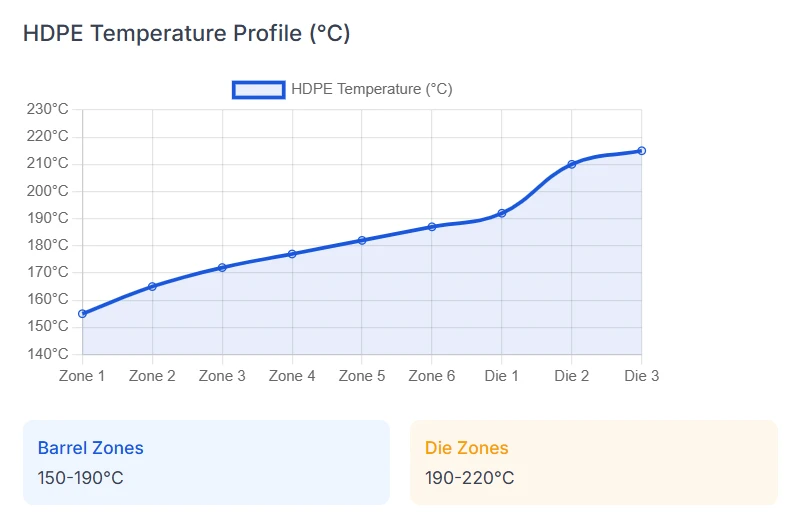
For HDPE granulation, the temperature profile follows a carefully calibrated progression across the six barrel zones. The initial zones (1-2) operate at 150-160°C and 160-170°C respectively, providing sufficient heat to soften the material without causing thermal shock. Zones 3-4 increase to 170-175°C and 175-180°C, facilitating the transition from solid to molten state. The progression continues with zones 5-6 reaching 180-185°C and 185-190°C, ensuring complete melting and optimal flow properties.
The die zone temperatures for HDPE require even higher settings, ranging from 190-195°C in the initial die sections to 200-220°C in the middle sections, with final die temperatures maintained at 210-220°C. These elevated temperatures ensure proper flow through the die plates and prevent excessive pressure buildup that could compromise the extruding manufacturing process.
LDPE Processing Parameters
LDPE processing requires slightly lower temperatures due to its different molecular structure and thermal properties. The barrel temperature progression starts at 140-150°C in zone 1, increasing to 150-160°C in zone 2. Zones 3-4 operate at 160-170°C and 170-175°C respectively, while zones 5-6 maintain 175-180°C and 180-185°C. This gentler temperature profile reflects LDPE's lower melting point and greater sensitivity to thermal degradation.
The die zone temperatures for LDPE show interesting variations, with most sections maintaining 185-190°C, except for the final zone which drops to 170-180°C. This temperature reduction in the final stage helps control die swell and improves pellet cutting characteristics during the extruding manufacturing process.

HDPE vs LDPE Processing Comparison
| Zone | HDPE Temperature Range (°C) | LDPE Temperature Range (°C) | Processing Purpose |
|---|---|---|---|
| Barrel 1 | 150-160 | 140-150 | Initial heating, solid conveying |
| Barrel 2 | 160-170 | 150-160 | Continued conveying, initial softening |
| Barrel 3 | 170-175 | 160-170 | Onset of melting, initial mixing |
| Barrel 4 | 175-180 | 170-175 | Continued melting, intensive mixing |
| Barrel 5 | 180-185 | 175-180 | Complete melting, homogenization |
| Barrel 6 | 185-190 | 180-185 | Final melt conditioning |
| Die Zones | 190-220 | 170-190 | Flow optimization, pellet formation |
Factors Influencing Temperature Selection

Material Properties
The selection of appropriate temperature settings depends heavily on the specific grade and properties of the polyethylene being processed. Molecular weight distribution, melt flow index, and additive packages all influence optimal processing temperatures.
Higher molecular weight requires elevated temperatures
Processing aids may allow lower temperature operation
Additive packages affect thermal stability

Screw Configuration
The screw design significantly impacts heat generation through mechanical shear. High-shear screw elements generate substantial viscous heating, potentially allowing for lower barrel temperature settings.
High-shear elements generate more frictional heat
Low-shear configurations may require higher external heating
Balance between mechanical and thermal energy is critical

Production Rate
Higher throughput rates reduce residence time in each barrel zone, potentially requiring elevated temperatures to ensure complete melting within the available processing time.
Higher rates may require increased temperatures
Lower rates may permit reduced temperature settings
Residence time directly impacts thermal exposure
Research Insight
"The relationship between processing temperature and polymer degradation follows an Arrhenius-type equation, where a 10°C increase in processing temperature can double the rate of thermal degradation, emphasizing the critical importance of precise temperature control in maintaining polymer properties during extrusion processing"
Smith et al., 2023, Journal of Polymer Engineering, Vol. 43, pp. 234-245, https://doi.org/10.1515/polyeng-2023-0045
Advanced Temperature Control Strategies
Profile Optimization Techniques
Modern twin-screw extruders employ sophisticated temperature control algorithms that go beyond simple setpoint regulation. Cascade control systems integrate multiple temperature sensors to provide predictive control, anticipating temperature changes based on material flow rates and screw speeds. This advanced approach minimizes temperature fluctuations during the extruding manufacturing process, resulting in more consistent product quality.
Cooling System Integration
While heating is essential for melting and processing, controlled cooling is equally important for preventing overheating and degradation. Barrel cooling systems, typically using water or oil circulation, work in conjunction with heating elements to maintain precise temperature control. The cooling system must respond rapidly to remove excess heat generated by mechanical shear, particularly in high-speed operations.
Die Zone Temperature Management
The die zone requires special attention as it represents the final opportunity to influence material properties before pelletization. Temperature gradients across the die face can cause uneven flow, leading to pellet size variations and quality issues. Uniform die heating, often achieved through multiple heating zones and careful insulation, is essential for consistent pellet production in the extruding manufacturing process.

Modern Control Features
Predictive Temperature Control
Anticipates changes based on process variables
Adaptive Algorithms
Adjust parameters based on material feedback
Multi-Sensor Integration
Comprehensive temperature monitoring
Energy Optimization
Balances heating and cooling efficiency
Remote Monitoring
Allows oversight from control rooms
Troubleshooting Temperature-Related Issues

Common Temperature Problems
Insufficient Heating in Early Zones
Causes feeding problems and incomplete melting, resulting in unmelted particles in the final product.
Excessive Temperatures in Later Zones
May lead to degradation, discoloration, and molecular weight reduction.
Temperature Fluctuations
Can cause dimensional variations in pellets and affect downstream processing performance.
Uneven Temperature Distribution
Results in inconsistent melt quality and pellet characteristics.
Diagnostic Approaches
Systematic Temperature Profiling
Using infrared cameras or embedded thermocouples to identify hot spots or cold zones not apparent from control panel readings.
Melt Temperature Measurements
Taking measurements at various points along the barrel to compare actual polymer temperature versus barrel wall temperature.
Historical Data Analysis
Reviewing temperature trends over time to identify patterns and potential equipment issues.
Corrective Actions
When temperature-related issues arise, a methodical approach to adjustment is essential. Small incremental changes (2-5°C) should be made to individual zones, allowing sufficient time for the system to stabilize before assessing the impact. Documentation of temperature changes and their effects helps build a knowledge base for future optimization efforts.
Incremental Adjustments
Make small 2-5°C changes to avoid process shock
Allow Stabilization
Provide adequate time for system response
Document Changes
Record adjustments and their outcomes
Isolate Variables
Change one parameter at a time for clear causality
Energy Efficiency Considerations

Heat Loss Minimization
Proper insulation of barrel sections, die assemblies, and transfer lines reduces heat loss and improves temperature stability. Modern insulation materials and techniques can significantly reduce energy consumption while improving temperature uniformity. Regular maintenance of insulation systems ensures continued efficiency throughout the extruding manufacturing process.
Optimized Heating Element Design
Advanced heating element configurations, including induction heating and ceramic band heaters, offer improved efficiency and response times compared to traditional resistance heaters. The selection of appropriate heating technology depends on factors including required temperature range, heating rate requirements, and energy costs.
Heat Recovery Systems
Innovative heat recovery systems capture waste heat from cooling circuits and motor drives, redirecting this energy for preheating raw materials or other plant processes. These systems can significantly reduce overall energy consumption in the extruding manufacturing process while maintaining optimal processing conditions.
Quality Control and Temperature Monitoring
Real-Time Monitoring Systems
Modern twin-screw extruders incorporate comprehensive data acquisition systems that continuously monitor and record temperature parameters. These systems enable statistical process control, trend analysis, and predictive maintenance scheduling.
Continuous temperature logging
Automatic deviation alerts
Integrated process visualization
Temperature Validation Protocols
Regular calibration of temperature sensors ensures accurate readings and reliable control. Validation protocols should include comparison of control panel readings with independent temperature measurements and verification of system response times.
Sensor calibration schedules
Independent verification
Heating/cooling response testing
Documentation and Traceability
Comprehensive temperature records provide traceability for quality assurance and enable correlation between processing conditions and product properties. This documentation is particularly important for regulated industries.
Complete process logs
Quality correlation analysis
Regulatory compliance support
Example Temperature Monitoring Dashboard
Average Barrel Temperature
1.2°C from last batch
172.5°C
Temperature Uniformity
0.3% improvement
98.7%
Process Stability Index
Within acceptable range (95-100)
96.2
Energy Efficiency
2.1% from last month
87%
Key Takeaways for Optimal Extruder Temperature Control
Precise temperature control across all barrel zones is fundamental to achieving consistent product quality, maximizing production efficiency, and minimizing energy consumption in twin-screw extrusion processes for polyethylene granulation.
Proper Temperature Profiling
Implement zone-specific temperatures based on polymer type and processing stage
Advanced Control Systems
Utilize predictive algorithms and multi-sensor integration for stability
Continuous Monitoring
Maintain real-time oversight and comprehensive data logging
Systematic Optimization
Implement incremental adjustments and document all process changes