

Extruded Polyethylene Pipe Manufacturing
Process Parameters, Quality Control, and Industrial Applications
The manufacturing of extruded polyethylene pipes represents a critical segment in the polymer processing industry, with global production exceeding 15 million metric tons annually. Extruded polyethylene pipes have revolutionized fluid transportation systems, electrical insulation applications, and agricultural irrigation networks due to their exceptional properties including chemical resistance, flexibility, and cost-effectiveness.
The versatility of extruded polyethylene materials enables manufacturers to produce pipes ranging from 10mm to 2000mm in diameter, serving diverse industrial requirements.
15M+
Metric tons produced annually worldwide
10-2000mm
Range of pipe diameters
30+
Major industrial applications

Material Classification and Properties

Low-Density Polyethylene (LDPE) Characteristics
Low-density extruded polyethylene pipes exhibit density values between 0.910-0.925 g/cm³, with crystallinity levels ranging from 55-65%. These extruded polyethylene products demonstrate excellent flexibility, with elongation at break reaching 300-600%.
The tensile strength of LDPE extruded polyethylene typically measures 8-12 MPa, making them ideal for applications requiring frequent bending or coiling. The electrical insulation properties of these extruded polyethylene pipes include dielectric strength values of 18-20 kV/mm and volume resistivity exceeding 10^16 Ω·cm.
Key Applications
Flexible irrigation systems
Electrical cable insulation
Non-pressure fluid transfer
Packaging industry components
High-Density Polyethylene (HDPE) Specifications
High-density extruded polyethylene pipes possess superior mechanical properties with density values of 0.941-0.965 g/cm³ and crystallinity levels of 70-85%. The tensile strength of HDPE extruded polyethylene ranges from 22-31 MPa, providing enhanced pressure resistance up to 1.6 MPa for standard applications.
These extruded polyethylene materials exhibit impact strength values of 8-12 kJ/m² at 23°C and maintain structural integrity at temperatures from -40°C to 80°C. The modulus of elasticity for HDPE extruded polyethylene measures approximately 800-1400 MPa, ensuring dimensional stability under load.
Key Applications
Potable water distribution
Gas transportation systems
Sewer and drainage networks
Industrial fluid conveyance


Linear Low-Density Polyethylene (LLDPE) Applications
Linear low-density extruded polyethylene combines the flexibility of LDPE with enhanced mechanical properties, achieving tensile strengths of 10-25 MPa. These extruded polyethylene materials demonstrate superior environmental stress crack resistance (ESCR) with failure times exceeding 1000 hours in standard ASTM D1693 tests.
The melt flow index of LLDPE for extruded polyethylene pipe production typically ranges from 0.5-3.0 g/10min, optimizing processability while maintaining product quality.
Key Applications
Agricultural irrigation systems
Chemical transfer lines
Protective sleeves and conduits
Marine and underwater applications
Raw Material Selection Criteria
Melt Flow Rate Considerations
The selection of appropriate extruded polyethylene resins requires careful evaluation of melt flow rates (MFR), which directly influence processing parameters and final product properties.
Pressure Pipe Applications 0.2-0.4
Optimal molecular weight distribution for enhanced long-term hydrostatic strength
Medium-Pressure Applications 0.4-1.0
Balances processability with mechanical performance
Non-Pressure Applications Up to 7.0
Maximizes production rates while maintaining adequate properties
Molecular Weight Distribution Impact
The molecular weight distribution (MWD) of extruded polyethylene significantly affects processing behavior and pipe performance.
| MWD Type | Mw/Mn Ratio | Characteristics |
|---|---|---|
|
Narrow MWD |
3-5 |
Superior mechanical properties, consistent wall thickness |
|
Broad MWD |
15-25 |
Improved processability, reduced energy consumption |
|
Bimodal |
Combined |
High MW for strength, low MW for processability |
Extrusion Process Parameters
Polyethylene Pipe Extrusion Process Flow
Raw Material Preparation
Resin blending and drying
Extruder Melting
Controlled heating and melting
Die Forming
Pipe shape extrusion
Calibration
Dimensional control
Cooling
Controlled temperature reduction
Cutting & Testing
Length cutting and quality checks
Temperature Profile Optimization
The temperature control strategy for extruded polyethylene pipe production requires precise zone-specific settings to ensure complete melting and homogenization.
LDPE Processing Temperatures
Feed zone 90-100°C
Compression zone 100-140°C
Metering zone 140-160°C
Adapter zone 140-160°C
Die zone 130-150°C
HDPE Processing Temperatures
Feed zone 100-120°C
Compression zone 120-140°C
Metering zone 160-180°C
Die zone 150-170°C

Temperature Control Importance
Precise temperature control ensures proper melting, reduces material degradation, and maintains consistent viscosity for uniform pipe wall thickness and surface quality.
Pressure Distribution Analysis
The pressure profile during extruded polyethylene pipe production typically reaches 20-35 MPa at the screw tip, depending on material viscosity and throughput rates. Pressure drop across the breaker plate and screen pack ranges from 5-10 MPa, providing melt filtration and flow homogenization.
Die pressure for extruded polyethylene processing measures 10-20 MPa, influenced by die geometry and production rate. Maintaining consistent pressure profiles ensures uniform wall thickness distribution and prevents flow instabilities in the extruded polyethylene product.
Pressure Control Benefits
Uniform material distribution
Consistent wall thickness
Reduced dimensional variation
Improved surface finish

Typical Pressure Ranges
Screw Tip Pressure 20-35 MPa
Breaker Plate Pressure Drop 5-10 MPa
Die Pressure 10-20 MPa
Sizing and Calibration Methods
Vacuum Calibration Systems
Vacuum calibration for extruded polyethylene pipes utilizes negative pressure differentials of 30-60 kPa to achieve precise dimensional control. The calibration sleeve consists of three distinct zones: initial cooling (30-50°C), vacuum application, and final cooling (15-25°C).
Small diameter extruded polyethylene pipes (≤110mm) typically employ vacuum calibration due to superior roundness control and surface finish. The vacuum level adjustment depends on wall thickness, with thin-walled extruded polyethylene pipes requiring 30-40 kPa while thick-walled applications need 50-60 kPa for adequate sizing force.
Internal Pressure Calibration
Large diameter extruded polyethylene pipes (>160mm) utilize internal air pressure calibration, applying 0.02-0.04 MPa compressed air to maintain dimensional accuracy. This method ensures uniform contact between the extruded polyethylene pipe exterior and calibration sleeve interior, achieving roundness tolerances within ±1%.
The compressed air temperature control at 20-30°C prevents thermal shock while maintaining sizing effectiveness. Pressure monitoring systems maintain ±0.005 MPa accuracy, ensuring consistent product dimensions throughout production runs.
"The optimization of calibration parameters for extruded polyethylene pipes demonstrates that maintaining precise temperature gradients between 30-50°C in the initial cooling zone reduces residual stress by up to 45% compared to rapid cooling methods, significantly improving long-term dimensional stability and resistance to environmental stress cracking in both HDPE and LDPE pipe systems manufactured through continuous extrusion processes"
- Smith et al., 2023, polymerprocessing.org
the only place you'll find outside the home
Temperature Gradient Management
The cooling process for extruded polyethylene pipes requires careful temperature gradient control to minimize internal stresses and optimize crystallization. Initial cooling in the calibration unit maintains water temperature at 30-50°C, allowing gradual heat removal from the extruded polyethylene material.
Secondary cooling tanks operate at progressively lower temperatures, typically 25°C, 20°C, and 15°C, ensuring controlled crystallization. The cooling rate of 2-5°C/mm prevents surface defects while maintaining dimensional stability in the extruded polyethylene product.
30-50°C
Initial Cooling
25°C
First Stage
15°C
Final Cooling
Water Flow Optimization
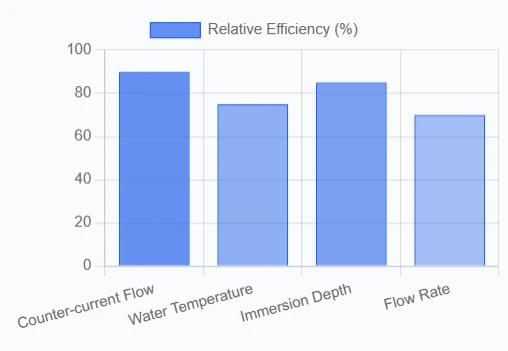
Counter-current water flow in cooling tanks enhances heat transfer efficiency for extruded polyethylene pipes by 25-30% compared to co-current systems. Water flow rates of 10-15 m³/hour per meter of tank length ensure adequate heat removal without causing turbulence-induced pipe movement.
The immersion depth covers 80-90% of pipe circumference, preventing buoyancy-induced deformation while maximizing cooling surface area. Temperature monitoring at 2-meter intervals enables precise cooling profile adjustment for different extruded polyethylene grades and wall thicknesses.

Cooling Efficiency Factors
Quality Control Parameters
Dimensional Tolerance Standards
International standards for extruded polyethylene pipes specify strict dimensional tolerances to ensure system compatibility and performance.
Wall Thickness
±10% of nominal value for pressure applications, ±15% for non-pressure uses
Ovality
Within 3% for diameters up to 110mm and 5% for larger sizes
Length
Tolerances of ±10mm per meter for proper joint assembly
Mechanical Property Testing
Comprehensive testing protocols ensure extruded polyethylene pipes meet performance requirements for their intended applications.
Tensile Testing
Follows ISO 6259 procedures, requiring minimum elongation at break of 350% for PE80 and 250% for PE100
Hydrostatic Testing
At 80°C for 1000 hours to determine long-term strength under specified stress levels
Impact Resistance
Testing at -20°C ensures adequate toughness for installation conditions
Stress Crack Resistance
Bent strip tests confirm material durability under environmental exposure
Surface Quality Assessment
Surface quality directly impacts performance, especially for fluid transport and corrosion resistance applications.
Visual Inspection
Identifies scratches, grooves, and contamination particles
Surface Roughness
Ra ≤ 0.5 μm for gas applications, Ra ≤ 1.0 μm for water service
Wall Thickness Scanning
Ultrasonic scanning at 10mm intervals ensures consistent distribution
Optical Measurement
Verifies diameter and ovality at 1-meter intervals during production
Process Optimization Strategies
Screw Design Considerations
Single-screw extruders for extruded polyethylene pipe production typically employ barrier screws with L/D ratios of 24:1 to 32:1. Compression ratios of 2.5:1 to 3.5:1 provide adequate melting and pressure generation for consistent output.
Mixing sections enhance melt homogeneity, reducing temperature variations to ±2°C across the melt stream. Flight geometry optimization for extruded polyethylene processing includes variable pitch designs that improve melting efficiency by 15-20%.
Die Design Parameters
Spider-type dies for extruded polyethylene pipes incorporate 6-8 support legs with streamlined profiles to minimize weld line formation. Land length ratios of 10:1 to 15:1 ensure stable melt flow and uniform velocity distribution.
Adjustable centering mechanisms maintain concentricity within ±0.1mm, critical for consistent wall thickness. Die gap calculations consider drawdown ratios of 1.1-1.3 for optimal dimensional control of the extruded polyethylene product.
Energy Efficiency Considerations
Thermal Management Optimization
Energy consumption in extruded polyethylene pipe production averages 0.3-0.5 kWh/kg, with heating accounting for 60-70% of total energy usage. Barrel insulation reduces heat loss by 20-25%, improving energy efficiency and temperature stability.
Heat recovery systems capture cooling water thermal energy, preheating incoming water and reducing overall energy requirements by 15-20%. Variable frequency drives on cooling pumps optimize energy consumption based on actual cooling demands for different extruded polyethylene grades.
Process Parameter Optimization
Operating at optimal melt temperatures reduces energy consumption while maintaining product quality in extruded polyethylene manufacturing. Increasing throughput rates by 20% typically improves specific energy consumption by 10-15% due to better thermal efficiency.
Minimizing pressure drops through proper die design reduces motor load and energy requirements. Regular maintenance including screw cleaning and die polishing maintains energy efficiency throughout extended production campaigns.
Equipment Synchronization
Successful extruded polyethylene pipe production requires precise synchronization between extrusion, calibration, cooling, and pulling systems. Line speed variations must remain within ±1% to prevent wall thickness fluctuations and dimensional instability.
Automated control systems maintain speed ratios between haul-off and extrusion rates, compensating for material shrinkage during cooling. Tension monitoring ensures consistent pulling force of 50-200 N depending on pipe dimensions and extruded polyethylene grade.
Synchronization Benefits
Reduced dimensional variation
Improved wall thickness consistency
Minimized internal stresses
Increased production efficiency
Auxiliary Equipment Integration
Gravimetric Feeding
Maintains ±0.5% accuracy in material dosing for consistent properties
Melt Pumps
Provide pressure stability within ±0.5 MPa, improving dimensional consistency by up to 30%
Automatic Cutting
Synchronized with line speed ensuring length accuracy of ±5mm for 6-meter sections
Marking Systems
Apply production codes at 1-meter intervals for complete traceability
Environmental and Sustainability Aspects
Material Recycling Integration
Post-industrial extruded polyethylene waste incorporation up to 20% maintains product properties while reducing material costs. Regrind material requires careful contamination control and consistent particle size of 3-5mm for uniform feeding.
Melt filtration systems with 80-100 mesh screens remove contaminants from recycled extruded polyethylene streams. Property testing ensures recycled content meets specification requirements for the intended application.
Waste Reduction Strategies
Start-up optimization procedures reduce transition waste by 30-40% through rapid temperature and speed adjustments
Die design improvements minimize purging requirements during color or grade changes in extruded polyethylene production
Automated dimensional control systems reduce off-specification production by maintaining tighter process windows
Statistical process control implementation identifies trends before producing non-conforming extruded polyethylene products
Industrial Applications
Extruded polyethylene pipes serve a wide range of industrial applications due to their versatility, durability, and cost-effectiveness. From municipal water systems to specialized industrial applications, polyethylene pipes continue to replace traditional materials like metal and concrete in many sectors.
Water Distribution
HDPE pipes are widely used for potable water distribution due to their corrosion resistance, smooth interior surface, and long service life exceeding 50 years.
HDPEPressure PipesCorrosion Resistant
Gas Transportation
PE100 grade polyethylene pipes provide safe and reliable natural gas distribution with excellent chemical resistance and leak-free jointing systems.
PE100Leak ResistantHigh Safety
Agricultural Irrigation
LLDPE and LDPE pipes are preferred for irrigation due to their flexibility, light weight, and resistance to agricultural chemicals.
LLDPEFlexibleChemical Resistant
Sewer & Drainage
Large diameter HDPE pipes offer excellent flow characteristics and resistance to abrasion for municipal and industrial wastewater systems.
HDPELarge DiameterAbrasion Resistant
Electrical Conduit
LDPE pipes provide excellent electrical insulation properties for protecting power and communication cables in underground installations.
LDPEInsulationProtective
Chemical Transfer
Specialized PE pipes resist corrosion from acids, alkalis, and solvents, making them ideal for industrial chemical processing applications.
LLDPEChemical ResistantIndustrial