


The integration of LED strip lighting into architectural and interior design applications has fundamentally shifted how lighting professionals approach ambient illumination. A diffuser LED strip light system transforms point-source LEDs into smooth, continuous linear illumination by dispersing emitted photons across a wider surface area, eliminating the harsh visible dots that characterize exposed SMD configurations. The optical principle relies on scattering light particles through translucent materials-typically polycarbonate or PMMA substrates with varying opacity levels-housed within aluminum extrusion channels that simultaneously function as heat dissipation mechanisms. For installations where aesthetic uniformity matters, understanding the interplay between diffuser opacity, channel depth, LED density, and viewing distance becomes non-negotiable.
Why Bare LED Strips Look Cheap (And What Actually Fixes It)
Here's the thing nobody tells you when you first start working with LED strips: the default look is terrible. Raw SMD LEDs mounted on a PCB create what the industry calls "dotting" or "hot spots"-bright pinpoints separated by dim gaps that make any installation look amateur. I've watched clients spend good money on high-CRI strips only to rip them out six months later because the lighting effect resembled a string of Christmas lights rather than professional linear illumination.
The solution is straightforward but poorly understood. You need distance between the LED chips and the viewing surface, combined with optical diffusion. An LED strip light diffuser cover achieves this by introducing a translucent barrier that scatters photons before they reach the eye. The scattered light overlaps, creating perceived uniformity. But-and this matters-not all diffusers perform equally.
Clear covers offer maybe 95% transmittance. Great for brightness, useless for dot elimination. Frosted sits around 85-90%. Milky white drops to 65-70%, sometimes lower. The tradeoff is always brightness versus smoothness.
The Aluminum Channel Question
Aluminum LED profiles aren't just mounting hardware. They're heat sinks. This distinction gets lost in consumer-grade installations where people stick strips directly to drywall or wood and wonder why their LEDs dim after eight months. The physics aren't complicated: LEDs convert electrical energy to light, but the process generates heat at the junction. PCB temperatures exceeding 70-80°C accelerate lumen depreciation and color shift.

Standard 6063-T5 aluminum alloy-the industry workhorse-conducts heat at roughly 201 W/(m·K). Compare that to plastic at maybe 0.2 W/(m·K). The thousand-fold difference explains why proper channels extend LED lifespan from a few years to a decade or more under continuous operation.
I worked on a jewelry store retrofit where the original installer used slim decorative channels with 1mm wall thickness for 15W/m high-CRI strips. Six months in, color rendering had shifted noticeably-customers were examining gemstones under degraded illumination. We replaced everything with 2mm wall finned profiles and the PCB temperatures dropped 7-8°C immediately.
Diffuser Types: What Works Where
Milky diffuser covers eliminate dots completely but sacrifice significant output-expect 30-45% lumen loss depending on the specific formulation. The opal finish represents middle ground: decent diffusion with maybe 25% loss. Frosted barely diffuses at all but protects the strip and provides minor softening.
Then there's the spotless diffuser category. These curved or thickened covers increase the optical path length without requiring deeper channels. Some manufacturers achieve near-perfect diffusion with 30 LED/m strips using specialized geometries. Flat diffusers struggle to match this performance even at 60 LED/m.
Black diffusers exist too, mostly for decorative effect when lights are off. Transmittance drops to 20-25%-barely functional for task lighting but visually interesting for architectural accent applications.
LED Density and the Dotless Effect
The rule of thumb suggests LEDs should be farther from the diffuser than they are from each other. At 30 LED/m spacing (roughly 33mm between chips), you'd need a diffuser height exceeding 32mm for theoretical spotlessness. Few standard profiles reach that depth.
At 60 LED/m, deep channels with milky covers achieve acceptable results. At 144 LED/m, almost any diffuser produces continuous-looking output. The practical limit becomes cost and power consumption rather than optical performance.
COB LED strips sidestep the density calculation entirely. Chip-on-board technology packs hundreds of tiny chips per meter under a phosphor layer that functions as an integrated diffuser. The result is seamless illumination without channels-though thermal management still benefits from aluminum mounting. COB strips typically run 320-528 LED/m equivalent density. The technology costs more but eliminates the profile diffuser decision tree.
Material Considerations Beyond Opacity
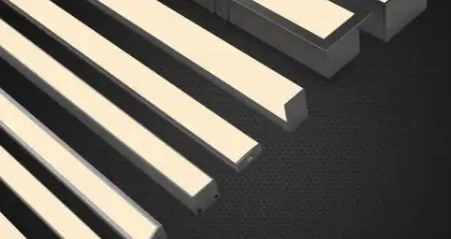
PC (polycarbonate) dominates the budget segment. Impact resistant, decent clarity, cheap to manufacture. PMMA (acrylic) offers superior optical properties-better light transmission, harder surface, stronger UV resistance-but cracks under impact rather than flexing. For high-power installations running continuously, PMMA resists yellowing longer. The material choice matters for commercial applications where diffuser replacement every two years becomes a maintenance burden.
Silicone diffusers handle curved installations where rigid materials fail. Transmittance hovers around 70-75%, flexibility is excellent, but the material degrades faster under UV exposure. Outdoor-rated variants exist but require UV-stabilized formulations that add cost.
Shallow vs. Deep Channels: The Tradeoff Nobody Discusses
Deep LED extrusion channels improve diffusion uniformity. The physics favor distance. But deep profiles also reduce output-light travels farther through diffuser material, experiencing additional absorption and scattering losses. A 20mm deep channel with milky cover might deliver 40% less usable lumens than a 10mm shallow channel with clear cover. Whether that matters depends entirely on the application.
Under-cabinet lighting for task work? Brightness matters. Cove lighting where fixtures remain invisible? Uniformity wins. The strip light diffuser selection should match the use case, not some abstract quality standard.
Installation Reality Checks
Measure PCB width before ordering channels. Common LED strips run 8mm, 10mm, or 12mm wide. I've seen projects stall because someone assumed 10mm channels would accommodate 12mm waterproof strips with silicone coating. They don't. The strip either won't fit or loses contact with the aluminum base, defeating the heat dissipation purpose.
Surface contact matters. Press the LED tape firmly into channel grooves. Consider thermal adhesive tape for high-power applications. Air gaps between PCB and aluminum create thermal resistance that undermines the entire system.
Cut channels with fine-tooth saws designed for soft metals. Hacksaw blades designed for steel tear aluminum edges. Wrap cutting areas with painter's tape to prevent burrs. End caps often need modification to accommodate wire pass-through-drill carefully or the plastic cracks.
When You Actually Don't Need Diffusers
Not every installation requires optical diffusion. Uplighting walls or ceilings where the strip remains hidden? The surface itself acts as a diffuser. Low-power decorative strips under 10W/m? Heat management becomes less critical. Indirect cove lighting shining away from viewers? Dot visibility drops to irrelevance.
Adding channels and diffuser LED strip light assemblies to hidden installations wastes budget and complicates replacement. The aluminum and polycarbonate cost money. Save that expense for applications where visible light quality actually impacts the space.

Troubleshooting Common Diffusion Problems
Uneven brightness along the strip usually indicates voltage drop over long runs rather than diffusion failure. 24V systems tolerate longer distances than 12V before dimming becomes visible. Power injection at multiple points solves most uniformity complaints.
Visible dots despite milky diffuser? Check channel depth and LED density combination. Sometimes upgrading from 60 LED/m to 120 LED/m costs less than retrofitting deeper profiles.
Diffuser yellowing after a year or two signals either UV exposure damage or heat degradation. High-quality PMMA resists both longer than budget PC. Replacement diffusers exist for most standard profiles-factor ongoing maintenance into project planning rather than treating initial installation as permanent.
Making the Right Choice
The LED channel diffuser market offers dozens of combinations-channel shapes, depths, materials, mounting styles, diffuser opacities. Decision paralysis is real. Start with the visible outcome: does the installation require spotless uniformity or just functional illumination? That single question eliminates most options.
For exposed applications where viewers see the light source directly, invest in deep channels with curved spotless diffusers and 60+ LED/m strips. For concealed installations, surface-mount U-channels with clear covers maximize brightness economically. For curves and architectural features, flexible silicone channels or COB strips avoid the complexity of rigid profiles.
The diffuser LED strip light assembly functions as a system-channel, diffuser, and LED strip must work together. Mismatched components produce disappointing results regardless of individual component quality. Match specifications to application requirements rather than purchasing based on price alone.
Professional lighting installers spec complete systems for good reason. The ecosystem approach guarantees compatibility and predictable performance. Sourcing channels from one vendor, diffusers from another, and strips from a third invites fitment problems and warranty complications. When projects matter, system integration matters more than component bargain hunting.