

ABS is one of those materials that looks simple until a project moves from an early drawing into actual production. It is familiar, widely available and easy to describe in broad terms: reasonably stiff, tough, easy to colour and suitable for many moulded and extruded parts. That familiarity is also why specifications sometimes stop at a single word: ABS.
For an early concept, that may be enough. For production, it often is not.
ABS stands for acrylonitrile butadiene styrene, but the name describes a material family rather than one fixed formulation. Producers adjust the polymer structure and formulation to emphasise different properties, which is why ABS is sold in general-purpose, high-flow, high-impact, heat-resistant, plating, flame-retardant and extrusion grades, among others.
The differences are not merely marketing labels. They can be large enough to change how the material processes and how a finished part performs.
Two TAIRILAC grades provide a useful example. AE8000-H is identified as an extrusion grade, while AG15A1-H is a general-purpose grade. In producer datasheets dated May 22, 2020, both report a tensile strength of 43 MPa. If tensile strength were the only figure being compared, there would be little reason to distinguish them.
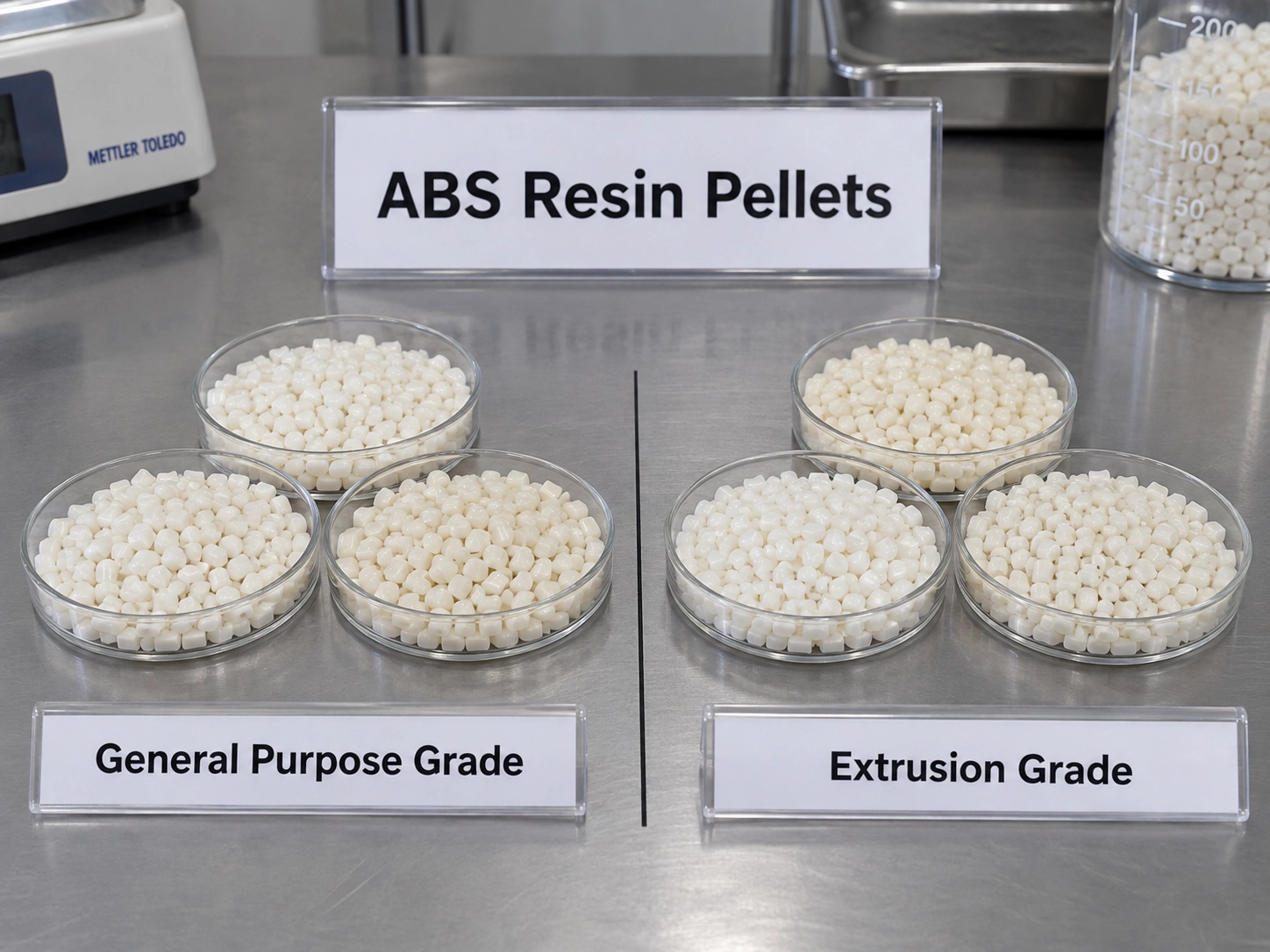
The rest of the data tells a different story.
| Property | AE8000-H Extrusion Grade | AG15A1-H General-Purpose Grade |
|---|---|---|
| Melt flow index, 220°C × 10 kg | 5.4 g/10 min | 22 g/10 min |
| Notched Izod impact, 23°C, 4 mm | 41 kJ/m² | 25 kJ/m² |
| Tensile strength, 23°C | 43 MPa | 43 MPa |
| Flexural modulus, 23°C | 2050 MPa | 2550 MPa |
| Vicat softening point, 50 N | 94°C | 93°C |
| HDT, 1.8 MPa, unannealed | 88°C | 86°C |
At the same melt-flow test condition, the general-purpose grade has roughly four times the reported MFI. The extrusion grade also reports higher notched Izod impact and a lower flexural modulus. Neither grade is universally better; they have simply been formulated around different priorities.
That is the first thing worth understanding about ABS. A familiar material name does not remove the need to identify the grade.
Why Published ABS Properties Vary So Much
Searching for ABS properties often produces a confusing mix of values. One source may show a tensile strength around 40 MPa, another gives a wider range, and a producer sheet for a particular resin may be different again.
Most of the apparent contradiction comes from the fact that the sources are answering different questions.

A general reference describes ABS as a material family. A material database may combine data from multiple commercial grades and therefore show a range. SpecialChem, for example, currently lists tensile strength at break around 29.8–43 MPa and flexural modulus around 1.6–2.4 GPa. Those figures are useful for understanding the approximate territory occupied by ABS, but they are not enough to specify a production resin.
A named producer datasheet is much more useful once a project gets serious because it identifies an actual grade and usually states the test method or condition. Even then, numbers should only be compared when the conditions are compatible.
Melt flow is a good example. A value measured at 200°C under a 5 kg load cannot be treated as equivalent to one measured at 220°C under 10 kg. The same caution applies to impact strength, where Izod and Charpy methods, notch condition and specimen geometry all affect the result. HDT changes with applied stress and specimen preparation. Annealed and unannealed values may also be reported separately.
This matters in purchasing as much as it does in design. It is easy for a property number to lose its original test condition as it moves from a resin datasheet into a customer drawing, quotation sheet or internal material list. Once that context disappears, a precise-looking number can become surprisingly ambiguous.
The date of the datasheet is part of that context as well. The 2020 AE8000-H sheet reports 5.4 g/10 min at 220°C × 10 kg. FCFC's current online information is not perfectly consistent with that historical sheet: the detailed property table currently shows 6.0 g/10 min, while another area of the same live page still shows 5.4.
For material education, that is an interesting illustration of how published data evolves. For a production specification, the response should be simpler: identify the producer and grade, and work from a current, version-controlled datasheet rather than from a number copied from a web page.
Where ABS Usually Reaches Its Limits
ABS works well in many indoor products because its properties are reasonably balanced. Problems tend to appear when a project asks the material to do something outside that comfortable range, particularly with long-term UV exposure, aggressive chemicals or elevated temperature.
Outdoor exposure
Unprotected ABS is not normally the first material to choose for prolonged outdoor weathering.
The vulnerable part of the structure is largely the polybutadiene phase. Under UV exposure, photo-oxidation can lead to surface yellowing and embrittlement. The important point is that the visible colour change is not necessarily the whole problem.

A CSIRO study on a commercial ABS pipe resin used accelerated xenon-arc weathering to investigate this behaviour. The researchers observed yellow-brown discoloration early in the exposure programme and reported a substantial reduction in impact resistance, from 214 to approximately 60 kJ/m². After an exposure corresponding to 12 months of simulated natural weathering in their test model, the discoloration depth was about 0.1 mm.
The study is useful because it shows that a relatively shallow degraded surface can have a much larger effect on impact performance than its depth might suggest. It should not be turned into a fixed outdoor service life for ABS. The work involved one resin, one test programme and one set of environmental assumptions. The paper also contains an inconsistent hour-to-month conversion in one section, so that disputed time conversion is not useful as a design figure.
For a real product, the questions are more practical. Will the profile be permanently outdoors or only see occasional sunlight? Is colour retention important? Is the part cosmetic, structural or both? Is a UV-stabilised ABS grade available, or would ASA be a more appropriate starting point?
ASA is commonly offered specifically for weather-resistant applications, which makes it a natural comparison when long-term outdoor appearance and UV performance dominate the requirement. That still does not mean every ASA grade is automatically preferable to every ABS grade; the actual comparison belongs at grade level.
Chemicals
Chemical resistance is another area where a generic ABS chart can only take a project so far.
ABS has useful resistance in many normal environments, but aromatic and halogenated hydrocarbons, ketones and esters are among the solvent groups commonly identified as problematic. The real behaviour of a finished part also depends on concentration, temperature, contact time and mechanical stress.
This becomes relevant in applications involving cleaning fluids, adhesives, lubricants or process chemicals. A material that survives an occasional wipe may not behave the same way under repeated exposure, immersion or contact while stressed.
For that reason, "chemical resistant" is not a particularly useful requirement by itself. Naming the actual chemical and the service condition gives the supplier something that can be checked against the resin data or, where necessary, tested.
Heat
Thermal data is easy to misread because the figures look like temperature limits.
In the two TAIRILAC examples above, unannealed HDT at 1.8 MPa is reported as 88°C and 86°C. Their Vicat softening temperatures are in a similar range. It would be tempting to reduce that to a simple statement such as "ABS can operate around 90°C," but that is not what the tests establish.
HDT describes deformation under a specified load in a defined test. Vicat measures another kind of thermal response. Neither one is a direct continuous-use-temperature rating for a finished profile.
A long component under load may also be affected by creep, thermal cycling, assembly stress and the amount of dimensional movement the application can tolerate. A housing that briefly reaches an elevated temperature and a long profile that must remain straight for years are different problems even if both are made from ABS.
When heat matters, an operating range and load condition are more useful than a generic temperature limit.
The Material Choice Changes Again When the Part Is Extruded
A large amount of ABS information online is written around injection moulding, which makes sense given how widely the material is used for housings, covers and moulded structural components. Profile extrusion places a different set of demands on the resin.
In a mould, the material fills a closed cavity and is supported as it cools. An extruded profile leaves the die continuously and must remain controllable while sizing and cooling establish its final dimensions. Once the section includes hollow chambers, thin faces, heavy ribs or asymmetric wall distribution, material behaviour and geometry start to interact in ways that are not obvious from a basic property table.
This is one reason an injection-moulded ABS reference part is not enough to qualify a grade for a long extrusion.

Consider a relatively small moulded enclosure and a 1.5-metre hollow profile. Both may be labelled ABS and both may have similar room-temperature strength requirements. The extrusion, however, also has to maintain its shape continuously after leaving the die. Uneven walls can cool at different rates, a heavier rib can pull on an adjacent cosmetic surface, and an asymmetric section can make dimensional control more difficult.
At that point, the relevant question is no longer simply whether ABS has adequate tensile or impact strength. The grade has to work with the section.
This is also why generic statements about "standard ABS wall thickness" or "normal ABS extrusion tolerance" are of limited value. A meaningful tolerance depends on the profile geometry, resin, tooling, cooling arrangement, measurement method and acceptance criteria. The same nominal tolerance may be routine on one section and unrealistic on another.
Melt-flow data helps describe part of the processing picture, but it should not be treated as a universal extrusion-grade threshold. The earlier TAIRILAC comparison shows that one producer deliberately positions its extrusion grade at much lower flow than its general-purpose grade under the same test condition. That is useful evidence of how differently grades can be formulated, not a rule that can be applied to every ABS resin.
For a real profile, the drawing is therefore part of the material discussion. A resin cannot be evaluated entirely separately from the geometry it has to become.
How ABS Compares With PVC, PC and ASA
Material comparisons are more useful when they begin with the reason a second material is being considered.
If outdoor weatherability is driving the discussion, ASA belongs on the shortlist because weather resistance and colour stability are central to the way ASA grades are positioned.
If transparency, very high impact performance or a higher thermal requirement becomes important, polycarbonate may deserve consideration.
Rigid PVC may be a stronger candidate where the project is already aligned with PVC's particular balance of stiffness, chemical behaviour, flame performance, cost and extrusion characteristics.
None of those comparisons can be settled properly with a generic table that gives one value for "ABS," one for "PVC" and one for "PC." All three are broad commercial material families with specialised grades.
Flame behaviour shows why this matters. The two TAIRILAC grades discussed earlier are reported as UL 94 HB at a stated thickness. That result belongs to those two grades at that thickness; it does not establish a flame classification for ABS as a whole. The same principle applies when comparing a particular PVC or PC grade.
The useful sequence is to define the requirement first, narrow the material family second and compare actual commercial grades once the shortlist becomes serious.
For projects that are still at the broader material-selection stage, our extrusion material selection guide covers that decision in more detail.
What Should Actually Go on an ABS Drawing?
A drawing does not need to reproduce an entire resin datasheet, but it should contain enough information to make the material requirement reproducible.
ISO 19062-1:2015 is the current published ISO designation standard for ABS moulding and extrusion materials. Its public description uses four designatory properties: Vicat softening temperature, melt mass-flow rate, Charpy notched impact strength and tensile modulus. It also accounts for factors such as composition, intended application or processing method, additives, colourants, fillers and reinforcement.
The older ISO 2580-1:2002 has been withdrawn and replaced by ISO 19062-1.
ASTM D4673-23 provides another classification and line-callout system for ABS moulding and extrusion materials in the U.S. One sentence in its scope is particularly useful: the system is intended for calling out materials used to fabricate parts rather than for performing material selection itself.
That distinction reflects what happens in practice. A standard can help two parties identify a material consistently, but it cannot decide whether that material suits the part.
For some projects, the most reliable specification is simply the producer and exact grade. Others need additional control over melt flow, impact performance, colour, additives, thermal behaviour or environmental exposure. Which fields belong on the drawing depends on what would actually cause the product to fail or become unacceptable.
A profile that will be used indoors at moderate temperature may need relatively little additional information. A visible outdoor profile exposed to sunlight, cleaning chemicals and dimensional constraints needs much more.
Before an ABS profile is reviewed for production, the most useful information is usually straightforward: the section drawing, intended environment, operating temperature, UV exposure, any relevant chemicals, appearance requirements and expected production volume. Those inputs reveal much more than another generic ABS property table.
Once the resin and section are reasonably defined, drying, melt condition, tooling, sizing and process control become a separate discussion. Those subjects are covered in our ABS extrusion process guide.
For hollow or geometrically demanding sections, our hollow profile extrusion guide explains why wall distribution and section geometry have such a strong influence on dimensional control.
If a current drawing says only ABS, that does not necessarily mean the material callout is wrong. It means there may still be decisions hidden behind it.
Sending the section drawing together with the service conditions is usually the quickest way to find out which of those decisions actually matter.
Send us your drawing or project requirements
Technical sources
TAIRILAC AE8000-H and AG15A1-H technical datasheets, Formosa Chemicals & Fibre Corp., dated May 22, 2020.
ISO 19062-1:2015, Plastics - Acrylonitrile-butadiene-styrene (ABS) moulding and extrusion materials - Part 1: Designation system and basis for specifications.
ASTM D4673-23, Standard Classification System for and Basis for Specification for Acrylonitrile–Butadiene–Styrene (ABS) Plastics and Alloys Molding and Extrusion Materials.
Tiganis, B. E., Davis, P., Burn, L. S. and Gotama, J., CSIRO, accelerated weathering study of ABS pipe resin.
SpecialChem, Acrylonitrile Butadiene Styrene (ABS): How to Select the Right Grade?