

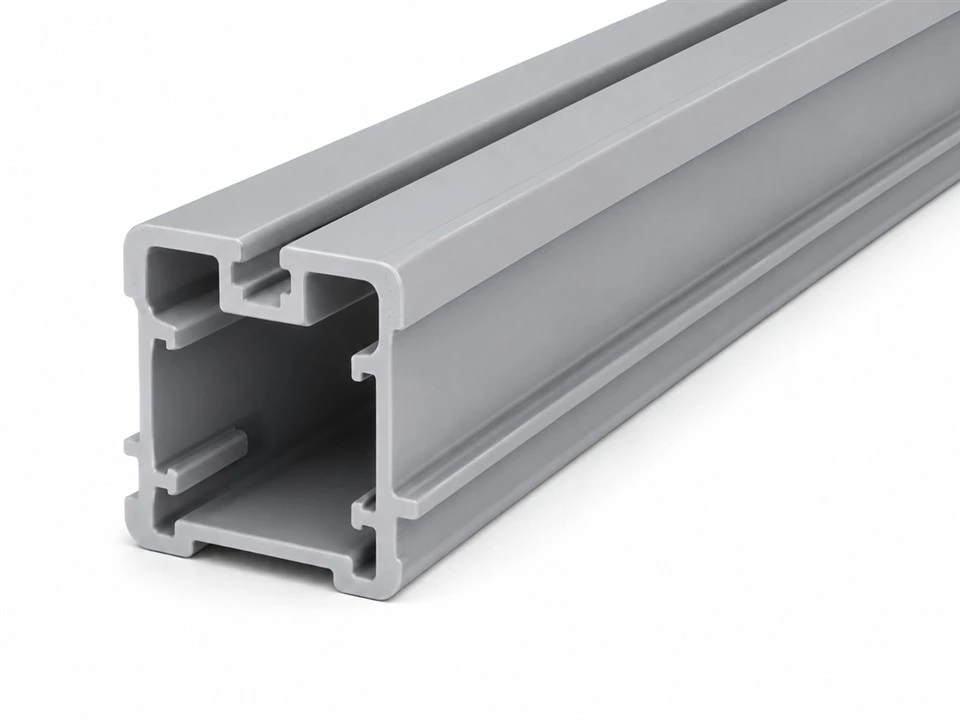
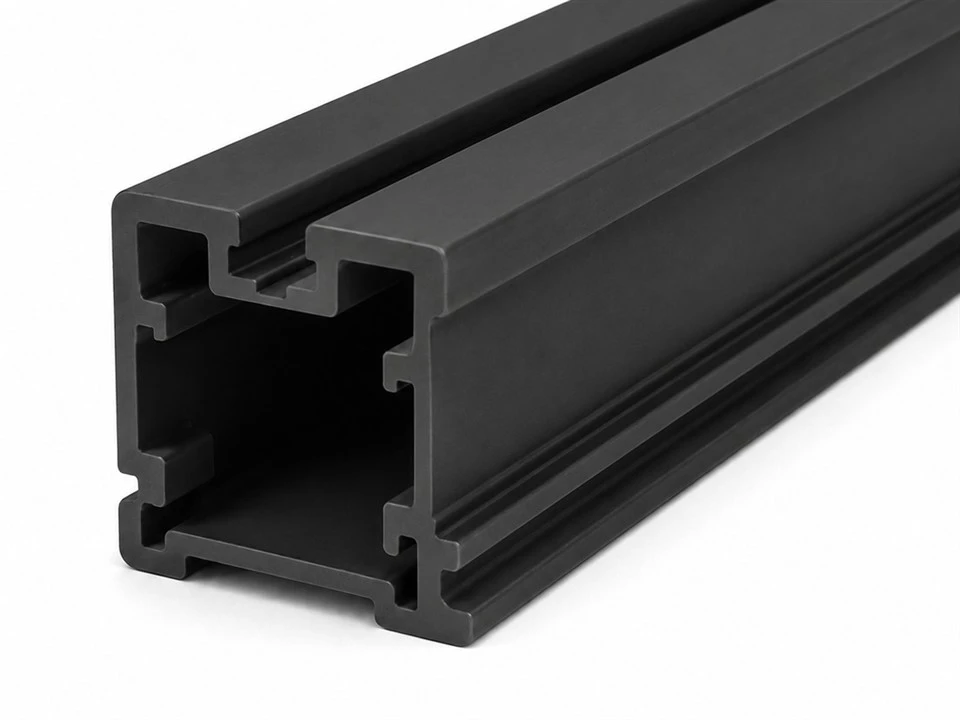
Full specifications of the Dachang flame retardant insulating plastic profile
This is the standard production envelope. Anything outside it gets quoted against your drawing rather than turned down.
| Function | Electrical isolation of live parts, clearance and creepage geometry |
|---|---|
| Materials | Flame retardant PVC, PP, PC, ABS / HIPS |
| Flame rating | UL94 V-0 / V-2 compounds |
| Section width | 10–250 mm (tooling to 300 mm on PVC lines) |
| Section height | 10–80 mm |
| Wall thickness | 0.8–3 mm (2.0 mm typical for uniform walls) |
| Dimensional tolerance | ±0.1 mm with inline calibration |
| Piece weight | 100–500 g typical |
| Colour | Matched to your Pantone or RAL reference |
| Surface finish | Matte or glossy, embossing available |
| Secondary processing | Cut to length, punching, drilling, notching |
| Compliance basis | ISO 9001 system, RoHS and REACH compliant compounds |
| Packing | Carton or plywood box |
| Trade terms | FOB / EXW / FCA, port of Shenzhen |
| Payment | 50% advance for tooling and order |
Dielectric, glow wire and tracking index figures are compound specific. Tell us the grade you need and the datasheet comes back with the quotation.
Why OEM buyers specify an extruded insulating plastic profile
An insulating extruded plastic profile is a continuous non-conductive section that keeps live parts apart inside an assembly: barrier strips in distribution cabinets, separators in wire harnesses, guide channels in switches and appliances, spacers between battery cells. Because the shape runs unchanged down the whole length, extrusion produces it at a fraction of the cost of moulding, and the cross section itself carries the clearance and creepage geometry your enclosure design depends on.
Two things decide whether a section passes inspection. The insulating compound has to hold off voltage and refuse to sustain a flame, and the geometry has to lengthen the surface path between conductors. Cheap sections usually fail on the second point, because the wall thins at the rib roots and the surface path collapses exactly where the designer assumed it was longest. Every die we cut is balanced for even melt flow, and wall thickness is measured on the first article before the run is released. If you want to see the standard part this envelope is built around, the extruded plastic profile with UL94 V-0 and V-2 fireproof rating carries the same width, wall and weight range described above.
Four reasons project buyers order these insulating extruded profiles in bulk
Ribs and steps that stretch the surface path
Clearance is the air gap between live parts. Creepage is the longest route current can crawl along the plastic surface. Multi-rib partitions and stepped shoulders extend that route without making the part any wider.
In your panel, the same barrier holds its insulation class in a narrower bay, so you are not redrawing busbar spacing to satisfy a certification body.
Creepage geometry
V-0 compounds that will not drip
Flame retardancy works on four fronts at once. Mineral additives release bound water and pull heat off the surface, the skin chars into an oxygen barrier, gas phase agents break the free radical chain, and raised melt viscosity stops burning material from falling.
That last one is what buyers under-specify. Molten drips ignite whatever sits below the barrier, which turns a contained fault into an enclosure fire and a field recall.
Self-extinguishing
Solid sections that block moisture and dust
Water conducts. Absorbed humidity and settled dust degrade surface resistance long before the polymer itself gives up, so a void free wall with a sealed skin matters as much as the resin grade.
For coastal and humid installations, this is the difference between an insulating barrier that holds its rating for the service life and one that starts tracking after two damp seasons.
Dense wall
Radiused corners instead of sharp edges
Sharp internal angles concentrate the electric field and become the puncture point under surge. Snap zones and bends are drawn with radii so the field spreads across the corner instead of piling up on it.
Your assembly team also gets a part that stops scoring wire insulation during routing, which is the second most common cause of harness rework.
Field control

Not sure which cross section clears your creepage requirement? Send the drawing and the working voltage. Dachang engineers mark up the section and quote it, usually inside one working day.
How to choose the material for your custom extruded plastic profile
Insulation material is a voltage and temperature decision, not a preference. Four compounds cover almost every enquiry that reaches our lines.
| Compound | Pick it when | Watch out for |
|---|---|---|
| Rigid PVC | General low voltage trunking, insulating barrier strips, electrician grade parts. Chlorine in the backbone gives flame resistance before any additive, so it is the lowest cost route to a V rating. | Narrowest service temperature window of the four. |
| PC | Higher withstand voltage and heat. Dielectric strength around 20–26 kV/mm and strength retained hot, the usual call for distribution cabinets and battery modules. | Highest material cost, needs dry feedstock. |
| PP | Halogen free policies in rail and building services, plus acid or alkali exposure. Common for low voltage harness separators. | Needs a non-halogen additive package to reach V-0. |
| ABS / HIPS | Sections carrying clips, hooks or retention lips that get assembled and disassembled repeatedly. | Toughness, not the top choice for high voltage duty. |
If your part carries more than one constraint at once, working through how to choose extrusion materials from the application backward will narrow the shortlist faster than comparing datasheets side by side.
On the line the process is simple to describe and unforgiving in practice. Compounded pellets go into the hopper, screw shear melts them, and the melt is forced through a die cut to your cross section. A calibration tank freezes the shape, then the haul off draws the section at constant speed, and that speed is what keeps wall thickness even. A thin wall at one rib root becomes the electrical weak point of the entire part, which is why we control it rather than inspect for it afterwards. Dies are cut in house on CNC and wire EDM, and the same die comes back out for repeat orders so batch three matches batch one. Why that steel decides your scrap rate for years is covered in our notes on extrusion die design principles and tooling cost of ownership.
Where insulating plastic profiles go to work in switchgear and harness projects
Four project types cover most of what leaves our lines. All of them buy the same three things: a fixed cross section, verified isolation between live parts, and lengths cut to the assembly instead of to a catalogue.
Distribution cabinets and switchgear
Phase barriers, busbar separators, terminal shrouds. A two metre barrier costs a fraction of a moulded equivalent, and we cut lengths to your cabinet pitch before packing so nothing gets trimmed on site.
Wire harness and cable management
Separator strips and duct frames that keep power and signal runs apart. Radiused edges protect conductor insulation during routing, which quietly removes an abrasion rework loop from the assembly line. Where the run needs an enclosed channel rather than an open separator, our cable trunking PVC extrusion profiles cover 10–300 mm widths on the same lines.
Appliance and switch housings
Internal channels, guide rails, clip-in insulation carriers. Snap geometry is extruded into the section, so the sub-assembly loses screws and the labour minutes that go with them.
Battery modules and storage
Cell spacers and inter-module isolation where a V-0 rating, dielectric margin and non-dripping behaviour are not negotiable. Hollow cavity designs add a still air layer that slows heat moving between cells.
OEM and ODM custom extruded plastic profiles built from your drawing
Send a DXF, a PDF drawing or a 100 mm piece of the extruded plastic profile you already buy. As a custom plastic profile manufacturer with our own die shop, Dachang reviews the cross section for manufacturability before any steel is cut: wall balance, rib root radii, draw down risk at thin features, and a compound recommendation matched to your voltage, temperature and flame requirement. Our design guide for custom plastic profiles sets out the wall thickness, corner radius and tolerance criteria that review actually runs against.
Send requirements
Drawing, sample or sketch, plus quantity and application. Quote back within 24 hours.
Die in 72 hours
Tooling cut in house after prepayment, against an industry norm of 10 to 15 days.
Approve the sample
First articles go out for dimensional and fit checks before the run is released.
Production and shipping
15 day production, export packing, FOB, EXW or FCA out of Shenzhen.
- Compound development: flame retardant, halogen free, UV stabilised and impact modified formulations built around the application.
- Finishing: cut to length, punching, drilling and notching, so parts arrive ready for your line instead of your workshop.
- Private label: your marking, labelling and packaging specification.
- Tool retention: dies stay on file, so a repeat schedule skips straight to production lead time.
More than 5,000 unique profile designs have been developed on these lines for customers in over 50 countries.
How Dachang factory tests every insulating plastic profile before it ships
Every insulating section runs under an ISO 9001 system, with in-process dimensional checks at the calibration stage and first article approval before release. Compounds ship against RoHS and REACH documentation, and material test reports for the resin grades in use, including REACH SVHC screening, are issued with the shipment on request.
One point of vocabulary is worth settling before the specification is frozen. Fire-proof is a marketing word. Flame retardant is the engineering one, and it is the word that belongs in the specification for an extruded plastic profile. A V-0 plastic profile is not incombustible: it self-extinguishes once the ignition source is removed and it does not drip burning material. If a tender asks for a fire-proof section, what needs to go into the spec is a flame rating, a test standard and a wall thickness, because a rating is only valid at the thickness it was tested on. We will flag that in your RFQ rather than quote around it.
Need test reports attached to the PO? Ask at the RFQ stage and the cost and timing are built into the quotation instead of arriving as a surprise before shipment.
How we pack and ship bulk orders of extruded plastic profiles
Extruded plastic profiles are bundled by length, film wrapped against transit abrasion and packed in export cartons or plywood boxes depending on section length and shipping mode. End caps and interleaving go in wherever a surface finish has to arrive unmarked.
Terms are FOB, EXW or FCA out of Shenzhen by sea, air or express. Long sections can be cut to a freight friendly length before packing, which is normally cheaper than paying oversize charges on lengths you were going to cut down anyway.
MOQ, tooling time and lead times for your extruded insulating plastic profile
| Minimum order | 300 kg per custom section |
|---|---|
| Sampling quantity | Below MOQ, at adjusted unit pricing |
| Die fabrication | 72 hours after tooling prepayment |
| Production lead time | 15 days from sample approval |
| Repeat orders | Existing die reused, production lead time only |
| Payment | 50% advance for tooling and order |
The 300 kg minimum applies per custom insulating plastic profile, not per order, so two different sections are two separate minimums. Multi-cavity dies and specialty compound development can extend the tooling stage. That is confirmed in writing at quotation, not after you place the order.
Gallery of extruded insulating plastic profiles from our production lines


Dachang is your factory direct insulating plastic profile manufacturer
Dachang is a dedicated plastic profile manufacturer and OEM supplier running a 16,000 m² extrusion plant in Dongguan, Guangdong, with an in-house die workshop, a QC lab and manufacturing support in Guangzhou, Shanghai and Beijing.
Line count is what actually protects a project schedule. Forty five large scale and twenty small scale extrusion machines, around 2,000 tonnes of annual output, and a die shop that turns custom tooling in 72 hours. That is why a sampling loop for a custom insulating plastic profile runs in days here, where a trading company still has to relay your drawing to somebody else's plant and wait.
What buyers ask before ordering extruded insulating plastic profiles
What is the minimum order for a custom insulating extruded plastic profile?
300 kg per custom section. Smaller quantities are accepted for sampling and qualification testing at adjusted unit pricing. Tooling is quoted separately and stays reusable, so the cost per metre of an insulating plastic profile drops sharply from your second order onward.
Which flame rating can you supply, and does V-0 cost more than V-2?
Both UL94 V-0 and V-2 compounds are standard. V-0 carries a heavier flame retardant package and normally costs more per kilogram, so specify what your certification actually requires rather than defaulting to the higher rating. As a flame retardant profile supplier working across four base resins, Dachang quotes both lines so the difference is visible before you commit.
How do I choose between PVC, PP, PC and ABS?
Give us three numbers: working voltage, continuous service temperature, and whether halogen free is mandatory. PVC covers general low voltage ducting at the lowest cost, PC handles higher withstand voltage and heat thanks to its dielectric strength, PP answers halogen free procurement policies, and ABS or HIPS suits sections with integrated snap features. A compound recommendation and its datasheet come back with the quotation.
What tolerance can you hold, and how is it verified?
±0.1 mm on controlled dimensions, held with inline calibration and constant haul-off speed. Wall thickness at rib roots is checked on the first article and sampled through the run, because that is where an insulating plastic profile loses its rating first.
Can you copy a profile we already buy from another supplier?
Yes. Send a 100 mm length or a dimensioned drawing. We measure the cross section, cut a die against it and return first articles for fit approval before production. Because Dachang cuts its own tooling rather than outsourcing it, a reverse engineering loop normally closes inside a working week.
How fast do you respond to a quotation request?
Within 24 hours for enquiries that include a drawing or sample, a quantity and an application. Quotes separate material, tooling and per-metre pricing so you can compare like for like against other bids instead of one bundled number.
Request a quote from Dachang, your insulating plastic profile supplier
Attach a drawing or describe the cross section. Pricing comes back within 24 hours with material, tooling and per-metre cost listed separately.