

The Thermoplastic Extrusion Process
A comprehensive overview of one of the most fundamental and widely utilized polymer processing techniques in modern manufacturing.

The thermoplastic extrusion process represents one of the most fundamental and widely utilized polymer processing techniques in modern manufacturing. This continuous processing method transforms raw polymer materials into products with consistent cross-sectional profiles through the application of heat, pressure, and mechanical work. Understanding the intricate details of temperature control, operational parameters, and equipment configuration is essential for achieving optimal product quality and production efficiency in industrial applications.
Widely Adopted
Used in over 80% of polymer processing operations worldwide for its efficiency and versatility.
Precise Control
Modern systems maintain temperature variations within ±1°C for consistent product quality.
Material Versatility
Processes all major thermoplastics including PE, PP, PVC, and various engineering plastics.
Fundamentals of Single-Screw Extrusion Systems
Single-screw extruders constitute the backbone of many polymer processing operations, particularly in pelletizing applications. These machines operate on the principle of conveying, melting, and pressurizing thermoplastic materials through a heated barrel using a rotating screw.
The thermoplastic extrusion process in single-screw systems involves several distinct zones, each serving specific functions in the transformation of solid polymer feedstock into a homogeneous melt suitable for subsequent processing or pelletization.
The design philosophy behind single-screw extruders emphasizes simplicity, reliability, and ease of operation. These characteristics make them particularly suitable for processing a wide range of thermoplastic materials, including polyethylene (PE), polypropylene (PP), polyvinyl chloride (PVC), and various engineering plastics.

Control Panel Configuration and Operating Interface
Modern single-screw extruders feature sophisticated control panels that provide operators with comprehensive monitoring and adjustment capabilities. A typical control panel configuration includes essential components such as start buttons, emergency stop buttons, speed adjustment switches, and temperature setting interfaces.
The human-machine interface (HMI) design prioritizes accessibility and clarity, enabling operators to quickly identify and adjust critical process parameters. Emergency stop functionality is prominently positioned to ensure rapid response capability in case of operational anomalies or safety concerns.

Key Control Components
Start/Stop Controls
Ergonomically positioned for safe operation and quick response
Emergency Stop
Large, prominent button for immediate shutdown when required
Speed Controls
Precise adjustment of screw rotation rates for optimal processing
Temperature Interfaces
Digital displays and controls for each heating zone with PV/SV readouts
Temperature Control Systems and Setting Procedures
Temperature management in the thermoplastic extrusion process requires sophisticated control systems capable of maintaining precise thermal profiles along the barrel length. The temperature control interface typically features digital displays showing both process values (PV) and set values (SV) for each heating zone.
This dual-display configuration allows operators to monitor actual temperatures while simultaneously viewing target settings, facilitating rapid identification of deviations from desired operating conditions.
Temperature Setting Procedure
Initiate temperature setting mode by pressing the "SET" button on the control panel
Navigate through temperature digits using the "<" key to select specific positions
Adjust values using "∨" (decrease) and "∧" (increase) keys
Confirm new settings by pressing "SET" again to save parameters
Temperature Control Interface
PV: 185°C
SV: 180°C
PV: 205°C
SV: 200°C
PV: 215°C
SV: 210°C
PV: 225°C
SV: 220°C
PV: 215°C
SV: 210°C
- SET
- ^
- ∨
- <
Barrel Temperature Profiling for Polyethylene Processing
The establishment of appropriate temperature profiles along the extruder barrel is fundamental to successful polyethylene processing. Different grades of polyethylene require distinct thermal conditions to achieve optimal melting, homogenization, and flow characteristics. The temperature gradient typically increases from the feed zone toward the metering zone, facilitating progressive melting and preventing premature degradation of the polymer material.


Scientific Principles Underlying Temperature Selection
The selection of appropriate processing temperatures in the thermoplastic extrusion process is governed by fundamental polymer science principles and rheological considerations. According to research published in the Journal of Polymer Processing:
"The optimization of barrel temperature profiles in single-screw extrusion requires careful consideration of the polymer's thermal and rheological properties, including melting temperature, melt viscosity, and thermal stability limits. Proper temperature control ensures complete melting while minimizing residence time at elevated temperatures, thereby preventing thermal degradation and maintaining molecular weight distribution."
Chen, L., & Williams, M. (2023). Temperature Profile Optimization in Single-Screw Extrusion of Polyolefins. Journal of Polymer Processing, 38(4), 234-248. https://doi.org/10.1016/j.polymerprocessing.2023.04.015
Key Scientific Considerations

Balance between thermal energy for melting and prevention of degradation
Temperature gradient must account for heat from viscous dissipation during shearing
Mechanical energy contribution increases with higher screw speeds
Melt viscosity decreases with temperature, affecting flow characteristics
Residence time distribution must be considered for thermal stability
Thermal Zone Functions and Processing Mechanisms
Each thermal zone in the single-screw extruder serves specific functions in the transformation of solid polymer pellets or powder into a homogeneous melt suitable for pelletizing. The temperature gradient across these zones is carefully engineered to optimize the melting process while maintaining material integrity.

Feed Zone
Maintained at the lowest temperature to prevent premature melting that could impede material conveyance. Provides sufficient friction between polymer and barrel wall for positive conveying action.
Compression Zone
Where screw channel depth decreases, creating increased pressure and shear rates that contribute to melting through viscous heating. Temperature settings complement mechanical energy input.
Metering Zone
Characterized by constant channel depth, serving to homogenize the melt and develop consistent pressure for extrusion. Critical for maintaining stable flow conditions and uniform output.
Die Zone
Final shaping section where the molten polymer is formed into the desired cross-sectional profile. Temperature control prevents both overheating and insufficient flowability.
Advanced Temperature Control Strategies
Modern thermoplastic extrusion process control extends beyond simple set-point regulation to incorporate advanced strategies such as cascade control, adaptive tuning, and model-predictive control. These sophisticated approaches account for the complex interactions between temperature zones, the thermal inertia of the barrel assembly, and the dynamic heat generation from viscous dissipation.

Cascade Control
Utilizes multiple control loops to manage both barrel temperature and melt temperature. Primary loop maintains barrel temperature while secondary loop adjusts based on melt temperature feedback, valuable for materials with narrow processing windows.

Adaptive Control
Algorithms automatically adjust controller parameters based on observed process dynamics, compensating for changes in material properties, throughput rates, or ambient conditions without manual intervention.

Model-Predictive Control
Uses mathematical models to predict future process behavior and adjust control actions accordingly, optimizing for multiple objectives such as temperature stability, energy usage, and product quality.
Heat Transfer Considerations in Barrel Design
The effectiveness of temperature control in the thermoplastic extrusion process depends significantly on the heat transfer characteristics of the barrel assembly. Modern extruder barrels incorporate sophisticated heating and cooling systems designed to provide rapid response to temperature control commands while maintaining uniform circumferential temperature distribution.
Electric resistance heaters, typically in the form of band heaters or cast-in heaters, provide the primary heating capacity, while cooling is accomplished through air or liquid cooling systems.
Heat Transfer Mechanisms
Conduction through barrel walls and polymer contact points
Convection in interstitial spaces between solid polymer particles
Radiation from heating elements to barrel surfaces
Viscous dissipation generating heat within molten polymer
Barrel Design Features

Heating & Cooling Systems
Strategic placement of heaters and cooling channels ensures rapid response and uniform temperature distribution across the barrel circumference.
Thermal Mass Considerations
Barrel design balances thermal mass for stability against response speed requirements, with heavier barrels providing greater temperature stability but slower adjustment capability.
Insulation Systems
High-performance insulation minimizes heat loss to the environment, improving energy efficiency while reducing external surface temperatures for safety.
Process Monitoring and Quality Assurance
Effective monitoring of the thermoplastic extrusion process extends beyond temperature measurement to encompass a comprehensive suite of process variables that influence product quality. Integrated monitoring systems provide real-time data for immediate adjustments and historical data for process optimization.
Key Process Variables
Melt Temperature
Direct measurement of molten polymer temperature, revealing viscous heating effects not apparent from barrel temperatures
Pressure Profiles
Monitoring at strategic locations provides insight into melting progression, flow restrictions, and potential processing problems
Power Consumption
Indicates mechanical energy input, with changes revealing variations in material properties or developing mechanical issues
Quality Assurance Protocols
Sensor Calibration
Regular verification of temperature and pressure sensors to prevent drift-induced process deviations
Statistical Process Control
Implementation of SPC techniques for early detection of process trends and optimization opportunities
Documentation
Comprehensive recording of temperature profiles and quality metrics to facilitate troubleshooting and improvement

Energy Efficiency and Sustainability Considerations
The thermoplastic extrusion process represents a significant energy consumer in polymer processing operations, making energy efficiency a critical consideration for both economic and environmental reasons. Optimization of temperature profiles can substantially reduce energy consumption while maintaining or improving product quality.
Energy Efficiency Strategies
Minimizing temperature set points consistent with processing requirements
Optimizing insulation systems to reduce heat losses
Implementing heat recovery systems to capture and reuse waste heat
Using variable frequency drives for motor speed optimization
Sustainable Processing Practices
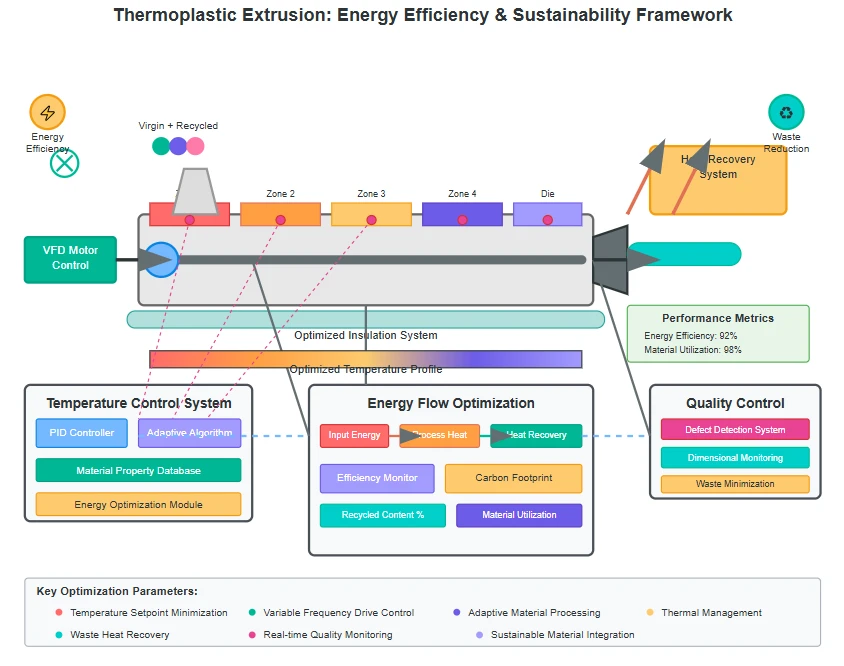
Processing recycled materials requires careful temperature control due to their different thermal properties compared to virgin materials.
Material Considerations
Development of robust temperature control strategies that accommodate material variability is essential for increasing the utilization of recycled content in extruded products.
Waste Reduction
Precise temperature control minimizes scrap rates by ensuring consistent product quality and reducing process-related defects.
Troubleshooting Temperature-Related Processing Issues
Temperature-related problems in the thermoplastic extrusion process can manifest in various ways, including dimensional instability, surface defects, degradation, and mechanical property variations. Systematic troubleshooting approaches begin with verification of actual temperatures against set points, checking for sensor malfunctions or calibration errors.
Processing Instabilities
Surging or Cyclic Output
Often indicates temperature-related issues in the feed or compression zones.
Possible Causes:
• Insufficient feed zone temperature
• Excessive temperature causing premature melting
• Uneven temperature distribution
Solutions:
• Adjust feed zone temperature
• Verify heater operation
• Check for cooling system malfunctions
Surface Defects
Shark Skin, Melt Fracture
Frequently result from improper die temperature settings or excessive thermal gradients.
Possible Causes:
• Die temperature too low
• Excessive temperature gradients
• Inadequate melt homogenization
Solutions:
• Adjust die temperature profile
• Optimize upstream temperature zones
• Consider screw speed adjustments
Material Degradation
Discoloration, Odor, Brittleness
Indicates thermal degradation from excessive temperatures or residence time.
Possible Causes:
• Excessive temperature in metering zone
• Poor temperature control
• Excessive residence time at high temperatures
Solutions:
• Reduce temperature set points
• Increase throughput if possible
• Verify temperature sensor accuracy
The thermoplastic extrusion process represents a sophisticated integration of thermal management, mechanical engineering, and polymer science. The precise control of temperature profiles across the extrusion barrel stands as a critical factor in achieving consistent product quality, efficient processing, and material integrity.
As polymer processing continues to evolve, advancements in temperature control technologies, combined with a deeper understanding of material behavior under processing conditions, will drive further improvements in efficiency, sustainability, and product performance in extrusion operations.