

What is Polymer Extrusion?
Polymer extrusion is a high-volume continuous manufacturing process that transforms raw thermoplastic materials into finished products with uniform cross-sections. In this process, polymer pellets or granules are fed into a heated barrel, melted by a combination of external heaters and mechanical friction from a rotating screw, and then forced through a precision-engineered die to create continuous shapes such as profiles, tubes, sheets, films, and rods. The process operates at temperatures ranging from 180°C to 275°C depending on the polymer type, with screw speeds typically around 120 RPM. Polymer extrusion is distinguished from other plastic forming methods by its ability to produce continuous lengths of product with consistent dimensions, making it ideal for applications requiring uniformity and high production volumes.
How Does the Polymer Extrusion Process Work?
The polymer extrusion process consists of five key stages:
- Feeding: Raw polymer materials (pellets, granules, or powder) are gravity-fed from a hopper into the extruder barrel.
- Melting: The material passes through heated zones (typically 180°C to 275°C) while a rotating screw (usually at 120 RPM) generates friction heat and forward pressure.
- Mixing & Compression: The screw design includes feed, compression, and metering zones that progressively melt, mix, and pressurize the polymer.
- Shaping: Molten polymer is forced through a die that determines the final cross-sectional shape of the product.
- Cooling & Cutting: The extrudate is cooled using water baths or air systems, then cut to length or wound onto spools.
What Materials Are Used in Polymer Extrusion?
Common materials processed through polymer extrusion include:
- Polyethylene (PE): HDPE, LDPE, LLDPE for packaging, pipes, and films
- Polypropylene (PP): Automotive parts, textiles, and containers
- Polyvinyl Chloride (PVC): Window profiles, pipes, and construction materials
- Polystyrene (PS): Packaging and insulation products
- Acrylonitrile Butadiene Styrene (ABS): Electronic housings and automotive components
- Polycarbonate (PC): LED light diffusers, safety products, and optical applications
- Acrylic/PMMA: Signage, lighting covers, and display applications
- Thermoplastic Elastomers (TPE): Seals, gaskets, and flexible profiles
Types of Polymer Extrusion Processes
| Extrusion Type | Description | Common Products |
|---|---|---|
| Profile Extrusion | Creates complex cross-sectional shapes | Window frames, LED diffusers, trim |
| Tube/Pipe Extrusion | Produces hollow cylindrical products | PVC pipes, medical tubing |
| Sheet Extrusion | Creates flat plastic sheets | Thermoformed packaging, panels |
| Film Extrusion | Produces thin continuous films | Packaging films, agricultural films |
| Co-Extrusion | Combines multiple materials in layers | Multi-layer pipes, colored profiles |
| Over-Jacketing | Coats wire or cable with plastic | Electrical insulation, fiber optics |
Key Advantages of Polymer Extrusion
- Continuous Production: Operates 24/7 without interruption for high-volume output
- Cost Efficiency: Lower per-unit costs compared to injection molding for long profiles
- Design Flexibility: Custom dies create unlimited cross-sectional shapes
- Material Versatility: Processes nearly all thermoplastic polymers
- Minimal Waste: Scrap material can be reground and reprocessed
- Consistent Quality: Uniform dimensions and properties across production runs
Polymer Extrusion vs. Injection Molding
| Factor | Polymer Extrusion | Injection Molding |
|---|---|---|
| Process Type | Continuous | Batch/Cyclic |
| Product Shape | Constant cross-section profiles | Complex 3D shapes |
| Tooling Cost | Lower | Higher |
| Production Volume | High (continuous lengths) | High (discrete parts) |
| Best For | Pipes, profiles, films, tubes | Bottles, caps, housings |
Applications of Polymer Extrusion
Polymer extrusion serves multiple industries including:
- Lighting: LED light diffusers, lampshades, polycarbonate covers
- Construction: Window profiles, PVC pipes, weatherstripping, siding
- Automotive: Door seals, trim, wire insulation, interior panels
- Packaging: Films, sheets, containers, shrink wrap
- Medical: Tubing, catheter components, IV lines
- Electronics: Wire insulation, cable conduits, connector housings
- Signage: Acrylic profiles, LED channel covers, display frames
Plastics Processing
The evolution of polymer extrusion technology has revolutionized the plastics processing industry, with twin-screw extruders representing one of the most significant advancements in this field. While the concept of twin-screw extrusion emerged in patents around 1900, it wasn't until thirty years later that Italy witnessed the successful development of the first twin-screw extruder specifically designed for polymer processing.
R. Colombo pioneered the co-rotating twin-screw extruder, marking a pivotal moment in the history of polymer extrusion engineering.
The modern twin-screw extruder has become an indispensable tool in the thermoplastic extrusion industry, offering superior mixing capabilities, enhanced processing control, and exceptional versatility compared to single-screw systems.
These sophisticated machines have transformed how we approach polymer modification, compounding, and reactive extrusion processes, establishing themselves as the preferred choice for demanding applications requiring precise control over material properties and processing conditions.

A Brief History
1900s
The concept of twin-screw extrusion emerges in early patents, laying the theoretical foundation for future development.
1930s
Italy witnesses the successful development of the first twin-screw extruder specifically designed for polymer processing.
1960s
Development of specialized thrust bearing systems represents a major technological breakthrough, improving reliability and operational life of twin-screw equipment.
Modern Era
High-torque twin-screw extruders with advanced gearbox designs operating at speeds up to 1500 RPM, with continuous innovations in efficiency and capabilities.
1.4.1 Twin-Screw Geometry and Configuration
The geometric design of twin-screw extruders represents a fundamental departure from single-screw systems, featuring two intermeshing screws housed within a figure-eight shaped barrel. This unique configuration enables complex flow patterns and intensive mixing actions that are impossible to achieve with single-screw designs.
The polymer extrusion process in twin-screw systems benefits from various geometric configurations, including fully intermeshing, partially intermeshing, and non-intermeshing designs, each offering distinct advantages for specific applications.
The screw elements in modern twin-screw extruders typically employ a modular design approach, allowing processors to customize the screw configuration to match specific processing requirements. These modular elements include conveying elements, kneading blocks, reverse elements, and specialized mixing elements that can be arranged in countless combinations.
The flexibility of this modular system enables processors to optimize the polymer extrusion process for different materials and product specifications, making twin-screw extruders particularly valuable in research and development environments where frequent configuration changes are necessary.
The intermeshing region between the two screws creates a unique processing environment characterized by high shear rates and excellent self-wiping action. This self-cleaning capability is particularly important when processing heat-sensitive materials or when frequent material changes are required.
Key Geometric Features
Intermeshing screw design with figure-eight barrel
Modular screw elements for customization
Self-wiping action for improved material handling
Controllable centerline distance ratio
Variety of element types for specific processes
Precision clearances for optimal mixing

1.4.2 Working Principles of Twin-Screw Extrusion
The operational principles of twin-screw extruders differ fundamentally from single-screw systems, primarily due to the positive displacement conveying mechanism created by the intermeshing screws. This positive pumping action ensures consistent material transport regardless of the friction coefficient between the material and the barrel surface.
Co-rotating Twin-Screws
In co-rotating twin-screw extruders, both screws rotate in the same direction, creating a complex flow pattern that combines drag flow, pressure flow, and leakage flow components.
The material experiences a figure-eight motion as it travels along the extruder, repeatedly transferring between the two screws. This transfer action creates excellent distributive mixing while the narrow clearances in the intermeshing region provide intensive dispersive mixing.

Counter-rotating Twin-Screws
Counter-rotating twin-screw extruders operate with screws rotating in opposite directions, creating a different flow pattern characterized by a calendering effect in the intermeshing region.
This configuration is particularly suitable for processing heat-sensitive materials such as rigid PVC, where gentle processing conditions are essential. The closed C-shaped chambers formed between the screw flights provide positive conveying with minimal shear heating.

Solid Conveying
Material feeding and initial transport
Melting
Transition from solid to molten state
Melt Conveying
Transport of molten material
Mixing
Homogenization of material components
Devolatilization
Removal of volatiles and moisture
Pressure Generation
Building pressure for die extrusion
"Twin-screw extruders demonstrate superior mixing efficiency compared to single-screw systems, with residence time distributions approaching plug flow characteristics and significantly enhanced distributive and dispersive mixing capabilities, making them the preferred choice for demanding compounding applications requiring precise control over material properties"
- SPE Journal of Polymer Processing, 2023
1.4.3 Key Components and Systems
Beyond the screws and barrel, twin-screw extruders incorporate several critical components that ensure reliable operation and optimal processing performance.
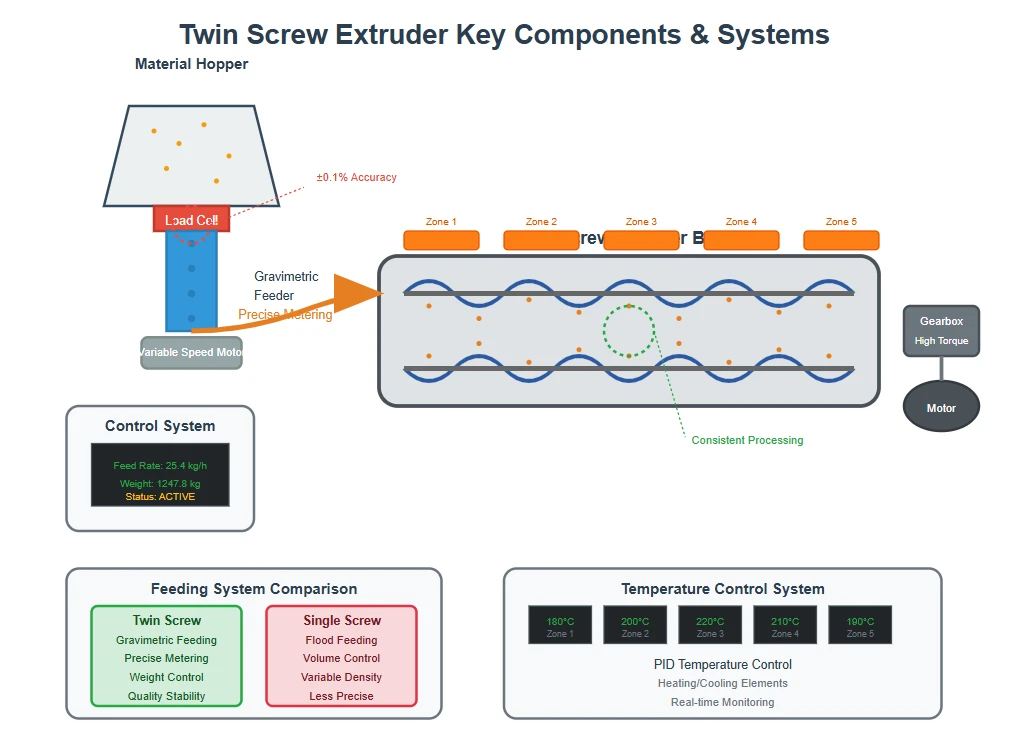
Feed System
Typically consisting of gravimetric feeders for accurate material dosing, representing a crucial element in maintaining consistent product quality. Unlike single-screw extruders that often rely on flood feeding, twin-screw systems require precise metering of materials.
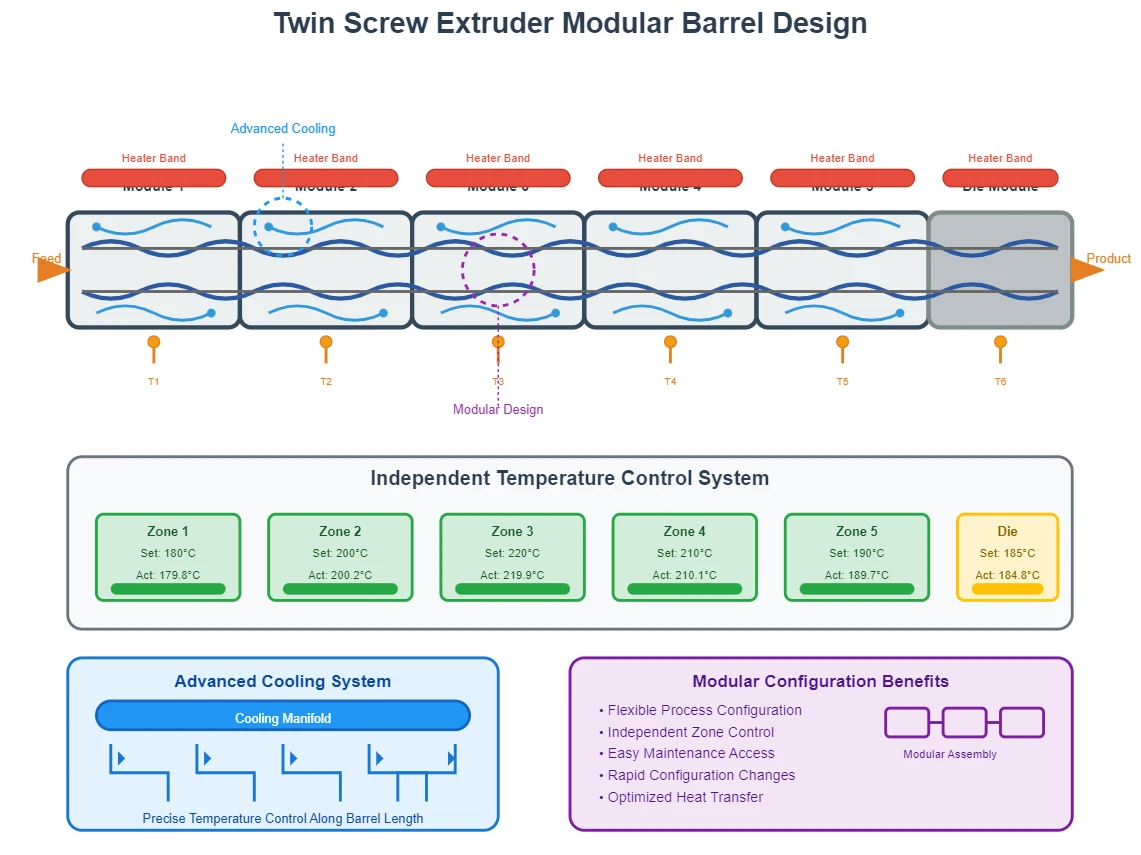
Barrel Design
Features a modular construction that allows for flexibility in process configuration. Individual barrel sections can be heated or cooled independently, providing precise temperature control along the extruder length with advanced cooling channels.

Drive System
The gearbox must transmit power to both screws while maintaining precise speed synchronization and handling substantial torque requirements. Modern designs operate at speeds from 600 to 1500 RPM, enabling high throughput rates.

Thrust Bearing
Must handle substantial axial forces generated during operation. Modern designs incorporate advanced materials and lubrication systems that enable continuous operation under demanding conditions, building on 1960s technological breakthroughs.
Twin-Screw Extruder Component Overview

1.4.4 Performance Comparison and Applications
When comparing twin-screw extruders to single-screw systems, several key advantages become apparent, making them the preferred choice for many demanding applications.
Metered Feeding Capability
Enables precise control over material throughput, independent of material properties or processing conditions. Particularly suitable for processing materials with varying bulk densities or flow properties.
Narrow Residence Time Distribution
Significantly narrower than in single-screw systems, approaching plug flow characteristics. Ensures all material elements experience similar thermal and shear histories, resulting in improved product uniformity.
Self-Wiping Action
Prevents material stagnation and degradation, making twin-screw extruders ideal for processing heat-sensitive materials or when frequent color or material changes are required.
Superior Devolatilization
Excellent surface renewal created by the intermeshing screws, combined with multiple venting zones, enables efficient removal of volatiles, moisture, and reaction byproducts.
Energy Efficiency
Studies have shown energy savings of up to 50% compared to single-screw systems processing the same materials at equivalent throughput rates, resulting from more efficient mixing mechanisms.
Process Versatility
Modular design allows for configuration optimization for specific materials and processes, from gentle mixing to intensive compounding, with the ability to introduce materials at multiple points.
Industry Case Study
Multi Plastics Extrusions Inc has reported significant operational improvements after transitioning from single-screw to twin-screw technology for their compounding operations:
- 35% reduction in energy consumption
- 28% increase in throughput rates
- Improved product consistency with 40% reduction in variation
- Extended production runs between cleaning cycles
- Expanded material processing capabilities
1.4.5 Temperature Control and Process Optimization
Temperature management in twin-screw extrusion represents a critical aspect of process control that directly impacts product quality, throughput, and equipment longevity. The temperature profile along the extruder must be carefully optimized to ensure proper melting, mixing, and material conveyance while avoiding degradation or excessive shear heating.
Modern twin-screw extruders feature sophisticated temperature control systems that enable precise management of barrel temperatures across multiple zones throughout the extruding manufacturing process .
The establishment of appropriate temperature profiles for pelletizing operations requires consideration of multiple factors including material properties, throughput rates, screw configuration, and desired product characteristics. For semicrystalline polymers, the feed zone temperature is typically maintained below the melting point to ensure proper solid conveying, while subsequent zones are heated above the melting temperature to facilitate complete melting and mixing.
In pelletizing applications, the die temperature represents a critical parameter that influences pellet quality, cutting efficiency, and production stability. The die temperature must be optimized to ensure proper melt viscosity for clean cutting while avoiding issues such as die drool or pellet agglomeration.
The cooling requirements for twin-screw extruders extend beyond simple barrel temperature control. Intensive mixing and high screw speeds can generate substantial viscous heating that must be managed through appropriate cooling strategies.
Advanced Cooling Systems
Internal screw cooling for temperature-sensitive materials
Intensive barrel cooling with precision temperature control
Specialized vent stuffing boxes to prevent overheating
Closed-loop water cooling systems with heat exchangers
Automatic temperature adjustment based on process conditions

Die Temperature Control
Advanced pelletizing systems incorporate automatic die plate temperature control that maintains optimal cutting conditions across varying throughput rates and material types.
Critical parameters include melt viscosity management, prevention of die drool, and ensuring proper pellet formation and cooling.
Advanced Applications and Future Developments
The versatility of twin-screw extrusion technology has enabled its adoption across diverse application areas, continuously expanding its capabilities and range of uses.
Polymer Compounding
Excel at incorporating high loadings of fillers, reinforcements, and additives while maintaining excellent dispersion quality with precise control over material properties.
Reactive Extrusion
Serve as continuous chemical reactors for polymerization, grafting, and functionalization reactions, enabling production of specialty polymers.
Pharmaceutical Processing
Used for hot melt extrusion, continuous granulation, and solid dispersion preparation, supporting the move toward continuous manufacturing paradigms.
Food Processing
Applied in various food extrusion processes requiring precise mixing, temperature control, and formulation capabilities for specialty food products.
Future Technological Advancements
Ultra-High-Speed Systems
Development of systems capable of operating at speeds exceeding 2000 RPM, enabling higher throughput rates while maintaining mixing quality and process control.
Advanced Screw Designs
Computational fluid dynamics optimization of screw geometries for enhanced mixing efficiency, reduced energy consumption, and improved material handling.
Intelligent Control Systems
Real-time process optimization using AI and machine learning algorithms that adapt to material variations and maintain optimal processing conditions automatically.