

The mandrel changes everything. Solid profile extrusion is essentially a shaping problem: push molten polymer through a die opening and cool it. Hollow profile extrusion introduces a component that must float inside the melt stream, stay perfectly centered under asymmetric pressure, and resist deflection across the full length of the die land. That single engineering constraint, supporting an internal forming tool within a moving fluid, is what makes tube and pipe extrusion a fundamentally different discipline from standard profile work.
The global plastic pipe market sits at roughly $65–73 billion in 2025, with Asia-Pacific commanding around 46% of that volume and PVC alone accounting for over half of all pipe revenue (Grand View Research). Growth projections through 2035 hover near 6% CAGR, driven primarily by water infrastructure modernization and agricultural irrigation expansion (Precedence Research). These numbers explain why extrusion capacity for hollow profiles keeps expanding, but they say nothing about how to actually produce a dimensionally stable tube. That engineering reality is where most published guides fall short, and where this one starts.

Before going further, it helps to pin down what the industry actually means by these terms. Tubes generally refer to smaller-diameter hollow profiles (often ≤1 inch) where flexibility or semi-rigidity is expected: medical catheters, fluid transfer lines. Pipes are rigid, structural hollow profiles designed for pressurized conveyance in plumbing or gas distribution. Hoses are larger-diameter flexible products for suction or pressure service. Rods are solid, no internal cavity at all. These distinctions matter because each category demands different die geometry, cooling strategy, and downstream handling, even though they all rely on the same core plastic tube extrusion process.
Die Head Selection for Hollow Profiles: Spider, Spiral Mandrel, and Crosshead
Selecting the right die head isn't a preference. It is a materials-physics decision with direct consequences for weld line integrity, dimensional stability, and achievable production speed. Three principal die architectures dominate: the spider die, the spiral mandrel die, and the crosshead die. Each solves the mandrel-support problem differently, and each introduces trade-offs that most comparison articles gloss over.
Spider dies use thin metal legs, typically three to four, radiating inward to hold the mandrel centered in the melt flow. The polymer stream splits around each leg, then recombines downstream. That recombination zone is the problem. Where the melt fronts rejoin, macromolecules align parallel to one another without adequate entanglement, creating a weld line that runs the full length of the extruded product. For pressure-rated pipe, this weld line directly reduces hoop strength because it sits at the worst possible orientation relative to internal pressure stress. The spider die's saving grace is residence time: melt passes through quickly, which makes it the standard choice for PVC and other thermally unstable polymers where prolonged heat exposure triggers degradation (Plastics Technology).
Spiral mandrel dies take the opposite approach. Helical grooves milled into the mandrel surface distribute the melt through overlapping flow paths, producing circumferential orientation and virtually eliminating weld lines. The mechanical payoff is substantial: pipes extruded through spiral mandrel tooling exhibit measurably better burst pressure performance.

What's rarely mentioned in buying guides is that spiral mandrel dies were originally developed for pipe, not blown film. Egan (now part of Davis-Standard) built the first spiral pipe dies in the early 1960s; the technology migrated to blown film afterward (Plastics Technology). This historical sequence matters because it means the flow-field design principles were optimized for annular pipe geometry first.
But spiral dies demand longer residence time, making them poorly suited for PVC. This creates the central engineering trade-off in hollow profile extrusion die design. Here's the decision rule we apply at Dachang: for HDPE or PP pressure pipe rated PN10 or above at DN75 and larger, the weld-line strength penalty from a spider die pushes the weld efficiency factor below acceptable thresholds (based on our burst-test data across 200+ production runs), and spiral mandrel tooling becomes non-negotiable regardless of cost. For PVC drainage pipe, which sees no sustained internal pressure, spider dies remain the sound engineering choice because the thermal degradation risk of extended residence time outweighs the weld-line concern. Between those two poles, the decision depends on the specific pressure class and material grade, not on general preference.
Crosshead dies orient the die axis perpendicular to the extruder. They're used primarily for wire coating and jacketing applications, or situations where the product being encapsulated must pass through the die center. For standalone pipe production, they're less common than spider or spiral configurations.
The practical comparison between spider and spiral mandrel pipe extrusion dies comes down to material, wall thickness requirements, and pressure rating:
| Parameter | Spider Die | Spiral Mandrel Die | Crosshead Die |
|---|---|---|---|
| Weld line presence | Yes - 3-4 axial lines | Virtually none | Possible - single axial line |
| Residence time | Short | Long | Medium |
| Best material fit | PVC, thermally sensitive polymers | HDPE, PP, polyolefins | Wire coating, jacketing |
| Hoop strength impact | Reduced at weld zones | Improved via circumferential orientation | Application-dependent |
| Relative tooling cost | Lower | Highest | Medium |
| Melt distribution uniformity | Moderate | Excellent | Moderate |
One point that most supplier literature won't surface: PVC processing releases hydrogen chloride gas, which corrodes standard tool steels. Any spider die running PVC needs premium-grade stainless steel or specialized coatings on all wetted surfaces, a cost factor that significantly increases tooling investment but rarely appears in initial quotes. When comparing die head quotes, ask whether the price includes HCl-resistant steel grades; if it doesn't, the real number will be materially higher.
For a deeper look at how extruder components upstream of the die influence melt quality, our extrusion process mechanics article walks through barrel zones, screw geometry, and feed-throat design.
Vacuum Sizing and the Physics of Dimensional Control
Once the still-soft tube exits the die, maintaining its shape becomes the dominant challenge. Vacuum sizing works by drawing the external surface of the extrudate against a precision-machined sleeve while cooling water solidifies the polymer from the outside in.
The sizing sleeve has a bore diameter slightly smaller than the die opening. Atmospheric pressure inside the tube, combined with vacuum on the exterior, pushes the hot polymer outward against the calibration surface (Atlas Copco). Internal air pressure through the mandrel pin maintains the inner diameter while the outer surface sets against the sleeve.

The critical variable is the coordination between three parameters: vacuum level, internal air pressure, and cooling water temperature. For smooth-wall HDPE pipe at SDR 11, stable production typically runs at 50–80 mbar vacuum with 0.8–1.2 bar internal air pressure. Corrugated pipe requires higher vacuum in the 100–200 mbar range to form the external ribbing against the mold blocks. These ranges shift with wall thickness and line speed. Thinner walls need lower vacuum to avoid collapse, while faster lines need more aggressive cooling to set the shape before the extrudate deforms. In practice, when we set up a new tube line for vacuum calibration in pipe extrusion, the first two hours of a production trial are entirely consumed by finding the stable operating window for these three parameters; the theoretical starting points get us into the neighborhood, but final values always come from on-line adjustment.
Excessive vacuum on thin-walled product pulls the tube against the sleeve unevenly. Thick sections resist while thin sections get drawn harder, amplifying any pre-existing wall-thickness variation into visible ovality. Insufficient internal air pressure allows the tube to sag under gravity before reaching the calibrator, producing a flat-bottom cross-section that no downstream correction can fix. Cooling water that's too cold locks in residual thermal stress as warping or post-extrusion shrinkage.
SDR (Standard Dimension Ratio) governs the relationship between pipe diameter and wall thickness. An SDR 11 pipe has a wall thickness equal to 1/11th of its outside diameter. This standardized ratio matters for pipe extrusion sizing because the calibrator tooling, vacuum level, and cooling-zone length must all be calculated against the specific SDR being produced. Switching from SDR 11 to SDR 17 on the same line requires recalibrating the entire downstream chain, not just swapping the sizing sleeve.
For multi-lumen tubing, conventional vacuum sizing breaks down entirely. Standard vacuum exerts equal force on all external surfaces, but wall thickness around each lumen varies, so the thinnest walls get pulled outward preferentially, producing ovality in each individual channel. The solution is a hybrid vacuum calibrator that applies controlled external constraint without the uniform radial pull of standard vacuum tooling, often combined with individually pressurized mandrel pins controlling each lumen independently (Medical Device & Diagnostic Industry). Multi-lumen tube extrusion tolerances at this level reach ±0.025 mm on outer diameter for medical-grade product, a specification that demands process stability measured in fractions of a degree Celsius and fractions of a bar.
Material Behavior in Hollow Extrusion
Polycarbonate's die-swell ratio shifts by up to 18% across its processing window of 260–310°C, which means a sizing sleeve validated at one temperature setting may not hold dimensional spec after a mid-run temperature correction. That single property makes PC hollow profiles more sensitive to thermal drift than any other polymer we routinely process, and it's the reason our PC tube runs include a mandatory re-measurement checkpoint 30 minutes after any temperature adjustment.
PVC requires barrel temperatures between roughly 160–200°C, with narrow processing windows. Exceed the upper limit and HCl gas degrades both the polymer and the die steel. HDPE processes at 180–230°C with considerably more thermal forgiveness but displays pronounced die swell that must be accounted for in sizing calculations. PC also demands thorough pre-drying to prevent hydrolytic degradation; residual moisture above 0.02% (per resin supplier technical data sheets) produces bubble defects and haze that no downstream correction can fix.
The regrind question deserves direct treatment because most published content either ignores it or handles it superficially. Industry standards (including relevant ASTM specifications) permit the use of in-plant regrind, material that was produced on the same line, scrapped for dimensional non-conformance, reground, and reprocessed. This is distinct from post-consumer recycled content, which introduces unknown thermal history, contaminants, and inconsistent melt flow index (MFI). A University of Stuttgart study documented that regrind particles' irregular shape reduces bulk density in the feed zone by 10–15%, simultaneously increasing melt temperature and narrowing the stable processing window (Polymers / MDPI). Some manufacturers, like Creek Plastics, publicly refuse to use any recycled material in pipe products and limit regrind to verified in-plant scrap (Creek Plastics). The pragmatic position: regrind from a controlled, single-material line is manageable with proper blending protocols. Anything beyond that introduces MFI variability that directly shows up as wall-thickness fluctuation and surface defects.
But "proper blending protocols" means different things depending on what you're making. On a DN20 non-pressure cable duct, 15–20% regrind blended through a gravimetric feeder creates no measurable quality difference. On a DN110 SDR 11 pressure pipe, even 10% regrind with a 0.5 g/10min MFI spread from the virgin batch can shift the process window enough to trigger intermittent wall-thickness alarms. The distinction isn't whether regrind is acceptable; it's whether the specific product's dimensional and pressure requirements can absorb the variability it introduces. For pressure pipe projects where regrind proportion is a cost consideration, our process engineers can run an MFI compatibility check before tooling commitment.
For a detailed walkthrough of how material selection interacts with profile geometry across PVC, PC, ABS, and other engineering plastics, our custom plastic profiles guide covers the full decision framework.
Co-Extrusion and Complex Hollow Geometries
Layer delamination is the failure mode that defines co-extrusion quality. It occurs when adjacent polymer layers lack sufficient molecular interpenetration at their interface, a function of melt temperature compatibility, residence time in the combining zone, and chemical affinity between the materials. Pairing HDPE with a nylon barrier layer, for instance, typically requires a tie layer (modified polyolefin adhesive resin, selected to match the MFI range of both adjacent layers) because the two polymers won't bond directly. Specifying the wrong tie layer chemistry is one of the most common co-extrusion failures we encounter when taking over projects from other suppliers, and it often doesn't manifest until the pipe is in service and exposed to temperature cycling. When evaluating a co-extrusion multi-layer pipe manufacturing partner, request the material compatibility test report for the specific layer combination; any supplier unwilling to provide this is working from assumption rather than data.
For non-circular hollow cross-sections (square tubes, C-channels, multi-cavity profiles) the design constraints tighten considerably. Uniform wall thickness becomes even more critical because uneven sections cool at different rates, producing internal stress that warps the profile after cutting. Two absolute design rules apply to any hollow extrusion: internal detail should be minimized because there's no practical way to calibrate the inside of a closed section during cooling. And hollow-within-hollow geometries (a tube inside a tube, extruded in a single pass) are not feasible; the inner hollow cannot be held in position during solidification and will inevitably shift.

Multi-lumen tube extrusion for medical applications pushes these constraints to their limit. Each internal channel is formed by an individual pin within the die, each with independently controlled air pressure. Wall thicknesses between lumens can be thinner than a human hair, and the tolerance stack across five or more channels simultaneously approaches the practical limits of current tooling technology. The reason most major medical device companies outsource this work rather than building internal capability isn't cost. It's that the process control required to hold ±0.025 mm across multiple lumens simultaneously demands dedicated tooling, purpose-built downstream equipment, and years of accumulated operator expertise.
Dachang runs multi-layer co-extrusion on dedicated lines with independent temperature control per extruder and layer-thickness monitoring at the die exit. For projects involving co-extruded hollow profiles or custom multi-layer tubing, our plastic tube product range provides a starting reference for material combinations and achievable geometries.
Defect Diagnosis: Tracing the Engineering Chain
Eccentric Wall Thickness
Root cause: Die-mandrel misalignment is the dominant factor. The mandrel, supported by spider legs in a cantilevered arrangement, deflects under asymmetric pressure from the melt stream. In our production records on 110mm HDPE pipe runs, a 0.1 mm mandrel offset consistently produced 0.25–0.35 mm wall-thickness differences across the pipe circumference, a 3× amplification ratio that holds across most pipe diameters we've run. Uneven die-head temperature compounds the problem: a 5°C differential across the die creates viscosity variation that changes local flow velocity, which our temperature-uniformity protocols are specifically designed to prevent.
Corrective action: Adjust centering bolts, verify die-head temperature uniformity across all zones, check spider leg condition for wear or buildup.
Prevention: For large-diameter pipe (DN200+), specify multi-point spider support designs that resist cantilever deflection. Implement regular centering verification with feeler gauges at cold startup, and cross-check with ultrasonic wall-thickness measurement during the first 15 minutes of production.
Weld Lines
Root cause: Inherent to spider die geometry, but severity varies with process conditions. Higher melt temperatures and longer post-spider flow paths allow more molecular re-entanglement across the weld zone.
Corrective action: Increase die-head zone 3–4 temperature by 5–8°C (for PVC, ceiling at 200°C to avoid degradation), while reducing haul-off speed by 10–15% to extend the consolidation window. In our experience running rigid PVC pipe on spider tooling, this combination typically recovers 60–70% of the weld-zone tensile strength deficit. The window is narrow: beyond a material-specific residence-time threshold, degradation losses overtake weld-healing gains.
Prevention: For applications where weld-line strength is critical (pressure pipe PN10+), specify spiral mandrel tooling at the design stage rather than attempting to compensate through process optimization. Our guide to polycarbonate extrusion failure prevention covers similar thermal-sensitivity challenges with a different polymer system.
Ovality
Root cause: The interval between die exit and calibrator entry. The extrudate is soft enough during this gap to deform under gravity, haul-off tension, or inconsistent vacuum. The most overlooked factor is cooling-water distribution within the vacuum tank itself: uneven water flow creates temperature gradients that solidify the pipe asymmetrically, locking in an oval shape.
Corrective action: Shorten the die-to-calibrator distance, verify calibrator level alignment, check vacuum tank water-distribution nozzles for blockage.
Prevention: Increase the number of vacuum sizing stages for wall thickness control on hollow plastic profiles. Ensure cooling water temperature variance stays within ±1°C across the full circumference of the sizing sleeve.
One documented case illustrates the financial stakes. An HDPE pipe manufacturer operating with defect rates approaching 60%, driven by surface defects, inconsistent wall thickness, and pigmentation flaws, underwent a Lean Six Sigma intervention that ultimately brought defect rates below 5% and reduced cost of poor quality from 37.5% to 15% of revenue. The root causes weren't exotic: inconsistent blend density, inadequate SOP compliance, and unmonitored process drift (AM Saxum). A separate DMAIC study on PVC pipe extrusion found that optimized die settings, standardized procedures, and improved operator training raised first-pass yield from 75% toward a 95% target (ResearchGate). The pattern is consistent: the biggest quality gains in plastic pipe extrusion defects and solutions come from process discipline, not equipment upgrades.
From Operator Intuition to Data-Driven Process Control
Experienced operators adjust parameters based on visual and tactile assessment of the extrudate. That accumulated knowledge is genuinely valuable. A senior operator can detect subtle changes in melt behavior that instruments miss. But it doesn't scale, doesn't transfer when people retire, and doesn't prevent gradual process drift between shift changes.
Before investing in full sensor integration, there's a practical middle step that most factories skip. At Dachang, we started by requiring operators to log key observations (melt appearance, haul-off tension feel, surface gloss changes) into a timestamped spreadsheet correlated with the line's existing temperature and speed readouts. Within six months, that dataset revealed three recurring parameter combinations that preceded wall-thickness alarms, none of which had been formalized in any SOP. The cost was essentially zero; the yield improvement on those specific product runs was measurable. Any factory with basic process data logging can do the same thing. The barrier isn't technology; it's the discipline to record observations in a structured format rather than passing them verbally at shift change.
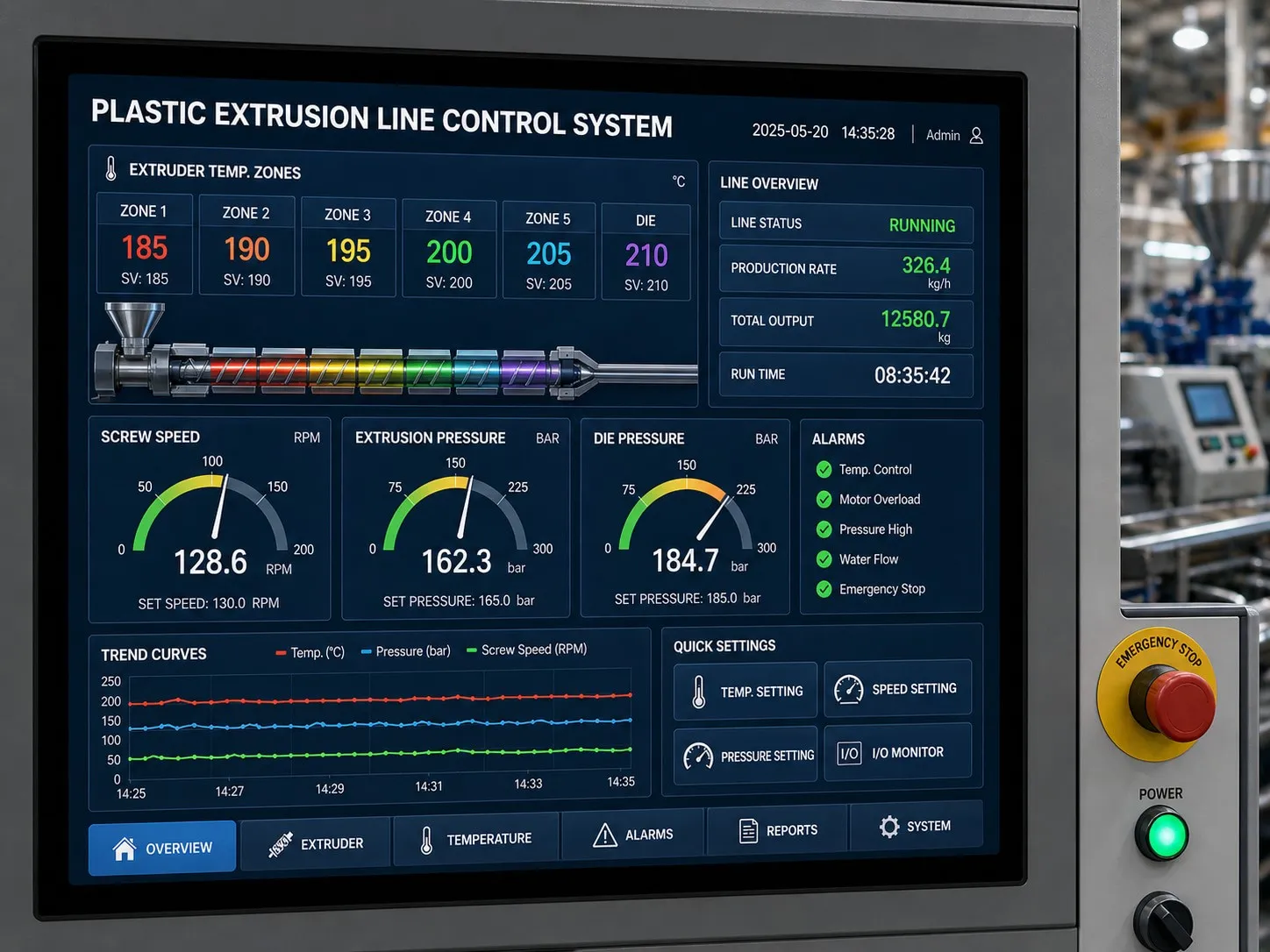
Full-scale extrusion monitoring systems track 80+ process variables simultaneously, using statistical models like Mahalanobis Distance to define the boundaries of stable operation. When incoming data drifts outside those boundaries, the system flags deviations within seconds, far faster than any human operator can detect a slow-moving temperature trend. Automated die adjustment systems on cast extrusion lines now achieve target thickness specifications within 20 seconds of a deviation, without manual intervention. For pipe and tube lines specifically, in-line laser gauging and ultrasonic wall-thickness measurement at multiple circumferential points enable closed-loop feedback to the vacuum calibration system, automatically correcting dimensional drift before it accumulates into scrap.
For operations running two or more shifts across five or more extrusion lines with annual output above 800 tons, documented cases show defect-rate reductions of 30% or more alongside 15–20% increases in effective output speed, with typical payback periods of 18–24 months. Below that scale, the per-line economics are harder to justify; the structured-observation approach described above delivers most of the benefit at negligible cost. Our extrusion technology article goes deeper into how AI-assisted optimization is reshaping quality control across the industry.
Standards, Compliance, and What Gets Marked on the Pipe
Pipe and tube products operate within a dense framework of material and dimensional standards. ASTM D2241 covers PVC pressure-rated pipe. ASTM F714 governs HDPE pipe for general use. ISO 4427 specifies HDPE pipe for water supply. UL94 fire ratings (V-0, V-1, V-2) apply to tubing used in electrical or electronics enclosures. Each standard defines not just final dimensions and tolerances, but also the specific materials, test methods, and certification protocols required for compliance.
At the end of every extrusion line, marking systems print identification onto the pipe at regular intervals: nominal size, material designation, SDR or schedule rating, manufacturer name, and production date code. This marking isn't decorative. It's a traceability requirement that allows any section of installed pipe to be traced back to the specific production run, resin lot, and process conditions under which it was made. For pressure-rated pipe, this traceability chain is the foundation of warranty and liability management. The plastic tube extrusion process step by step, from pellet to marked and cut pipe, is a sequence where each station's output constrains the next station's operating window.
Evaluating a Custom Tube and Pipe Extrusion Partner
When the engineering is this process-dependent, supplier selection goes beyond price-per-meter. Five capability indicators separate vendors who can reliably deliver hollow profiles from those who'll require multiple sample iterations and still produce inconsistent results.
Die tooling capability matters first. A manufacturer with in-house mold design and fabrication can iterate on die geometry in days rather than weeks, and can adjust mandrel positioning, land length, and flow-channel geometry based on actual trial-run data rather than theoretical calculations alone. Material versatility is the second filter: working across PVC, HDPE, PP, PC, ABS, and PMMA each demands different screw configurations, temperature profiles, and downstream handling. A single-material shop will struggle when your project requires polycarbonate clarity with ABS impact resistance in a co-extruded structure.
Tolerance commitments should be specific and verifiable, not vague references to "tight tolerances." Ask for documented Cpk data from production runs on comparable products. The fourth indicator, sample turnaround speed, reveals more about a supplier's infrastructure than any capability brochure. Most custom-profile suppliers quote 1–3 weeks for first samples because they outsource die fabrication. If a supplier can deliver in days rather than weeks, that usually means they machine mandrels and dies in-house. A useful verification question during quoting: "Do you fabricate your own mandrels, or do you send die work out?" The answer tells you whether quoted lead times are sustainable or optimistic.
Finally, quality certification (ISO 9001 at minimum, with industry-specific compliance like RoHS and UL94 as applicable) provides the audit trail that procurement teams need. A sixth criterion worth adding to any shortlist evaluation: ask for reference production samples from a comparable co-extrusion or multi-lumen project. Willingness and ability to produce these quickly separates manufacturers with genuine process depth from those operating at the edge of their capability.
At Dachang, each of these indicators maps to specific, verifiable capabilities: our mold department machines mandrels and complete die assemblies in-house, delivering custom tooling within 72 hours, the direct result of not outsourcing die work. We run 40+ extrusion lines covering PVC through engineering polymers, with annual throughput exceeding 2,000 tons under ISO 9001 process controls. Rather than stating that we meet these criteria in the abstract, we encourage prospective customers to review our product range and request a sample, because the turnaround speed and dimensional consistency of that sample will demonstrate the capabilities more convincingly than any description.
Frequently Asked Questions
FAQ
Q: What is the difference between spider die and spiral mandrel die in pipe extrusion?
A: Spider dies use metal legs to support the mandrel, creating weld lines where the melt recombines. Spiral mandrel dies use helical channels to distribute the melt, virtually eliminating weld lines. Spider dies suit PVC; spiral mandrel dies are preferred for polyolefins.
Q: How do you control wall thickness in hollow profile extrusion?
A: Through die-mandrel concentricity, consistent melt temperature across the die head, balanced vacuum sizing pressure, and stable haul-off speed. In-line ultrasonic measurement systems detect variations and can automatically adjust calibration parameters.
Q: What causes ovality in extruded plastic pipes?
A: Uneven cooling, inconsistent haul-off tension, improper vacuum pressure, or gravitational sag between die exit and calibrator entry. Multiple vacuum sizing stages and uniform cooling-water distribution are the primary corrective measures.
Q: Can regrind material be used in pipe extrusion?
A: In-plant regrind from a controlled single-material line is manageable with proper blending protocols. Post-consumer recycled content typically does not meet pressure-pipe standards due to inconsistent melt flow index and contamination risk.
Q: What tolerances are achievable in multi-lumen tube extrusion?
A: Medical-grade multi-lumen tubing can achieve outer diameter tolerances of ±0.025 mm, with each lumen independently controlled via air pressure through individual mandrel pins.
For any hollow profile project requiring engineering input before tooling commitment, request a free DFM review and our extrusion engineering team will assess feasibility and provide a detailed manufacturing recommendation.