

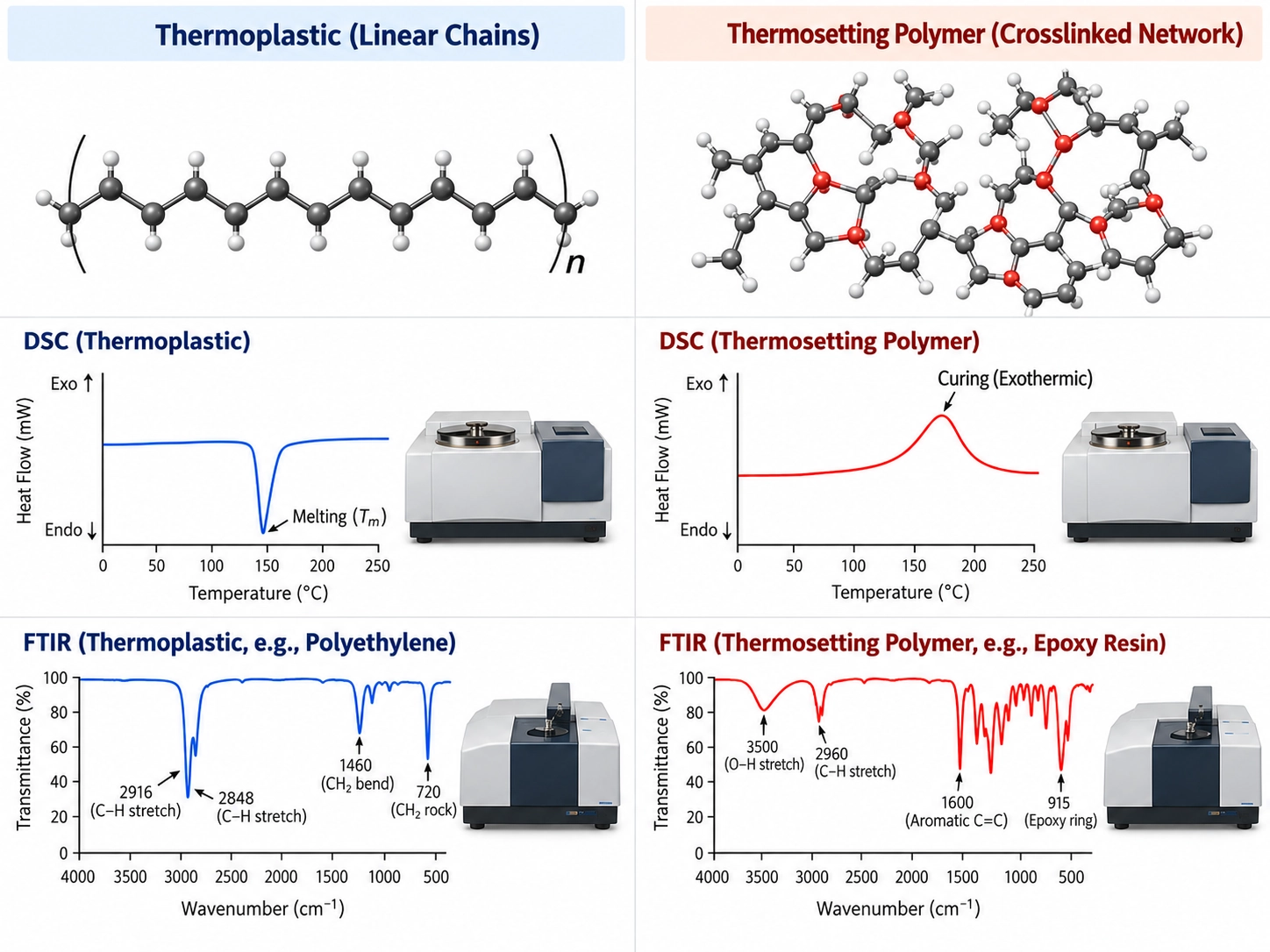
Thermoplastics soften when heated and solidify when cooled. Conventional thermosets form a permanent crosslinked network during curing and cannot subsequently be remelted through the same heating-and-cooling cycle.
That difference determines how the materials can be shaped and reprocessed. It does not, by itself, tell you which finished part will withstand more heat, hold a tighter fit or perform better in service.
For designers and buyers, the useful comparison connects three things: polymer structure, manufacturing route and evidence for the intended application. Understanding that connection helps prevent two common specification errors: choosing a material that does not suit the proposed process, and treating a material category as proof of finished-product performance.
What Actually Changes When the Material Is Heated?
Thermoplastics: shaping through reversible softening
In conventional thermoplastic processing, heating gives the polymer chains sufficient mobility for shaping. Cooling reduces that mobility and establishes the finished form. The material can potentially be softened again for further processing.
PVC, polyethylene, polypropylene, polycarbonate and PMMA belong to this broad category. Their different properties make them useful for applications ranging from flexible films to rigid profiles and transparent covers.
The important limitation is that reversible softening does not mean reversible processing damage. Heat, oxygen and processing history can change material properties. The Open University's polymer course explicitly distinguishes the theoretical reversibility of thermoplastic softening from the thermal and oxidative degradation that can occur in practice.
Consequently, the ability to remelt scrap is only the starting point for deciding whether it can be used again.
Thermosets: shaping followed by chemical curing
Thermosetting systems undergo a chemical reaction that connects molecules into a crosslinked network. The part is formed while the system is still processable, and curing establishes the network.
As Autodesk's thermoset materials documentation explains, these connections restrict the movement of individual polymer chains. Reheating the cured material does not simply restore the original processable state.
Cured epoxy and phenolic resin systems are familiar examples. Depending on the application, a thermosetting resin may function as an adhesive, coating, encapsulant or matrix surrounding reinforcing fibers.
This distinction also explains why "thermoset resin" and "finished thermoset composite" are different specification levels. A resin name does not fully describe a component containing reinforcement, fillers and a particular cured construction.
| Question | Thermoplastics | Conventional thermosets |
|---|---|---|
| How is the shape established? | Material is softened, shaped and cooled | A processable system is shaped and chemically cured |
| What happens during reheating? | Further softening can permit reshaping, subject to degradation | The cured network does not return to an ordinary processable melt |
| Familiar examples | PVC, PE, PP, PC and PMMA | Cured epoxy and phenolic systems |
| What does the category help establish? | Possible thermal processing and reprocessing routes | The need to account for curing and the cured network |
| What does it leave unresolved? | Grade suitability and finished-part performance | Resin system, reinforcement, cure condition and finished-part performance |
How the Difference Changes Profile Manufacturing
A long, constant cross-section does not uniquely identify the material or process. Both thermoplastic profiles and thermosetting composite profiles can be manufactured continuously, but their forming mechanisms differ.
Thermoplastic extrusion: push, support and cool
In thermoplastic profile extrusion, plasticized material is pushed through a shaped die. The emerging section then needs appropriate support and cooling.
The die creates the initial cross-section, but dimensional control continues downstream. Formtech's extrusion FAQ describes calibration tooling and sizers that hold the extruded material in shape while it cools. Its tolerance discussion also identifies material choice and cooling control as relevant manufacturing factors.
This matters when reviewing a profile drawing. Specifying a die opening is not equivalent to specifying the dimensions of the cooled product.
A useful drawing therefore identifies the features that control function: a channel opening that receives another component, a mounting lip, a cover width or a mating surface. These features give the processor a basis for reviewing tooling, support and inspection requirements.
Thermoset pultrusion: pull reinforcement and cure the resin
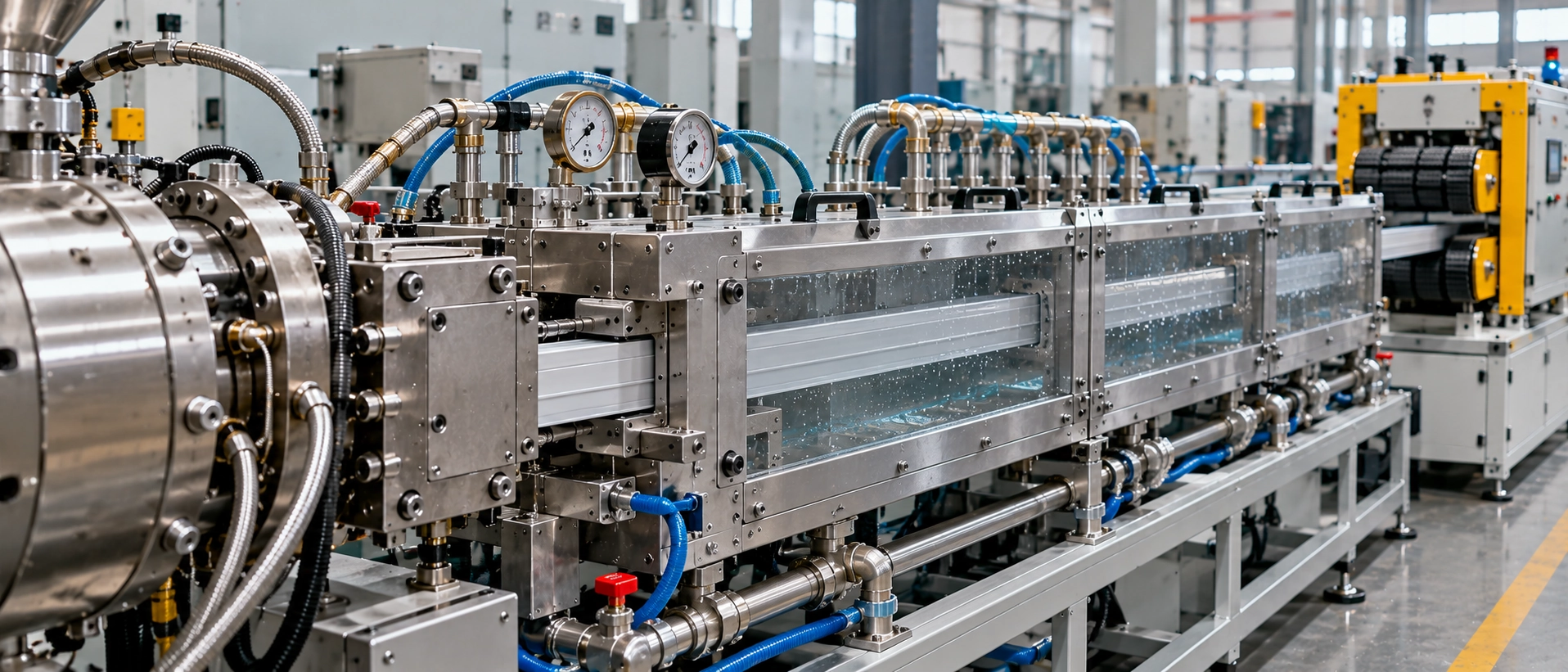
In the process described by Strongwell, continuous reinforcing fibers are combined with a liquid resin mixture and pulled through a heated forming die. Heat initiates the resin's hardening, producing a cured composite section.
The process does not require an already cured thermoset to melt again. It shapes the reinforcement and resin before the network is fully established.
| Process feature | Thermoplastic profile extrusion | Thermoset pultrusion described here |
|---|---|---|
| Material entering the forming stage | Plasticized thermoplastic | Continuous reinforcement with a liquid resin mixture |
| Main forming action | Material is pushed through a die | Reinforcement and resin are pulled through a die |
| How the section becomes stable | Cooling and suitable downstream support | Resin curing in the heated forming die |
| Central review question | Can the proposed grade and section be extruded, supported and cooled as required? | Can the reinforcement, resin system and curing process produce the required composite section? |
The practical conclusion is that a continuous section can be produced through different material systems. Process selection must follow the component's requirements.
A supplier's thermoplastic extrusion catalogue establishes neither its ability to manufacture thermoset pultrusions nor the suitability of those composites for a particular application.
Why "Does Not Melt" Is Not a Heat-Resistance Specification
A thermoset's resistance to remelting describes its network structure. It does not establish an unlimited operating temperature or guarantee that a loaded component will retain its dimensions.
Similarly, a thermoplastic's ability to soften during manufacturing does not establish its acceptable service temperature.
The distinction becomes clearer when looking at actual grade data.
One PC grade, two different HDT values
Covestro's official Makrolon® 3206 product data lists the following typical values:
| Property | Reported test condition | Typical value | Listed method |
|---|---|---|---|
| Heat deflection temperature, HDT | 0.45 MPa | 142°C | ISO 75-1, -2 |
| Heat deflection temperature, HDT | 1.80 MPa | 130°C | ISO 75-1, -2 |
These are values for the same named polycarbonate grade. Changing the reported loading condition changes the result.
Neither value should be shortened to "PC works up to this temperature." Doing so removes the grade identity, test conditions and distinction between a material test and the intended component.
This is a data-reading example, not a recommendation of Makrolon 3206 for a particular extrusion or assembly.
ASTM makes the limits of thermal test interpretation explicit in its public description of ASTM D648-18: results should not be used to predict high-temperature behavior when relevant application conditions differ from the test, or to establish elevated-temperature endurance. The page also warns against directly comparing results from that method with ISO 75 results.
For a material comparison, keep the following attached to every temperature value:
- The exact material grade.
- The property being measured.
- The test method and loading condition.
- The relevant specimen and conditioning details.
- The evidence connecting that result to the finished application.
A higher value in a different test is not sufficient evidence that one proposed component will outperform another.
Material Family, Grade and Finished Part Answer Different Questions
A useful material selection process moves through progressively more specific decisions.
The family identifies the broad chemistry. PVC, PC and PMMA help establish an initial shortlist and possible processing routes.
The compound describes the formulation. Plasticizers, fillers, stabilizers and other ingredients can change the behavior of a material within the same family. The Open University's material table, for example, distinguishes plasticized PVC from unplasticized PVC used in rigid products.
The grade identifies a specific commercial material. It provides a reference for technical data and processing guidance. Two materials described simply as "PC" are not automatically interchangeable.
The finished part combines material and manufacturing. Its geometry, processing history, interfaces and installation determine what needs to be evaluated in the actual assembly.
These levels explain why broad statements such as "thermosets are stronger" or "thermoplastics are cheaper" provide little purchasing guidance. They do not identify the materials, construction, property, process or comparison conditions.
For profile projects, the next useful step is to connect the material family to the proposed compound and grade. Dachang's guide to thermoplastic materials for profile extrusion develops that distinction across common profile materials.
Applying the Comparison to a Lighting Cover
For an extruded lighting cover, the initial question is usually more specific than "thermoplastic or thermoset."
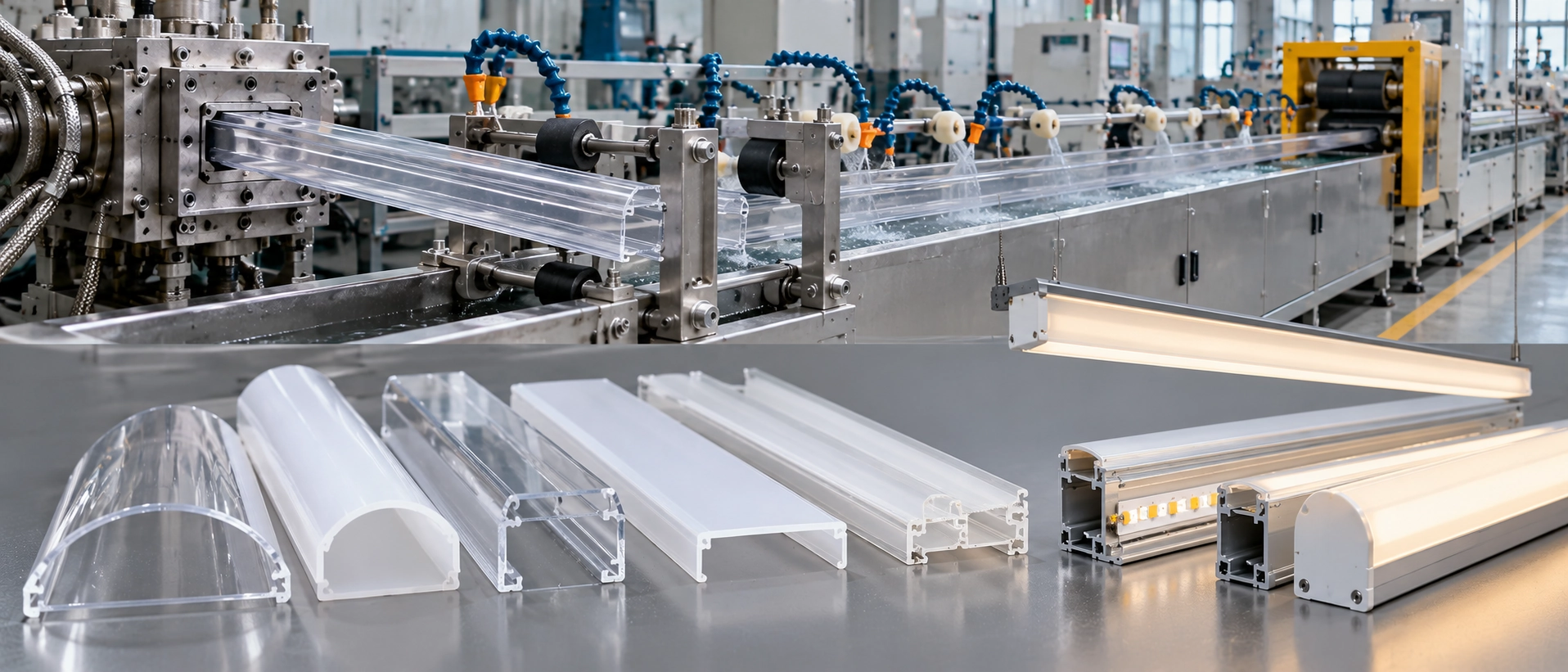
The component must perform an optical function, fit an assembly and retain the required performance under its service conditions. Dachang's product catalogue includes PC and PMMA lighting product forms, making these relevant starting points for a thermoplastic profile discussion.
Their presence in a catalogue does not decide which grade or section should be approved. The evaluation needs to connect each requirement to suitable evidence.
| Requirement | Define before comparing materials | Evidence to review |
|---|---|---|
| Optical function | Clear transmission, diffusion, concealment of individual light sources or a specified visual effect | Representative samples viewed in the intended lighting assembly |
| Assembly fit | Mating parts, mounting features and dimensions that control retention and installation | Dimensioned drawing, agreed inspection conditions and assembled samples |
| Thermal exposure | Expected conditions, exposure duration and whether the cover is loaded or constrained | Grade-specific thermal data and application-relevant checks |
| Contact environment | Cleaning agents, other chemicals, moisture and contact duration | Applicable material information and representative exposure evaluation |
| Mechanical function | Handling, installation movement and any required protective role | Checks that represent the actual section and mounting arrangement |
| Compliance requirements | Destination market, intended use and required document scope | Documentation applicable to the proposed material and finished product |
This approach also reveals what a successful sample does-and does not-prove.
A cover that clips into place at room temperature has demonstrated an initial fit. That result does not establish its behavior after exposure to heat or cleaning agents.
An attractive diffuser has demonstrated an optical result in the evaluated arrangement. It has not automatically demonstrated mechanical suitability or regulatory compliance.
Compare candidates against the same requirements and agreed conditions. Record the exact grade and sample construction so that a later material substitution can be reviewed against the evidence already collected.
The outcome should be a specific material-and-section proposal with defined acceptance checks, rather than a preference for a polymer category.
Reprocessing and Recycling Are Separate Decisions
Thermoplastic remelting creates a possible route for reprocessing, but a recycling claim also needs a practical collection system, suitable treatment and an intended use for the recovered material.
The Open University's discussion of processing degradation explains why recovered thermoplastic cannot automatically be treated as equivalent to the original material. Its next use needs an evaluation of the properties that matter for that application.
Conventional thermosets do not have the same straightforward remelting route. However, that does not eliminate all recovery options.
The U.S. Department of Energy's Wind Energy End-of-Service Guide describes mechanical recycling and thermal decomposition for composite wind turbine blades. Mechanical processing can create material for other manufacturing processes, while thermal treatment can recover glass fibers.
Those examples establish the existence of particular recovery routes. They do not establish equivalent new-product performance, local collection availability or commercial suitability for every thermoset component.

A useful recycling discussion therefore separates four questions:
- What is being collected? Identify the polymer, reinforcement, additives and other attached materials.
- Which processor will accept it? Confirm the actual product construction, not only the polymer family.
- What treatment will be used? Distinguish remelting, mechanical processing, thermal recovery and direct reuse.
- What will the output become? Identify its destination and the evidence needed for that use.
This avoids treating either "thermoplastic" as a complete recyclability claim or "thermoset" as proof that no recovery route exists.
Turning the Comparison Into a Useful Material Brief
Classification is most useful when it narrows the next technical question.
For a thermoplastic profile, that question may concern grade suitability, cooling support or the dimensions that control assembly. For a thermosetting composite section, it may concern the resin-and-reinforcement system and the curing route. For either category, final acceptance requires evidence relevant to the component's function.
Prepare a brief that includes:
- The component's purpose and proposed manufacturing route.
- A section drawing showing mating parts and critical dimensions.
- Optical, mechanical and appearance requirements.
- Temperature, chemical, moisture and outdoor exposure conditions.
- Proposed material grades and the available supporting data.
- Agreed sample checks and any required compliance documentation.
For a Dachang thermoplastic profile inquiry, use the product catalogue to identify relevant forms, then provide the drawing and application requirements. Ask which material options and section designs can be assessed, and agree what the samples must demonstrate before approving the production specification.