

A ULTEM datasheet can show 217°C, 201°C, 190°C and 170°C for the same resin. Each number answers a different question. If an engineer treats any one of them as "the operating temperature," the material can be wrong for the part. Flame ratings work the same way. A UL 94 V-0 listing is tied to a specific specimen thickness and color range. It is not a property of every part molded or extruded from that resin.
This guide explains how to read ULTEM heat and flame data grade by grade. It separates the numbers that support early material screening from the ones that still need validation on the actual part.
What Do ULTEM Material Specs Actually Describe?
ULTEM is SABIC's trade name for a family of polyetherimide (PEI) resins. The name covers many grades, not one material. These include unfilled grades such as ULTEM 1000, glass-filled grades such as ULTEM 2300 (30% glass fiber), and grades made for particular processes, such as ULTEM 9075. Their property values differ, sometimes by a lot (SABIC Material Finder).
A usable spec has three layers:
- Resin grade data: values measured on standardized test specimens under defined conditions. This is what a SABIC datasheet reports.
- Material listings: third-party records such as the UL file. Each flame and thermal-aging rating is tied to a thickness, a color range and a test basis.
- Part qualification: tests on the actual component, at its real wall thickness, geometry, processing history and service environment.
Many generic "ULTEM properties" tables give one typical value per property without the grade, specimen thickness or test condition. They are fine for a first look but not a basis for design.
How Should Engineers Read ULTEM Heat Resistance Data?
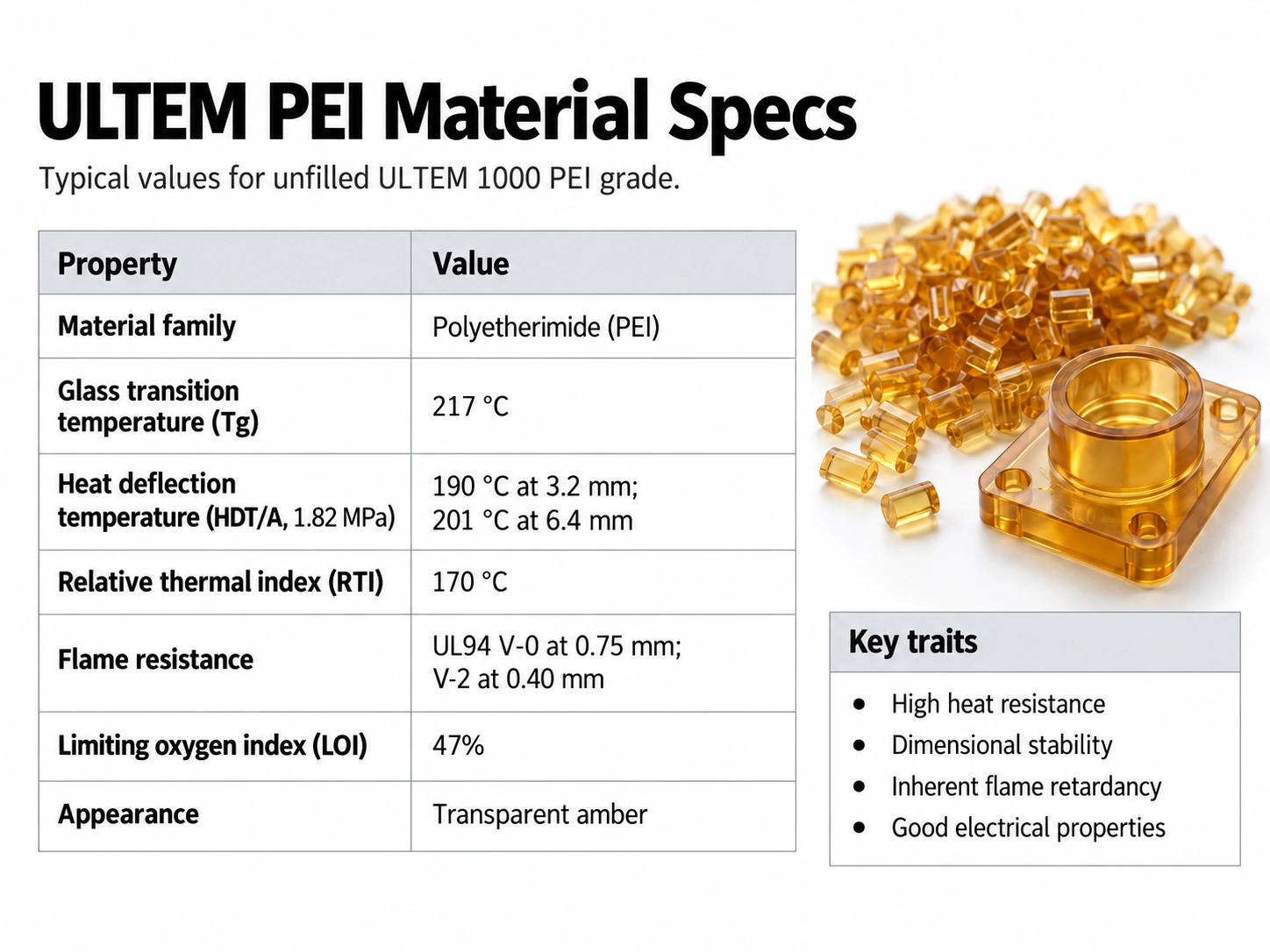
Tg, HDT and RTI answer different questions
All values in the table below are for ULTEM 1000.
| Metric | ULTEM 1000 value | Test basis | What it tells you | What it does not tell you |
|---|---|---|---|---|
| Glass transition temperature (Tg) | 217°C | SABIC grade description (test method not stated on the grade page) | Where the amorphous polymer softens sharply; an upper physical boundary | A safe continuous-use temperature |
| Heat deflection temperature (HDT) | 190°C | ASTM D648, 1.82 MPa, 3.2 mm, unannealed | Short-term deflection under a defined bending load | Long-term life under heat |
| HDT | 201°C | ASTM D648, 1.82 MPa, 6.4 mm, unannealed | Same test on a thicker bar | Long-term life under heat |
| Relative thermal index (RTI) | 170°C (electrical, mechanical impact and mechanical strength) at 0.75 mm in listed colors and at 1.5 mm in all colors; 105°C for the 0.40 mm entry | UL 746B, per UL file entry | Long-term thermal-aging limit for keeping specific properties, at the listed thickness | Behavior at thicknesses or colors outside the listing, or under sustained mechanical load |
Sources: SABIC Material Finder – ULTEM 1000; UL Product iQ – ULTEM 1000 listing.

Tg (217°C) marks the change from a glassy to a rubbery state. Stiffness drops steeply as the material approaches Tg, so engineering designs stay well below it. Tg is a ceiling, not a working temperature.
HDT is a short-term test. A specimen carries a fixed bending stress while the temperature rises, and the result is the temperature at which it deflects by a set amount. ASTM D648 notes that the result should not be used on its own to predict long-term behavior at elevated temperature (ASTM International). In ULTEM 1000 under the same load, a 3.2 mm bar reads 190°C and a 6.4 mm bar reads 201°C. An HDT value is incomplete without its stress level and specimen thickness.
RTI comes from long-term heat aging under UL 746B. It is the temperature at which the material keeps a defined fraction of a property, such as dielectric strength, impact strength or tensile strength, over an extended period. UL lists separate RTIs for electrical, mechanical-with-impact and mechanical-without-impact properties, and each entry applies to a specific thickness. For ULTEM 1000, the 170°C values apply at 0.75 mm (listed colors) and 1.5 mm (all colors). The thinner 0.40 mm entry carries 105°C for all three. The aging tests are run without mechanical load. RTI is the closest of the three numbers to a long-term thermal limit, but it does not cover creep under sustained stress.
Why different websites list different values
Sources often disagree. One published comparison table lists ULTEM 1000 Tg as 210°C, while SABIC's current grade page lists 217°C (Plastic Machining Inc.). The published pages do not explain the gap. Do not try to reconcile values like these and do not average them. Use the resin producer's current datasheet for the exact grade you plan to buy, and record the source and revision date in your specification.
What Do ULTEM Flame Ratings Actually Prove?
UL 94 ratings are thickness-specific
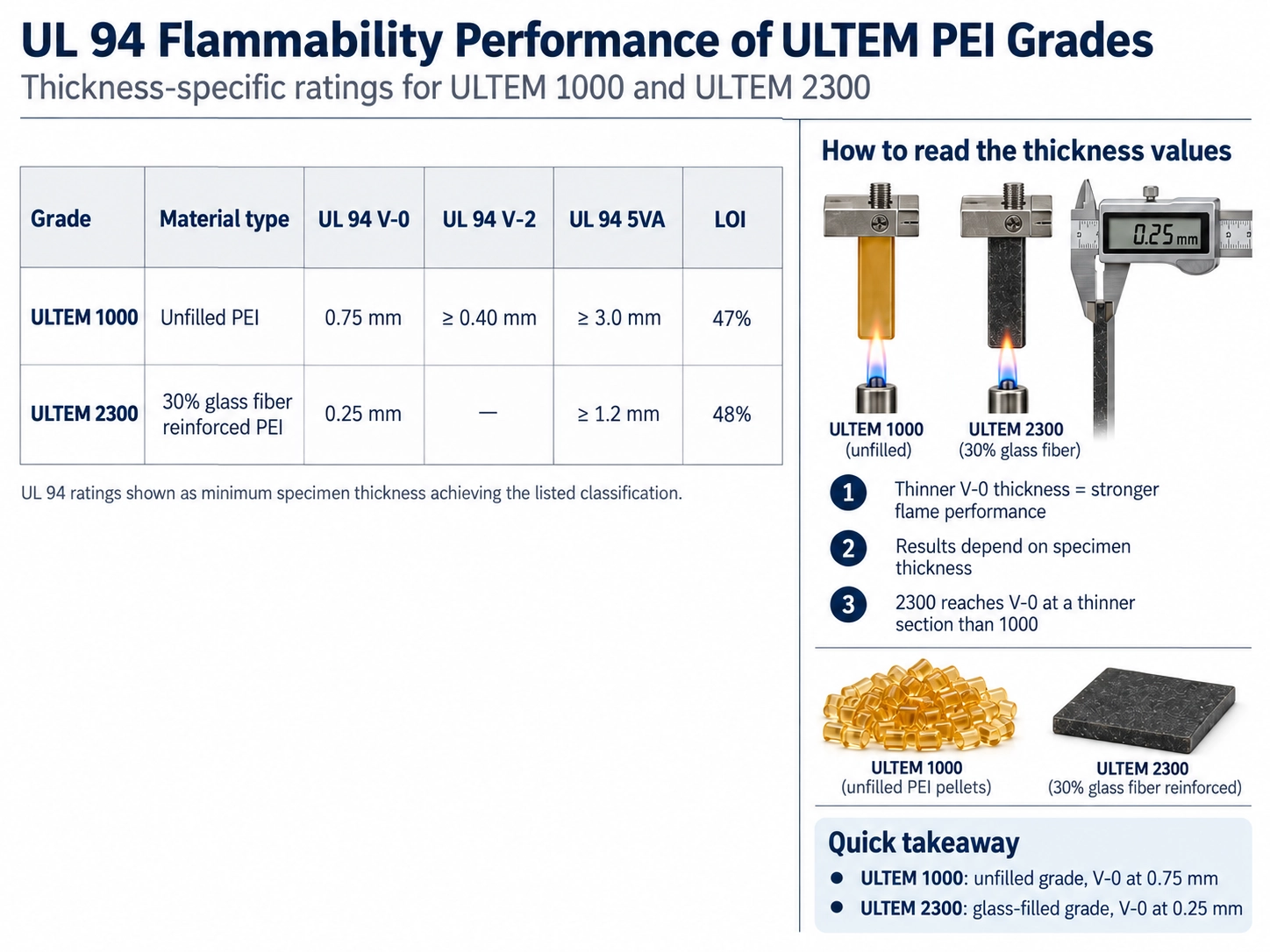
UL 94 is a small-scale burning test on standard specimens. For ULTEM 1000, SABIC lists V-0 at 0.75 mm and 5VA at 3 mm and above (SABIC Material Finder). The UL listing narrows this further. V-0 at 0.75 mm applies only to the color ranges listed in the UL file, V-0 at 1.5 mm applies to all colors, and the 0.40 mm entry is rated V-2, not V-0 (UL Product iQ).
Confirm three points before citing a flame rating in a specification:
- The minimum thickness in the listing is at or below the thinnest wall of your part.
- Your color is covered by that listing entry.
- The grade and listing file match the material you will actually purchase.
Reading a UL listing: the thin-wall trap
The ULTEM 2300 listing shows why thickness, flammability and thermal aging have to be read together (UL Product iQ – ULTEM 2300):
| Thickness | UL 94 | RTI electrical | RTI mechanical (with impact) | RTI mechanical (without impact) |
|---|---|---|---|---|
| 0.25 mm | V-0 | 105°C | 105°C | 105°C |
| 1.5 mm | V-0 | 180°C | 170°C | 180°C |
A summary sheet may show "V-0 at 0.25 mm" and "RTI 180°C" side by side. A designer could then conclude that a 0.25 mm part will run safely at 180°C over the long term. The listing does not support that. At 0.25 mm all three RTIs are 105°C. Even at 1.5 mm, a part that must survive mechanical impact is governed by the 170°C impact RTI, not the 180°C figures. The part has to fit the flammability record and the thermal-aging record at its own thickness, for the property that matters in service.
What a material listing is not
A UL material record tells an engineer how the plastic performs under specific test conditions. It does not certify a finished product. End products are evaluated under their own standards, and some of those include larger-scale fire tests (UL Solutions).
How Do ULTEM 1000 and 2300 Differ?
| Property | ULTEM 1000 (unfilled) | ULTEM 2300 (30% glass fiber) | Source |
|---|---|---|---|
| HDT, ASTM D648, 1.82 MPa, 3.2 mm, unannealed | 190°C | 211°C | SABIC |
| Flexural modulus, ISO 178, 2 mm/min | 3,300 MPa | 9,600 MPa | SABIC |
| Tensile strain at break, ISO 527 | 50% (50 mm/min) | 2.4% (5 mm/min) | SABIC |
| Thinnest V-0 listing | 0.75 mm (listed colors) | 0.25 mm | UL Product iQ |
| RTI at 1.5 mm (elec / impact / strength) | 170 / 170 / 170°C | 180 / 170 / 180°C | UL Product iQ |
| CTE, ISO 11359-2, −40°C to 150°C | 5.2×10⁻⁵/°C, flow and cross-flow | 1.8×10⁻⁵/°C flow; 4.8×10⁻⁵/°C cross-flow | SABIC |
Sources: SABIC – ULTEM 2300; SABIC – ULTEM 1000; UL listings linked above. All SABIC values are typical values on standard molded specimens, not guaranteed properties of a finished part. SABIC reports the two strain-at-break values at different test speeds, so treat the comparison as indicative.
Glass reinforcement roughly triples flexural stiffness and raises HDT. It also cuts elongation at break from tens of percent to a few percent, and it does not raise the impact RTI at 1.5 mm. The other trade-off is direction. ULTEM 1000 expands about equally in all directions. ULTEM 2300 expands more than twice as much across the flow as along it.
These CTE figures come from molded specimens. In an extruded profile, fiber orientation can be influenced by the cross-section geometry, local flow and processing conditions, so the real orientation and expansion are not known until they are measured on representative samples. In a long profile, or one fixed at both ends, directional expansion can cause warpage or stress at the fixing points during temperature cycling. The choice between unfilled and glass-filled grades depends on geometry, constraint, loading direction and the toughness the part needs. A higher HDT alone does not decide it.
Where Do Flame and Heat Ratings Stop Being Enough?
Datasheet values are a necessary filter, but they cannot reproduce every service condition. Three gaps come up most often:
- Combined stress. Heat, mechanical load and chemicals interact. ULTEM is susceptible to environmental stress cracking with certain solvents, including MEK (Curbell Plastics). A part that passes thermal and flame screening can still crack under assembly stress when exposed to a cleaning agent. Test these conditions together.
- Sector-specific fire requirements. UL 94 does not replace application standards. Aircraft cabin interiors, for example, are evaluated under requirements such as FAR 25.853, which cover different fire behaviors. A V-0 rating does not show compliance with them.
- Long-term load at temperature. HDT is a short-term test, and RTI aging is done without load. For parts carrying sustained load near their thermal limit, check creep data or run part-level tests.
A published application shows how selection works in practice. SABIC reports that Ushio used ULTEM 1000 for the inner housing of its Care222 far UV-C module, choosing the material on mechanical, flame and service-environment requirements together (SABIC). This is a resin producer's case study of an injection-molded part. It shows how a selection decision is made. It does not show how an extruded part will perform.
What Changes When ULTEM Is Used in an Extruded Profile?
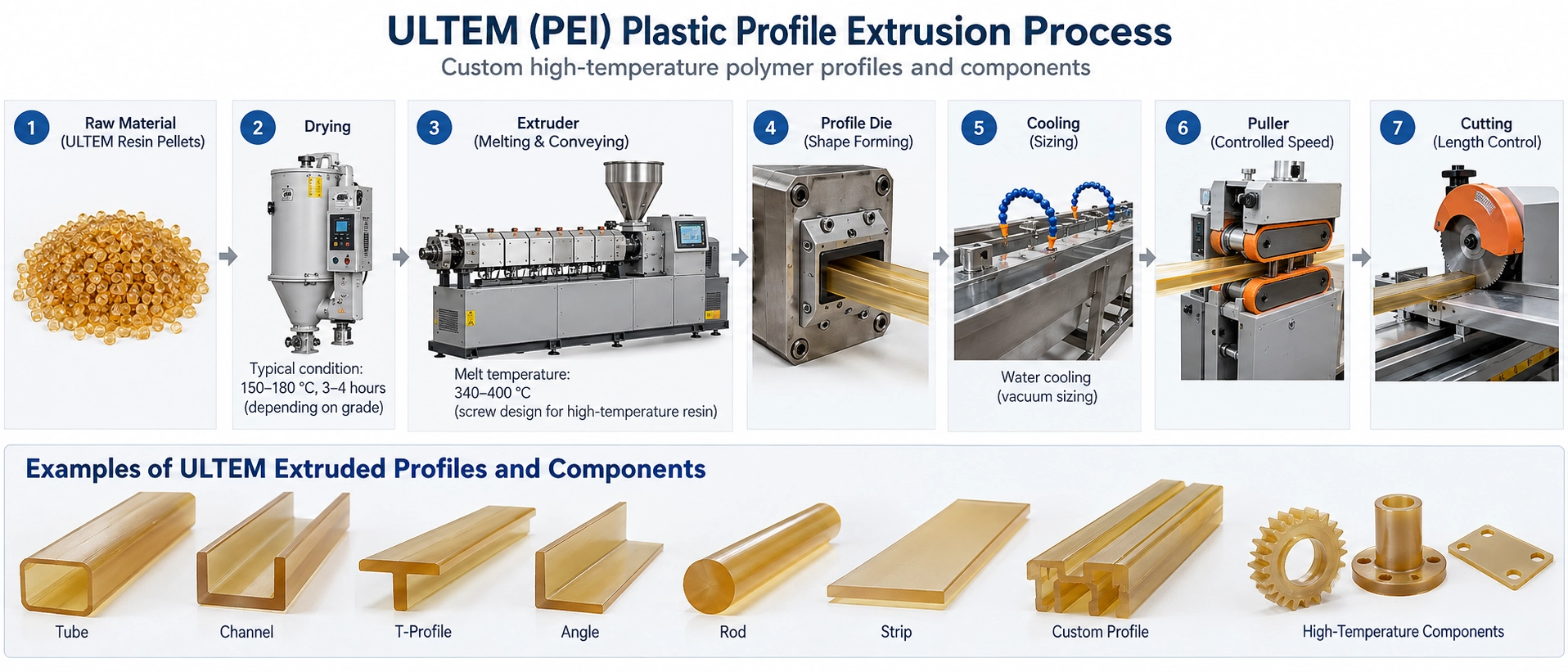
The grade data cited in this guide comes from standardized molded test specimens. A continuous extruded profile has a different thermal and stress history, so the resin datasheet does not automatically describe it.
Choose the grade first. SABIC publishes profile-extrusion processing guidance for ULTEM 9075, which it describes as a PEI blend: drying at 130–140°C for 4–6 hours to a maximum moisture content of 0.02%, and a melt temperature of 295–330°C (SABIC – ULTEM 9075). These conditions apply to ULTEM 9075 only. Do not transfer them to ULTEM 1000, 2300 or other grades, and confirm them against the current regional datasheet before use. A published processing window shows that the grade is intended for this process. It does not show that any particular production line can run it consistently.
To validate extruded samples, separate three levels of evidence: resin data for screening, sample acceptance for the process, and end-product testing for compliance. At sample level, check:
- Material traceability: grade, lot number and drying records for the resin used in the samples.
- Critical dimensions: thinnest wall, corners and mating features, measured at defined sampling positions along the length.
- Listing fit: the thinnest measured wall is at or above the minimum thickness of the UL entry you rely on, in the color you will produce.
- Thermal cycling: warpage and dimensional change after cycling through the expected service range, with the profile fixed the way it will be installed.
- Stress at fixing points: cracking or deformation near fasteners and clamps, including after exposure to the cleaners or fluids the part will meet.
- End-product tests: the flame, electrical or sector-specific tests the finished assembly needs, scheduled on parts made by the final process.
Pass/fail limits for each check come from the drawing, the customer specification and the applicable standard, not from the resin datasheet.
When temperature and flame requirements are moderate, other materials may be worth comparing. Examples are the properties of rigid polycarbonate profile materials and flame-resistant polycarbonate extrusion profiles, which are evaluated against a target UL 94 rating and wall thickness. Any comparison must use like-for-like test data. PC and PEI sit in different thermal classes.
What Should Be Verified Before Approving a ULTEM Grade?
| Check | Question to answer | Evidence to obtain |
|---|---|---|
| Grade | Is the exact grade named, not just "ULTEM"? | Current SABIC TDS for that grade |
| Continuous temperature | Is the continuous service temperature below the RTI for the property that matters (electrical, impact or strength), at the part's thickness and color, with margin? | UL listing entry; applicable end-product standard |
| Short-term peaks | How high and how long are temperature excursions, and is the part loaded during them? | HDT at the stated stress and thickness; part-level tests at peak conditions |
| Load at temperature | Is sustained load present near the thermal limit? | Creep data; part testing |
| Flame | Does the thinnest wall meet the UL 94 minimum thickness? Is the color covered? | UL Product iQ entry |
| Application standard | Do sector rules (aircraft, electrical equipment, building) apply? | Applicable end-product standard |
| Chemicals | Which fluids, cleaners or adhesives contact the part under stress? | Chemical resistance data; ESC testing |
| Geometry | Do glass orientation and anisotropic expansion matter for this shape? | CTE data; expansion measured on the part |
| Process | Was the data generated on the same process as the final part? | Tests on samples made by the final process |
How Should an OEM Prepare a Material Feasibility Review?
A feasibility review goes faster when the supplier gets the full set of conditions at the start:
- A drawing or cross-section with critical dimensions and the thinnest wall
- Operating temperature profile: peak, continuous and cycling
- Mechanical loads and how the part is fixed
- Flame requirement, with the target standard and thickness
- Chemical exposure during cleaning, assembly and service
- Candidate grades and any customer-mandated resin
- Expected annual volume and the validation tests required
Next step: If you are developing a continuous profile for a high-temperature or flame-rated application, send your drawing and the conditions above for a custom plastic profile extrusion feasibility review. The review covers material options, cross-section design and the validation steps your application needs.