

Polyethylene Extrusion: HDPE and LDPE Tubing
Polyethylene extrusion forms continuous PE tubing from molten resin. HDPE generally offers greater stiffness, while LDPE provides a more flexible starting point. These tendencies help shortlist a material; the finished tube still needs verification against its dimensions, connections and service conditions.
For an OEM engineer, the useful decision is more specific than choosing "hard" or "soft" PE. Identify what the tube must do, select a grade for evaluation, and define what the sample must demonstrate before approval.
Define the Tubing Scope Before Selecting a Resin
This article focuses on custom PE tubing for equipment water lines, pickup tubes and general industrial fluid transfer. It covers material selection and the evidence needed to review the finished tube. Film extrusion, extrusion coating and equipment purchasing involve different tasks and fall outside this scope.
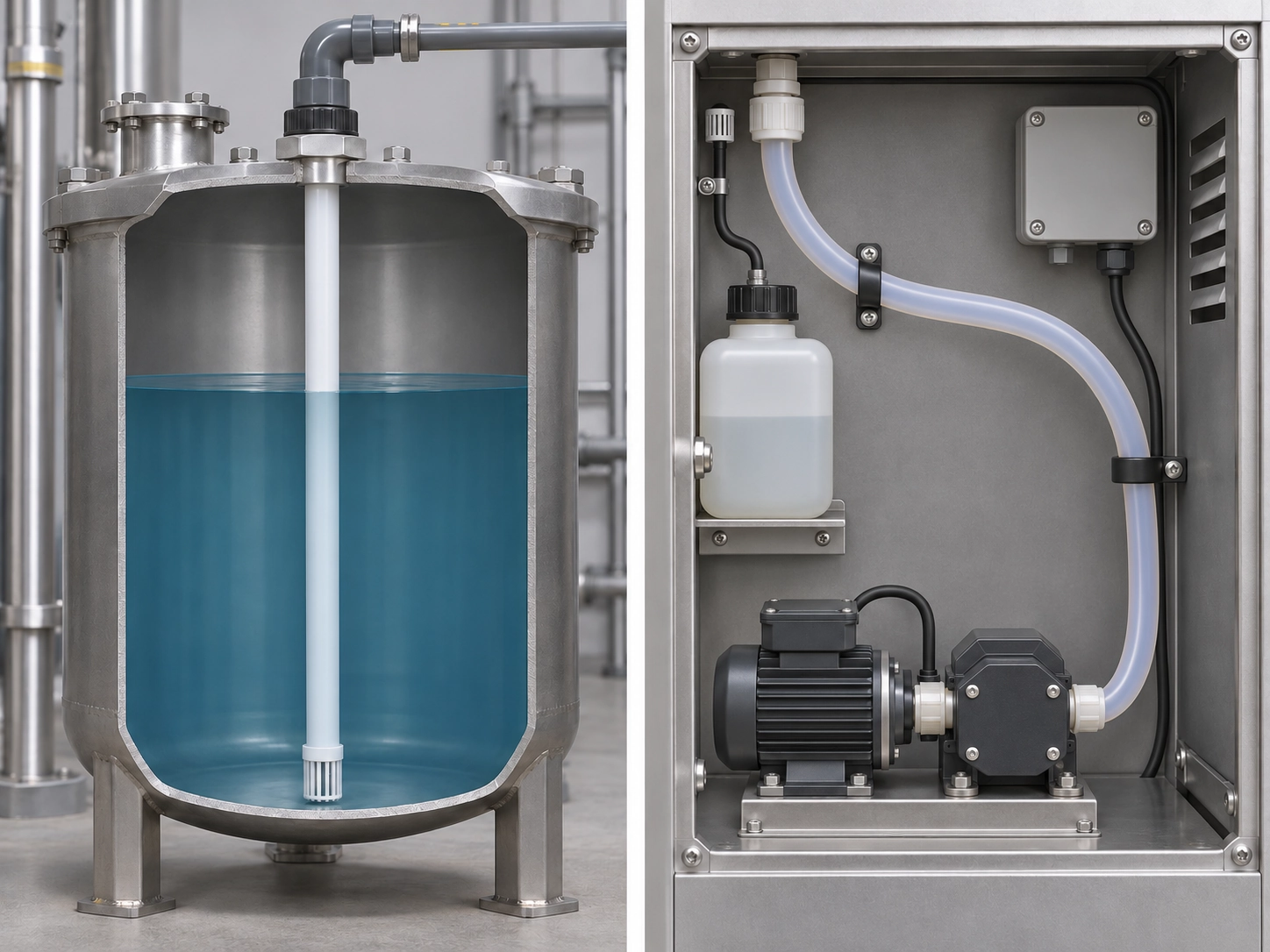
Start with the installed function. A pickup tube may need to keep its inlet at a defined position inside a vessel. A routed line may need to pass through a confined enclosure without restricting the bore or interfering with its fittings. These requirements provide the basis for comparing candidates and planning an assembly trial.
How HDPE and LDPE Change Tube Performance
Rigidity, Flexibility and Grade Selection
Higher PE density generally increases stiffness, but density alone does not establish suitability or stress-crack resistance. Molecular weight and molecular weight distribution also influence performance. The Plastics Pipe Institute's 2008 material-properties chapter explains these relationships; they support initial screening rather than a universal ranking of finished tubes.
Use the following proposed sample checks to connect that screening decision to the application. The project drawing or test plan must define the acceptable results.
| Application need | Initial material direction | Sample check and decision |
|---|---|---|
| Keep a pickup inlet in a defined position | Consider an HDPE grade where greater stiffness is needed | Install the intended length with its actual supports. Check whether the inlet stays within the specified position; an assembly outside that limit needs revision before approval. |
| Route a line through a confined enclosure | Consider an LDPE grade where flexibility is needed | Follow the intended path and tightest required bend. Check for kinking, bore flattening and interference; assess the result against the agreed flow and assembly requirements. |
| Connect the tube to a specified fitting | Keep either candidate open until the connection is evaluated | Use the intended fitting and assembly method. Verify fit, retention and sealing under the defined service conditions. |
| Handle a particular fluid, cleaner or pressure duty | Keep the grade decision open | Require evidence for the proposed grade, tube and installed conditions. A family name cannot complete this decision. |
A candidate that bends into place still needs connection and service checks. Likewise, a stiff sample that holds its position has not demonstrated chemical compatibility or pressure capability. Keep each approval tied to the requirement actually evaluated.
Why the Resin Name Is Not a Finished Specification
"HDPE" and "LDPE" identify material families. A reviewable material selection identifies the resin manufacturer, complete grade designation, color formulation and permitted substitutions.
When comparing technical data sheets, use a short comparison record:
- Record the complete grade name and document revision or date, where available. Retain suffixes and the supplier's description of the intended processing application.
- Identify the proposed color and additive requirements. Resolve differences between the data-sheet material and the formulation proposed for the tube.
- Compare each relevant property with its test method, units and conditions beside it. For melt flow rate or melt index, retain the test temperature and load; values measured under different conditions are not directly comparable.
- Record which application requirements still need finished-tube evidence. Treat a proposed grade or formulation substitution as a change requiring review against those requirements.
PPI describes melt flow as a test under specified conditions. It does not provide a finished tube's pressure rating. Matching density or melt-flow values also does not establish that two grades are equivalent.
For the wider distinction between material names and purchasing specifications, see our explanation of resin families, compounds and grades.
How Forming, Sizing and Cooling Affect Tube Dimensions
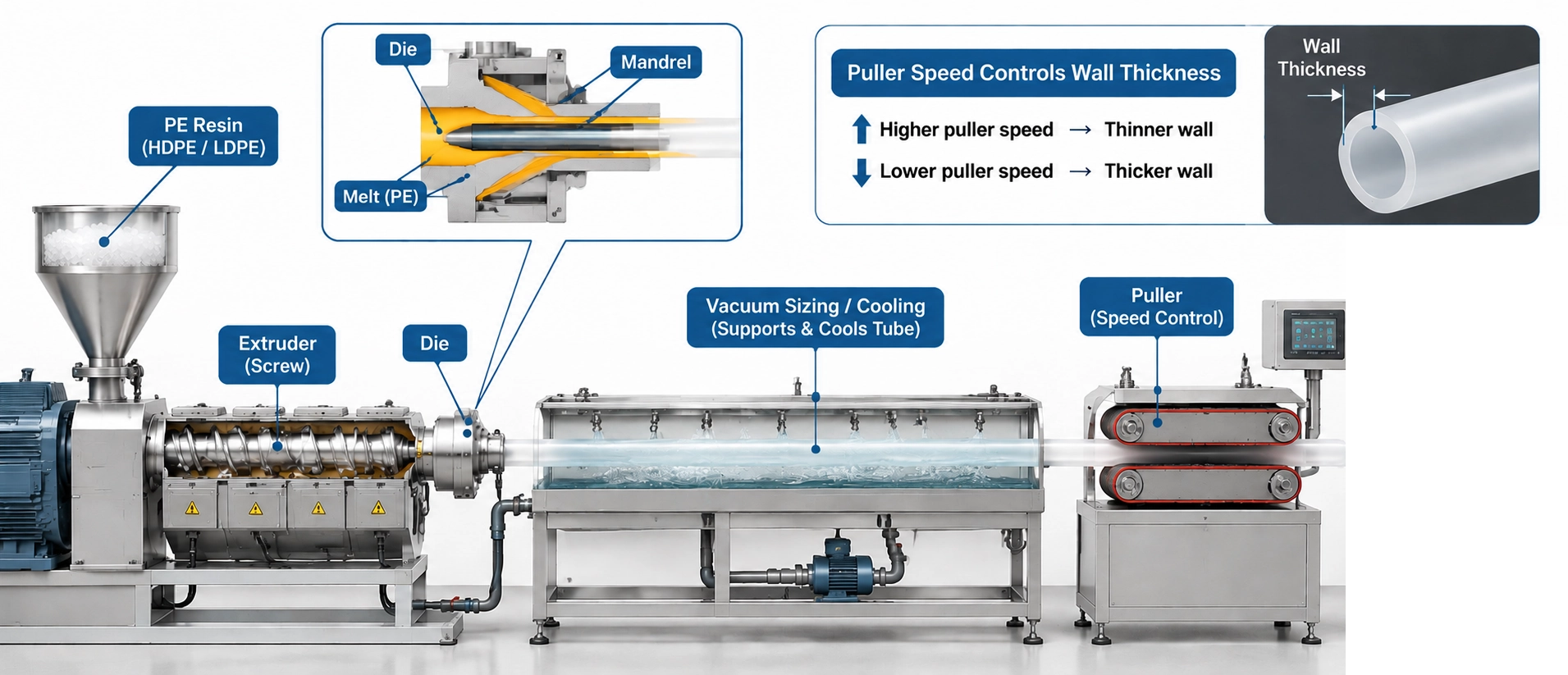
For solid-wall PE tubing, the die distributes melt around a mandrel to form the hollow section. Sizing supports the tube geometry during cooling, while the puller speed, considered together with extruder screw speed, affects the finished wall thickness. The PPI manufacturing chapter, published in 2008, describes these principles for PE pipe. Its equipment arrangements and operating settings should not be transferred directly to a small custom tube.
For sample approval, evaluate the cooled tube against the drawing. A die dimension or a resin data sheet cannot substitute for measurements of the finished section. If the selected grade or formulation changes, review the affected sample requirements before accepting the replacement.
Control OD, Wall and Ovality Together
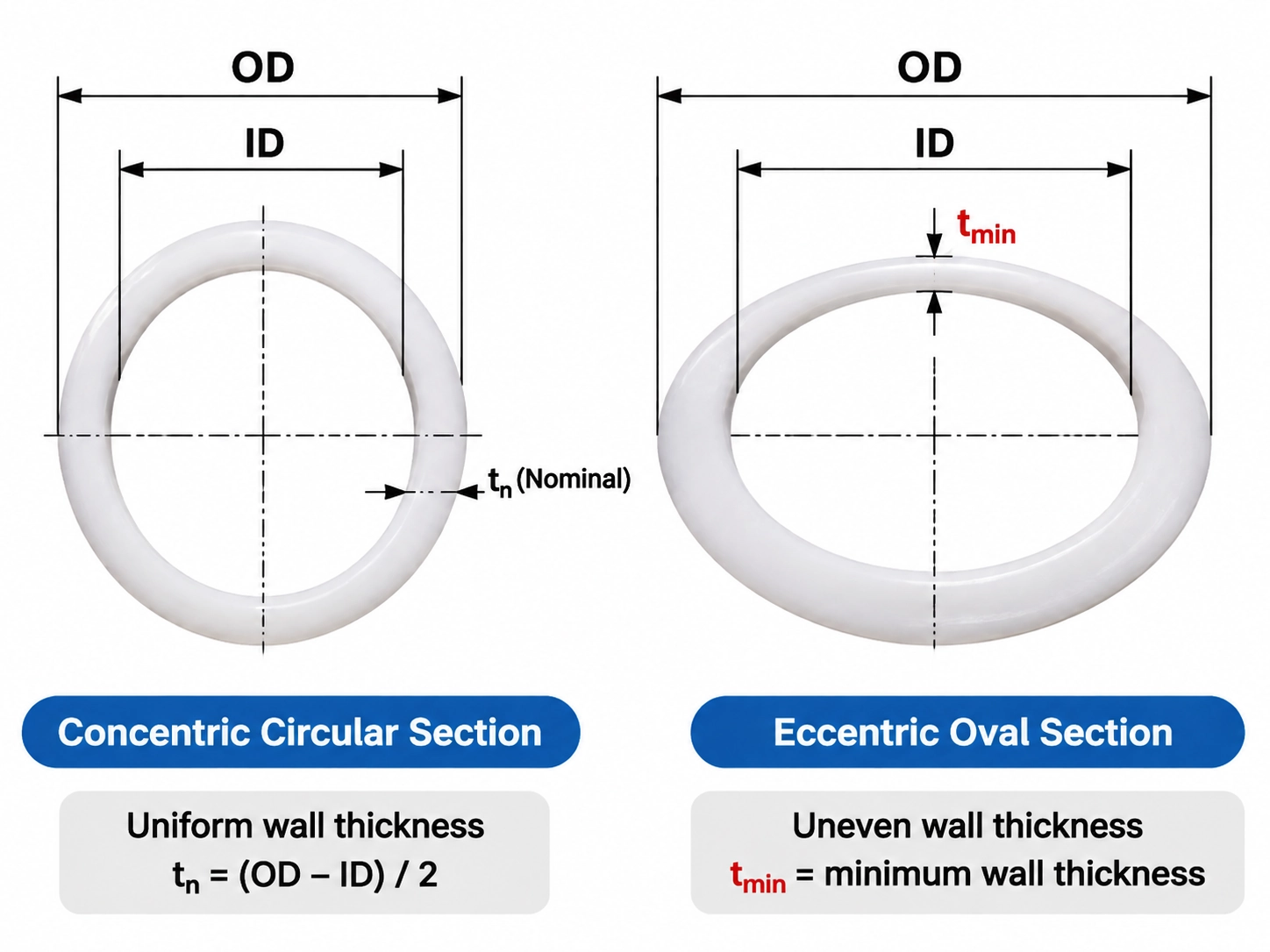
Outside diameter (OD), inside diameter (ID) and wall thickness are related. For an ideal concentric circular section, nominal wall thickness calculated from the specified OD and ID is (OD − ID) / 2. For an eccentric section, that calculation does not identify the thinnest wall. Keep nominal wall and measured minimum wall distinct.
Specify which dimensions control fitting engagement, bore clearance and wall acceptance. Include ovality, with its definition and measurement method, where it affects the application. For a flexible sample, record the inspection condition and support arrangement so supplier and customer results refer to the same state.
These checks establish what to measure; they do not establish a universal PE tubing tolerance. Our tube dimensions and acceptance requirements guide provides the detailed drawing and inspection workflow.
Check the Service Conditions Before Approving PE Tubing
Media, Stress and Temperature
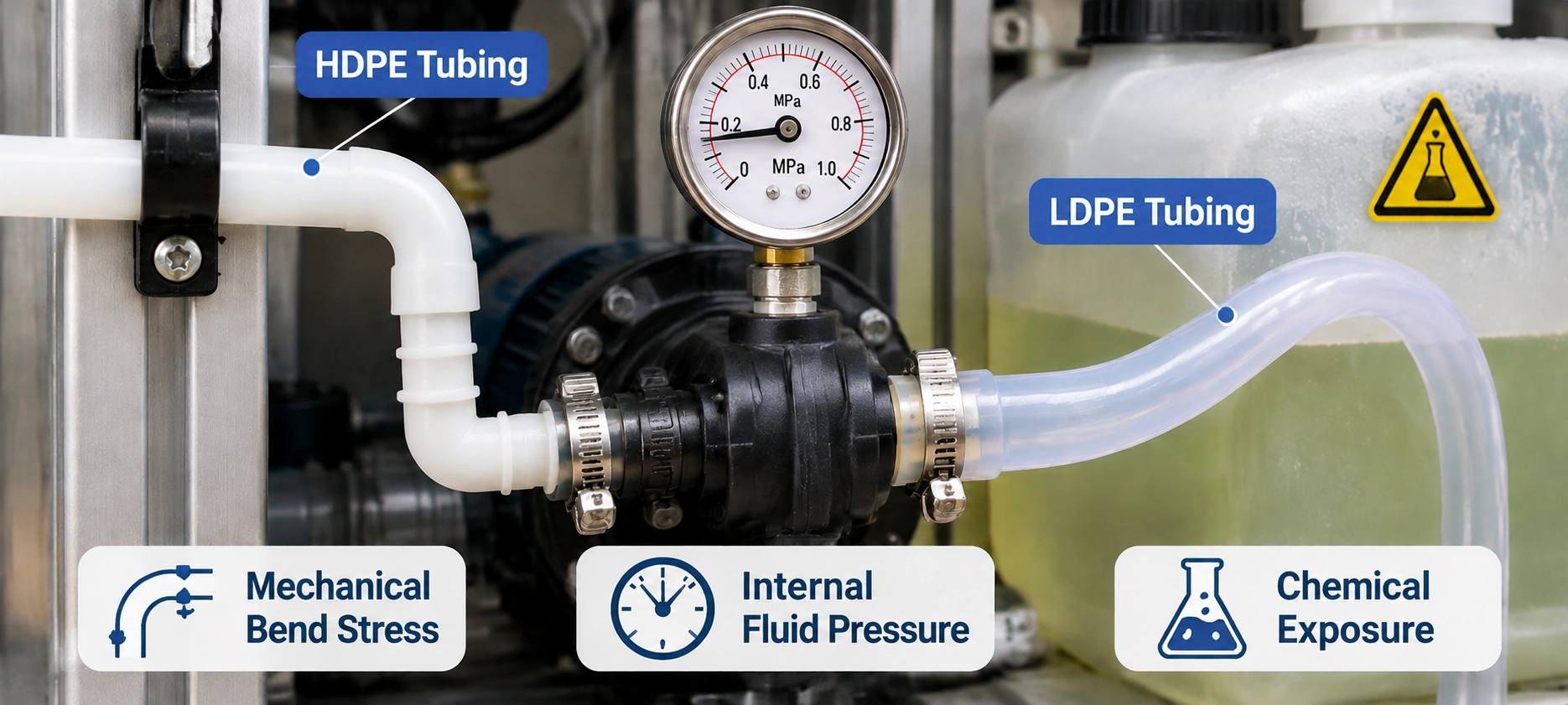
Review chemical exposure together with mechanical loading. The public guidance for ASTM D1693-21 describes environmental stress-cracking under specified conditions and cautions against directly applying the results to engineering problems. A material test result cannot by itself establish the service life of an installed tube.
Describe the fluid and concentration, operating temperature, cleaning exposure and contact duration. Then identify the installed loading, including bends and connections. A straight immersed sample and a tube held in a loaded assembly answer different verification questions.
For a pickup tube, include the actual support and end position in the proposed assessment. For a routed line, include the installed bend and fitting arrangement. The responsible engineer should select representative conditions, duration and acceptance criteria; a general chemical-resistance statement cannot replace that assessment.
Pressure and Fittings Need Product Evidence
There is no single working-pressure value for all HDPE tubing or all LDPE tubing. As a commercial product example, Parker's PE tubing data sheet provides pressure-temperature curves for specified tube sizes and relates performance to the fluid and fittings. It also distinguishes LDPE from its partially crosslinked Advanced PE product. These are Parker product data, with no clear revision date shown in the document; they are not Dachang specifications.
For a custom tube, define normal pressure, temporary peaks, temperature and any vacuum duty separately. Request evidence covering the proposed tube dimensions and connection assembly. Identify whether each result concerns a short test, sustained exposure or cycling, and compare it only with the requirement it addresses.
A standard designation also needs a scope check. The public scope of ASTM D2737-26 concerns PE tubing pressure-rated for water. It does not establish that every custom PE tube falls within that scope or complies with the standard. Food-contact or drinking-water approval also requires documentation applicable to the proposed material, formulation, intended use, contact conditions and destination market.
Build a PE Tubing Specification That Can Be Verified
Before approving a sample, connect the material selection to four decisions. This is a proposed review structure, rather than a claim that a supplier has completed the checks.
| Approval decision | Evidence to keep with the sample | What remains open if it is missing |
|---|---|---|
| Which PE material was evaluated? | Manufacturer, complete grade, color/additive identification and agreed substitution terms | Material identity and the basis for reviewing a replacement |
| Does the cooled tube meet the functional geometry? | Drawing revision and results for the controlling dimensions, minimum wall and relevant ovality requirements | Dimensional acceptance for the intended installation |
| Does the assembly meet its defined service conditions? | Relevant compatibility, connection and operating-condition evidence, with methods and limits | Suitability for requirements not covered by the available tests |
| Is the proposed production supply represented by the approved sample? | Sample reference and material/formulation identification, with changes recorded for review | Whether the approval applies to the proposed supply |
Keep material documents, dimensional inspection and assembly testing separate in the approval record. A resin data sheet describes its identified material under stated test conditions. A dimensional report covers the inspected samples. An assembly report covers the tested tube, connections and conditions.
If only an assembly-fit trial is complete, record that limited approval and leave service acceptance open. This allows useful sample work to proceed without presenting untested requirements as satisfied.
Discuss Your PE Tubing Requirements With Dachang
Dachang's PE tube category includes PE siphon tubing for water-dispenser applications. The published product page lists cut pieces and special length, size and color options, and shows a special-angle cutting example. It identifies the material as PE without specifying an HDPE or LDPE grade. The grade and suitability of a new project therefore need confirmation.
Send your PE tubing requirements to Dachang for a project and quotation discussion. Include the drawing, preferred grade if already selected, fluid and cleaning exposure, temperature, pressure or vacuum duty, fittings, and sample acceptance requirements. Ask which material and dimensions can be proposed and what supporting evidence is available before treating the proposal as an approved tube specification.