

When sourcing co-extrusion and tri-extrusion profiles, start with what each material zone must do. Then ask suppliers to explain the proposed grades, interfaces, tooling scope and sample acceptance plan. A process name or a photograph cannot establish whether the profile will meet your assembly requirements.
This guide helps OEM purchasing, engineering and quality teams prepare comparable requests for quotation and decide what evidence to request before approving a custom industrial profile. It is published by Dachang as a supplier-side purchasing guide; the checklists are suggested project documents, not a material compatibility guarantee or an industry standard.
Define What Each Material Zone Must Do
Mark the functional areas on the cross-section before asking for a material recommendation. Identify the surfaces that locate the part, contact the mating component, provide a seal or remain visible after assembly. A requirement such as "a rigid carrier with a flexible lip" is more useful than "a two-color extrusion," because it gives the supplier a function to evaluate.
Use a table like this alongside the drawing. The entries below are design prompts, not an approved material selection.
| Drawing zone | Intended function | Material information to complete | Requirement to define |
|---|---|---|---|
| Carrier or mounting area | Locate and support the profile | Proposed grade and supplier; approved alternatives, if any | Mating geometry, load and critical dimensions |
| Contact lip or rib, if needed | Deflect against a mating surface | Proposed flexible compound and hardness requirement | Contact position, available movement and service conditions |
| Exposed surface, if needed | Provide the specified finish or surface function | Proposed surface grade and color formulation | Coverage, appearance reference and relevant exposure |
| Internal interface, if needed | Join adjacent material zones | Direct bond, tie material or other proposed retention arrangement | Evidence and acceptance method for that interface |


Clarify Co-Extrusion and Tri-Extrusion Terminology
Co-extrusion brings separate polymer melt streams together in a die or extrusion head to form one continuous product. In its January 22, 2026 process article, KRAIBURG TPE describes the process and illustrates a hard PVC core with a TPE sealing rib. This is a material supplier's application example, not proof that every PVC and TPE grade will bond. (KRAIBURG TPE)
In supplier discussions, co-extrusion often refers to a two-stream arrangement, while tri-extrusion identifies a three-stream proposal. Broader technical usage also includes structures with more streams under co-extrusion. For purchasing, resolve the terminology by requesting a marked cross-section and a description of each feed, formulation and material region. Do not make the equipment configuration a conclusion drawn from the number of visible colors.
Decide Whether Another Melt Stream Is Needed
Add a material stream when it addresses a requirement that the simpler proposal does not meet. Ask the supplier to state that requirement and how it will be checked. A third stream should have a defined purpose; the word "tri-extrusion" alone is not a performance advantage.
Consider three different purchasing situations. If one grade can satisfy the mounting and surface requirements, request a single-material proposal as a baseline. If the part needs a rigid carrier and a deformable sealing area, investigate a suitable two-material design. If a further interface or surface requirement remains unresolved, ask whether an additional stream is justified.
A third stream may serve an internal bonding function rather than create another exposed feature. Spectrum's technical article explains tie layers in multilayer medical tubing. That example supports the interface concept; its tubing dimensions, pressure values and construction are not specifications for an industrial profile. (Spectrum)
Compare Integrated Profiles with Separate Parts
Compare the proposed integrated profile with the assembled alternative against the same requirements.
| Proposal | When to investigate it | What the quotation and trial must resolve |
|---|---|---|
| Single-material profile | One grade may meet the required functions | Whether geometry and material selection deliver the required fit and service performance |
| Co-extruded profile | Distinct areas need different properties | Proposed grades, zone placement and interface performance |
| Tri-extruded profile | A further material function or interface needs a separate stream | Why the extra stream is needed and how its contribution will be verified |
| Separate carrier and seal or trim | Independent replacement, sourcing or adjustment is useful | Retention, assembly work, part availability and responsibility for fit |
Use the total quoted scope to compare costs: development and tooling, materials, production and changeovers, secondary work, inspection, assembly, packaging and logistics. Include agreed rework and retrial responsibilities. An integrated part may remove an assembly operation, but that does not establish a lower total cost without comparable quotations and project assumptions.
If the design includes a pre-existing wire or metal reinforcement, describe that core separately. The explanation of crosshead coating around a pre-existing core helps distinguish the substrate from the polymer feeds. Core handling and the number of melt streams are separate questions to resolve in the proposed construction.
Qualify the Proposed Material Combination
A supplier's list of materials is a starting point for a discussion. Ask for the actual grades proposed for your cross-section and the evidence relevant to their combination.
For example, a hard PVC carrier with a TPE lip gives each region a distinct role. The purchase specification still needs the selected compounds, interface arrangement and service requirements. Likewise, an acrylic surface over an ABS base needs a defined coverage area and grade combination. These descriptions establish design questions, not interchangeable recipes.
Ask for Grades and Interface Evidence
Request a written material proposal covering:
- The manufacturer and grade for each region, including any tie material.
- Colorants, additives and any proposed recycled content, with approval requirements for changes.
- The service temperature range, exposure, contact conditions and mating materials the supplier has assessed.
- The intended interface mechanism and the evidence available for the proposed combination.
- Unresolved processing or geometry questions that require a trial.
Spectrum discusses differences in polymer flow behavior and interlayer adhesion in multilayer tubing. For a profile buyer, the useful implication is to ask separately about material selection, zone distribution and interface verification, rather than accept a resin name as evidence for all three. (Spectrum)
Separate a supplier's previous work into what transfers and what remains unproven. A sample using different grades, section geometry or exposure conditions can inform the development discussion; it does not automatically qualify the new part.
For the ABS/PMMA case, the guide to evaluating an acrylic-capped ABS profile explains why sheet data and a custom profile need separate consideration. Ask which submitted evidence concerns the resin, which concerns another product form and which comes from the proposed profile itself.
Build an RFQ That Suppliers Can Quote Consistently
Send the same drawing revision, functional requirements and quantity basis to every shortlisted supplier. Ask each supplier to identify deviations and assumptions explicitly. A quotation based on an alternative grade or excluded inspection is a different proposal, even when the part number is the same.
Use this co-extrusion profile RFQ checklist as a working document. Complete unknown fields with the responsible person and a resolution date; an unanswered item should remain visible.
| RFQ field | Buyer information | Supplier response to request |
|---|---|---|
| Part identification | Part number, drawing revision and relevant CAD files | Revision quoted; missing information and assumptions |
| Functional zones | Marked cross-section and function of each region | Proposed feeds, grades and zone arrangement |
| Service and mating parts | Exposure, temperature range, load, contact conditions and assembly drawing | Assessment boundaries and proposed validation |
| Dimensions and lengths | Critical features, datums, cut lengths and inspection conditions | Feasible tolerances and measurement proposal |
| Appearance | Visible faces, color reference and unacceptable defect locations | Appearance assessment and reference-sample proposal |
| Demand | Annual estimate, release quantities and delivery pattern | Pricing basis, minimum run assumptions and validity |
| Secondary work and packaging | Holes, notches, joining, tape, protection and packing requirements | Included operations, subcontracted work and exclusions |
| Tooling | Ownership, maintenance, modification and transfer expectations | Included tools, ownership terms and modification boundaries |
| Trials and acceptance | Required sample form, validation responsibilities and acceptance documents | Trial scope, evidence supplied and retrial terms |
| Production control | Traceability and change-notification requirements | Records available and proposed approval process |
Separate Tooling, Trials and Production Scope
Ask for development charges, tooling, trial material, samples and production pricing to be identified separately. Confirm whether the quotation includes secondary-operation fixtures and inspection gauges as well as the extrusion tooling.
Clarify what happens if the first trial misses an agreed requirement. Which changes are included, which require another quotation, and who approves a revised drawing or material proposal? Record whether the delivery estimate starts from drawing approval, payment, material availability or another stated event.
Keep the quantity basis visible when comparing prices per length, per piece or per mass. Where conversion is needed, use the quoted finished length and documented mass basis, including the treatment of cutting loss. Do not rank unlike prices as though their scope were identical.
Agree on Sample Acceptance Before the Trial
Write the acceptance plan before producing the approval samples. It should identify what will be measured, on which samples, under what conditions, against which requirement and by whom. Set actual limits with the responsible engineering and quality teams; the matrix below does not supply universal pass criteria.
| Check | Evidence to agree before the trial | Acceptance record |
|---|---|---|
| Material identity | Grade documents and traceability to the trial | Material and compound lots linked to sample IDs |
| Material placement | Section locations and method for identifying zones | Images or measurements against the marked drawing |
| Interface integrity | Suitable specimen, preparation, loading and conditioning method | Result, failure location and agreed acceptance decision |
| Critical dimensions | Datums, fixture, instrument and measurement conditions | Actual readings against the approved revision |
| Shape and assembly fit | Evaluation length, support, conditioning and mating-part revision | Shape readings and functional fit observations |
| Relevant service performance | Exposure or cycling justified by the application | Conditions, results and any limits on approval |
| Finished appearance and secondary work | Reference sample and inspection stage | Findings after the specified operations and packing |
Check Material Zones and Interfaces
Overall width and height do not describe every material boundary. Identify the locations where a sealing region, cap coverage or internal layer is critical, and agree how those locations will be examined. A section image can document visible placement, but it cannot by itself establish the required bond performance.
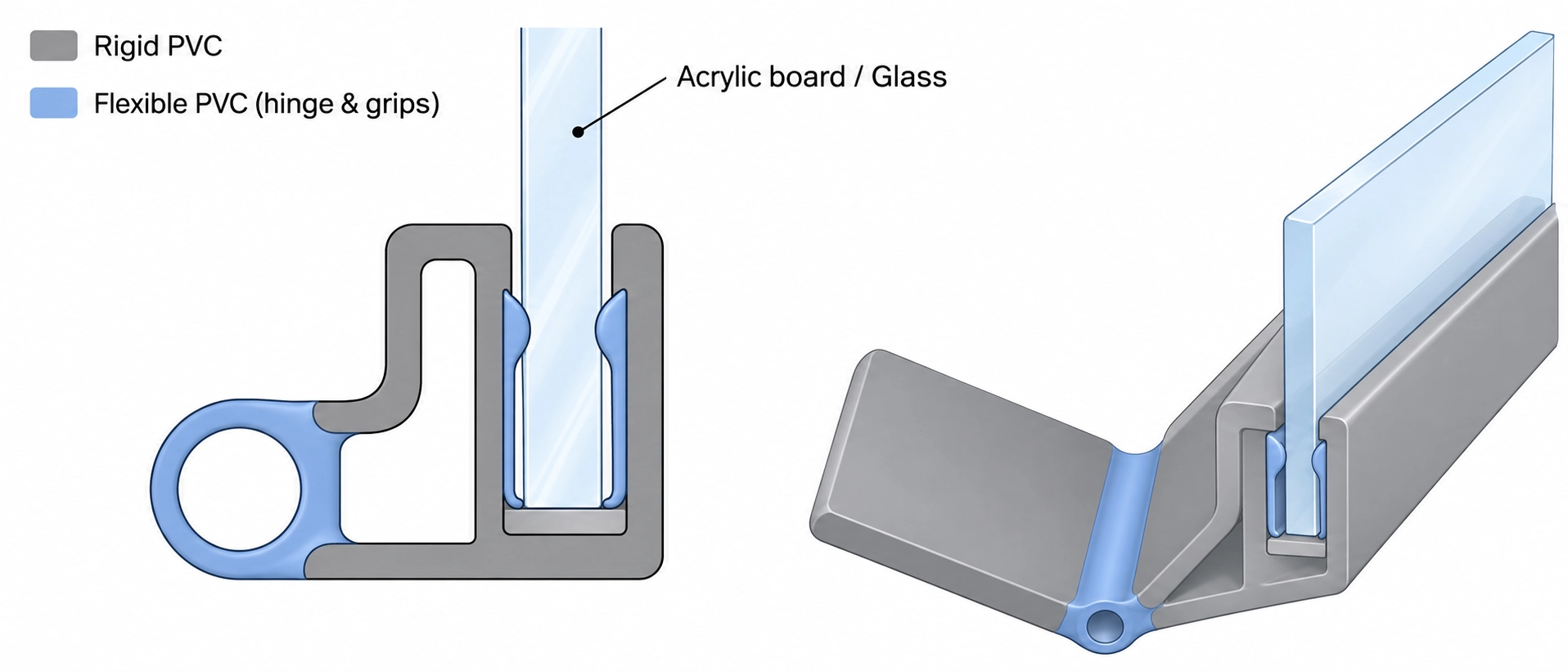
For interface testing, define specimen geometry, preparation, conditioning, loading direction and how the failure will be recorded. A narrow lip or curved section may require a different specimen arrangement from a flat coupon. Ask the technical reviewer to confirm the method's suitability before adding a standard number or strength limit to the purchase specification.
Record the failure location as well as the measured result. Separation at the interface and tearing within a material describe different observations. Neither should be called acceptable without reference to the agreed criteria and the part's function.
Verify Fit After Conditioning
Agree when samples will be measured and assembled, including any required conditioning or service exposure. Record the evaluated length, support arrangement and mating-part revision so the supplier's and buyer's results can be compared.
The guide to defining bow and twist inspection conditions discusses these records for ABS profiles. Use it to frame the inspection discussion; the limits for a different material combination must be specified for that project.
Include relevant cutting, drilling or other secondary work in approval when it affects the finished part's fit or interfaces. If transport protection matters, evaluate the supplied condition rather than approving only an unpacked short section from the trial line.
Compare Supplier Evidence and Control Production Changes
Separate evidence of a product's appearance from evidence of a qualified construction and evidence of repeatable production. A photograph may show the general shape. A documented trial can establish results for its stated materials and conditions. Production records address the batches they actually cover.
Use a short evidence register when comparing suppliers:
| Supplier statement | Supporting evidence to request | Unresolved item | Owner and decision |
|---|---|---|---|
| "We can make the section" | Proposed construction and relevant sample or trial plan | Differences from the requested geometry or grades | Record reviewer and next action |
| "The materials bond" | Evidence identifying grades, specimen, method and conditions | Applicability to this interface and service | Define remaining validation |
| "The dimensions are achievable" | Measurement proposal and representative readings | Length, conditioning, support or tolerance exclusions | Agree the drawing and inspection basis |
| "Production will match the sample" | Proposed lot records and change controls | Which features are monitored and how changes are handled | Assign release responsibilities |
This register is a purchasing aid. It does not imply that every supplier holds a particular certification or uses the same approval system.
Record What the Approved Sample Covers
Link approval to the drawing revision, material grades, compound and color details, relevant tooling identification, sample IDs, inspection results and agreed deviations. State whether approval covers initial fit, the specified validation work, production release or a narrower purpose.
Define notification and reapproval requirements for changes to grades, formulations, material sources, tooling, manufacturing location or subcontracted operations where they may affect the approved requirements. Assign responsibility for deciding what needs to be checked again. Do not leave that decision implicit in an instruction to "match the sample."
Agree ongoing sampling and lot-release records separately from first-article approval. A successful first sample is evidence for that sample and its recorded conditions; the purchasing agreement should explain how subsequent deliveries will be checked.
Prepare Your Drawing for a Feasibility Discussion
Prepare a marked cross-section, mating-part information, service conditions, quantity basis and proposed acceptance requirements. Highlight which requirements are fixed and where an alternative grade, zone layout or assembly route may be considered.
You can explore custom plastic profile options in Dachang's product range and review the relevant custom co-extruded profile options. Use Dachang's inquiry page to describe your RFQ requirements and arrange how to send your drawing. Request a written response on the proposed construction, unresolved questions, trial scope and evidence needed for approval. Confirm the specific two-stream or three-stream arrangement against your drawing before proceeding with tooling or samples.