

A custom flat ABS plastic strip is not fully specified by width, thickness, and color. If it must fit a channel, align with another component, or remain visually straight over a long span, the drawing also needs to identify the dimensions that control function, the agreed method for measuring straightness, the required ABS grade or performance, and the evidence needed before production release.
The purchasing objective is not simply to produce one acceptable sample. It is to establish a specification and approval process that can keep the strip acceptable across a production run.
The decision path is:
Define → DFM → Tool → Approve → Stabilize → Buy
What Buyers Need to Define Before Tooling a Flat ABS Plastic Strip
A useful RFQ begins with the application, not the die. The supplier needs enough information to understand what the strip must do and which variations would cause a functional or appearance failure.
At minimum, define:
- The 2D cross-section and required cut length.
- Expected batch volume and annual demand.
- Mating parts, slots, clips, or adhesive interfaces.
- Critical-to-quality dimensions and separate reference dimensions.
- Visible surfaces, texture, and color requirements.
- Straightness, bow, camber, twist, or flatness requirements where relevant.
- Service-temperature range, indoor or outdoor exposure, and contact chemicals.
- The required ABS grade or the performance and compliance criteria used to select one.
- Required secondary operations, such as drilling, punching, adhesive application, or assembly.
- Packaging and transport conditions for long lengths.

Without these inputs, two quotations may not describe the same deliverable. One supplier may price a nominal section with basic inspection, while another may include tighter critical dimensions, custom gauging, controlled material traceability, and cut-length inspection.
Define Critical Dimensions, Not Just Nominal Size
Mark each dimension according to its function. A width that locates the strip inside a channel may be critical. A non-mating cosmetic edge may allow more variation. Cut length may control an assembly stop, while another project may trim the strip after delivery and treat supplied length as non-critical.
Applying tight tolerances to non-functional dimensions should be justified because it can increase manufacturing and inspection burden without improving the finished assembly. Classify dimensions by their effect on the application:
| Drawing status | Meaning | Typical treatment |
|---|---|---|
| CTQ | Failure affects fit, function, safety, or a regulated requirement | Explicit tolerance and inspection method |
| Major | Variation affects assembly efficiency or visible quality | Agreed tolerance and routine inspection |
| Reference | Informational; controlled indirectly by other dimensions | No independent acceptance requirement unless agreed |
Specify the ABS Grade or the Required Performance
"ABS" is a material family, not a complete purchasing specification. ASTM D4673-23 provides a classification and line-callout system for ABS molding and extrusion materials, but ASTM states that the system is not intended for material selection. Selection still depends on economics, the service environment, material properties, part design, required performance, and the manufacturing process.
If the project already has an approved resin, state the manufacturer and exact grade, together with any permitted alternative or change-approval rule. If the grade is not fixed, provide functional requirements such as:
- Required impact performance and service-temperature range.
- Stiffness or maximum allowable deflection.
- Required heat resistance.
- Indoor or outdoor exposure conditions.
- Flammability or other regulatory requirements.
- Color, gloss, and surface requirements.
- Restrictions on regrind or recycled content.
- Required declarations or test documentation.
This allows the supplier to propose a grade without presenting one datasheet as proof of how every ABS formulation will perform. Dachang's custom ABS extrusion profiles page shows the relevant product family, but the approved grade still needs to be defined for each project.
DFM for Flat ABS Extrusions: Flatness Matters as Much as Thickness
A strip can meet its width and thickness limits and still fail in assembly because it bows along its length, curves sideways, or twists. For a long flat profile, straightness is therefore a separate acceptance characteristic rather than an assumed result of holding the cross-section.
The risk rises when the cross-section cools or shrinks unevenly. A 2022 peer-reviewed study of extruded polymer profiles found that uniform cooling is required to avoid warpage and twisting caused by differential shrinkage, and that cooling conditions influence residual stress and extrudate shape. The study supports the mechanism; it does not establish a universal production tolerance for flat ABS strips.

Wall Balance and Geometry
Even a simple-looking flat section may contain features that unbalance flow or cooling: a heavy mounting rib on one side, a thin visible face, an asymmetric lip, or a local groove. These features can cool at different rates and pull the section away from the intended geometry.
During DFM, review the following questions:
- Can wall transitions be made more gradual?
- Can non-functional mass be removed?
- Do ribs, lips, or grooves create an asymmetric cooling load?
- Which surfaces require calibration or support?
- Does a cosmetic face need separate surface acceptance criteria?
- How will the part be stored and supported after cutting?
For broader cross-section guidance, use Dachang's plastic extrusion profile design guidelines as a separate DFM reference rather than repeating a general profile-design guide here.
Define How Straightness Will Be Measured
"Must be flat" is not an inspectable requirement. Terminology and measurement conventions should be agreed on the drawing or inspection specification. The parties need to identify the controlled feature, measurement span, support condition, method, conditioning state, reporting unit, and allowable deviation.
Depending on the project, the specification may distinguish:
- Bow: Deviation from straightness along an agreed face and length.
- Camber: Sideways curvature along the strip.
- Twist: Angular rotation of the cross-section over a defined length.
- Local flatness: Surface deviation over a specified local area.
These descriptions are starting points for project language, not a universal dimensional standard. A strip bonded continuously to a rigid substrate may require a different acceptance method from a free-spanning decorative trim. Measurement after a defined conditioning period may also be necessary if the profile continues to stabilize after cutting.
From Drawing to Extrusion Die and First Article
The extrusion die is engineering tooling, not a one-to-one cutout of the finished cross-section. Polymer flow changes as the melt passes through and exits the die; downstream sizing, cooling, and haul-off also affect the final geometry.
Why the Die Is Not a 1:1 Copy of the Finished Profile
Die swell is one reason the emerging section does not simply reproduce the opening. NIST's 2023 study describes die swell as a polymer-extrusion flow effect involving rapid stress and dimensional changes as material exits an orifice. The study tested ABS filament in an additive-manufacturing material-extrusion system. Its numerical results-including its flow rates, temperatures, and nozzle sizes-should not be transferred to an industrial profile line; it is used here only to support the underlying mechanism.
In profile extrusion, the toolmaker must also account for flow balance, drawdown, shrinkage, and the behavior of the section in calibration and cooling. A tooling trial may therefore show that one region needs correction even when the machined die matches the intended design. Trial, measurement, and correction are normal steps in converting a drawing into production tooling.
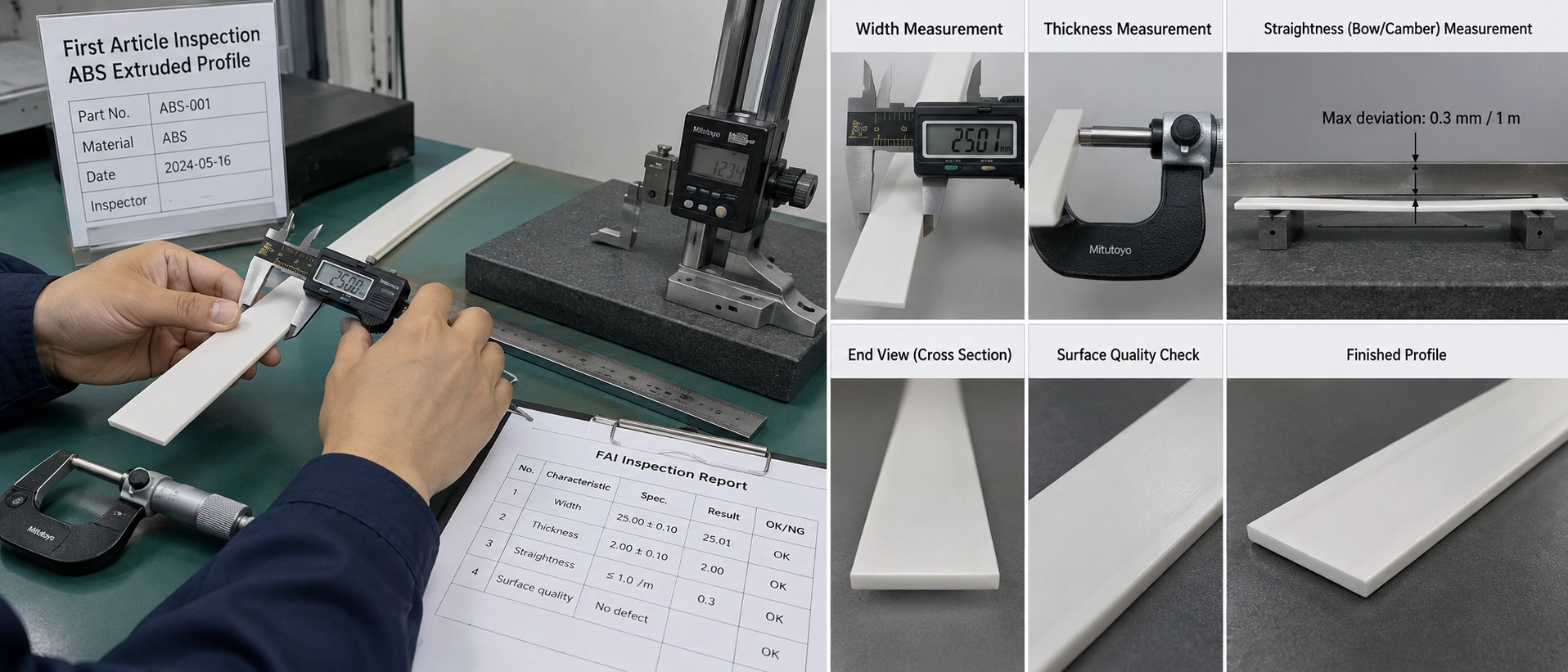
What a First-Article Approval Should Actually Check
The exact first-article inspection scope is project-specific. For a flat ABS strip, candidate checks can include:
- Material manufacturer and grade.
- Color and approved masterbatch reference.
- CTQ cross-sectional dimensions.
- Required cut length.
- Bow, camber, twist, or local flatness where specified.
- Surface texture, gloss, streaks, and die lines.
- Mass per unit length when it is an agreed indicator of section drift.
- Fit with the mating component.
- Results of required secondary operations.
- Drawing and tooling revision status.
The approved sample should be linked to a drawing revision and inspection record. A loose physical sample without revision control can become ambiguous when the tool or drawing later changes.
How Cooling, Sizing, and Pulling Affect the Finished Strip
After the melt exits the die, sizing, cooling, and haul-off help establish the final dimensions. They are not merely transport stages. Uneven cooling can produce differential shrinkage, insufficient total cooling can allow downstream deformation, and an unsuitable balance between output and haul-off can change dimensions or orient the material.
For a detailed treatment of drying, melt checks, calibration, cooling, and haul-off, see Dachang's guide to ABS profile extrusion process parameters. The buyer-level question is how the supplier connects those process controls to release inspection.
Useful questions include:
- Are dimensions released immediately at the saw or after defined conditioning?
- Which process records are linked to the production lot?
- How are line speed, output, and mass per length monitored when dimensions drift?
- How is cooling stability checked during a long run?
- What triggers containment, reinspection, or process correction?
Separate Dimensional Stabilization from Transport Deformation
Cooling faster is not automatically better. The TU/e study found that fast cooling can freeze elastic stresses into the extrudate, while slower cooling can permit more swell under the modeled conditions. The purchasing implication is not to prescribe an arbitrary water temperature. It is to require a stable process and agree when the product is dimensionally ready for final inspection.
That is a manufacturing and conditioning issue. Packaging is a separate control: long lengths need agreed support and restraint so stacking and transport do not introduce deformation after the part has been accepted. Both controls matter, but they address different failure mechanisms.
What Must Be Reconfirmed Before Mass Production
First-article approval proves that an identified sample met the agreed checks. It does not, by itself, define how the supplier will keep later production within specification.
Before release, confirm the production-intent baseline:
- The approved drawing revision.
- The production die and calibrator revision.
- The approved resin grade and color system.
- The CTQ list and agreed measurement methods.
- Conditioning requirements before final measurement.
- The sampling plan and reaction plan.
- Material and production-lot traceability.
- Change-notification requirements.
- The packaging method used to protect long lengths.
- Retained-sample or golden-sample controls, if used.
Production-Intent Material and Tooling
Samples should be produced with the material, tooling, and relevant downstream conditions intended for production. If prototype material or temporary tooling is used, the report should identify what must be revalidated later.
Material substitution also needs a clear rule. An alternative ABS grade may fit the same broad classification but differ in flow, gloss, impact behavior, heat resistance, or shrinkage. No substitution should be treated as automatically equivalent solely because both materials are called ABS.
Samples should be produced with the material, tooling, and relevant downstream conditions intended for production. If prototype material or temporary tooling is used, the report should identify what must be revalidated later.
Material substitution also needs a clear rule. An alternative ABS grade may fit the same broad classification but differ in flow, gloss, impact behavior, heat resistance, or shrinkage. No substitution should be treated as automatically equivalent solely because both materials are called ABS.
Inspection Frequency and Change Control
The supplier and buyer should agree which features are checked at setup, during the run, and before shipment. Frequency should reflect feature risk, process stability, lot size, and measurement burden; it should not be presented as a universal number in a marketing article.
Change control should address resin grade, colorant, regrind policy, die or calibrator modification, process relocation, and any inspection-method change that could affect result comparability. The quotation and quality agreement should state which changes require notification or reapproval.
Standard Strip or Custom Tooling? A Buyer Decision Check
Quick rule: start with an existing profile if its geometry, ABS grade, finish, available length, and straightness requirements already meet the drawing. If any of those conditions are not met, evaluate custom tooling.
Custom tooling may be appropriate in any of the following situations:
- The strip must fit a proprietary channel or assembly.
- The application has specific CTQ requirements.
- The section must integrate ribs, lips, grooves, or snap features.
- The project requires a defined resin grade, color, or surface finish.
- A custom section could reduce downstream machining or assembly.
- Repeat orders require a controlled profile revision.
Dachang's published existing ABS plastic strip profile is one example of a current section. Its listed dimensions and tolerances apply to that published product, not automatically to every new custom profile. Compare the existing section with the application drawing before deciding whether new tooling is justified.
RFQ Checklist for a Custom Flat ABS Plastic Strip
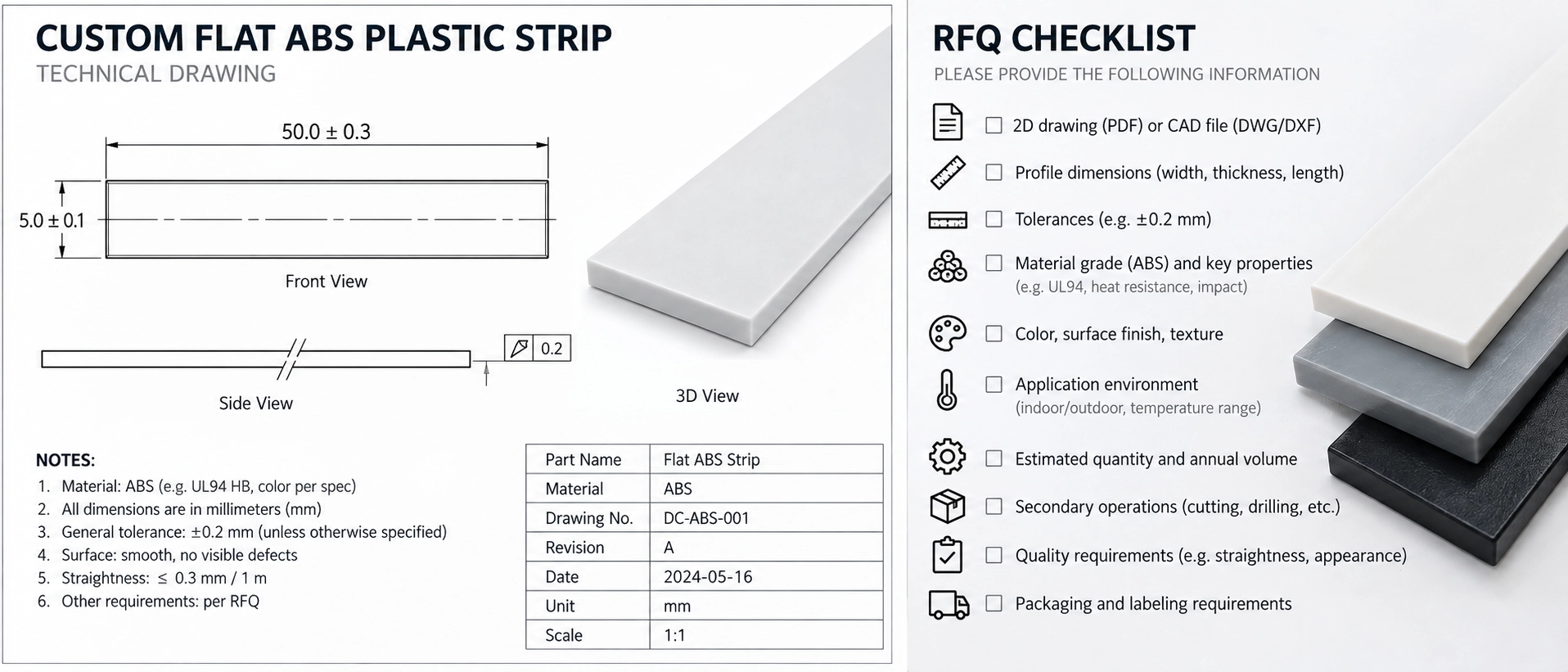
Send the following information with the RFQ so the supplier can assess feasibility and quote the same scope you intend to approve:
- A 2D profile drawing in PDF format, plus an editable CAD or DXF file if available.
- Required width, thickness, cross-sectional dimensions, and cut length.
- Identification of CTQ, major, and reference dimensions.
- Definitions and measurement spans for bow, camber, twist, or flatness.
- The specified ABS grade or required material performance.
- Color standard, gloss level, texture, and visible-surface requirements.
- Indoor or outdoor use, service-temperature range, and chemical exposure.
- Mating-component details or fit-test requirements.
- Required secondary operations, such as drilling, punching, bonding, or assembly.
- Initial order quantity and estimated annual volume.
- Packaging, labeling, and traceability requirements.
- Compliance documents required at quotation or shipment.
- First-article inspection requirements and production-approval criteria.
- Change-notification and reapproval requirements.
If the drawing and acceptance criteria are ready, send the drawing, application conditions, and acceptance requirements to Dachang for material, die-design, and manufacturability review with the quotation.
From Approved Sample to Repeatable Production
The strongest custom flat ABS plastic strip specification connects the drawing to a measurable production-control plan. Width and thickness remain important, but they are only part of the decision. Material grade, CTQ allocation, straightness measurement, tooling revision, first-article inspection, and change control determine whether a good sample can become a repeatable supplied part.
For a new program, approve the specification and inspection method before treating the tooling sample as a production release. Then use the same material, revision status, conditioning rules, and defined checks to control repeat orders.