

A Material Name Is Not a Specification
Rigid PVC profiles are a strong engineering choice when an extruded section must retain its geometry, resist moisture and many common chemicals, and run consistently in long production lengths. In commercial specifications, the same material is also commonly called uPVC, while ISO and EN documents generally use the formal term PVC-U.
The important distinction is that "rigid PVC" describes a material family, not a complete finished-part specification. A purchasing drawing can contain three separate layers of requirements: the PVC-U compound, the extruded profile, and the performance of the final assembly.
ASTM D1784-25 is a classification system for rigid PVC and CPVC compounds. It covers properties used to classify the material, but ASTM explicitly warns that results obtained from standard specimens are not directly applicable to finished products; an appropriate finished-product specification still has to be considered.
A supplier saying "the material meets ASTM D1784" has not, by that statement alone, demonstrated that the finished profile meets the requirements of your application.
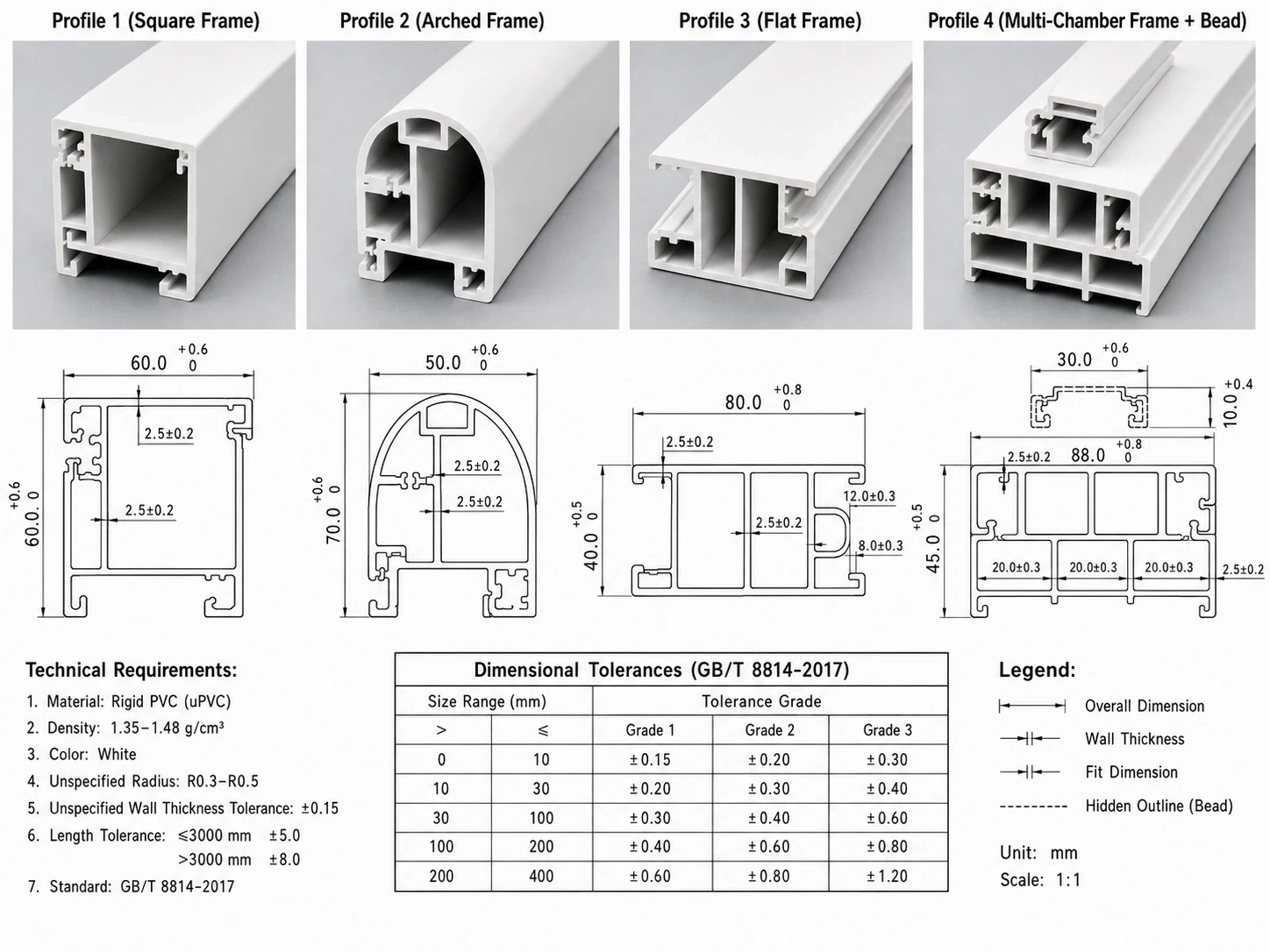
That missing layer is where many RFQs become ambiguous. The relevant questions are usually dimensional stability, impact requirement, fusion quality, wall geometry, outdoor exposure and what the completed assembly is expected to survive.
Match the Profile to the Environment Before Comparing Datasheets
Applications for rigid PVC profiles are more useful when organized by service condition than by a generic list of industries.
For an indoor structural or finishing section, such as cable-management channels, decorative trims, machine covers or panel retainers, dimensional consistency, snap geometry and extrusion quality may dominate. UV performance may have little value, while one critical mating dimension can decide whether the profile works.
For exterior rigid PVC profiles, the decision changes. Outdoor service adds weatherability, pigment and stabilizer selection, temperature cycling and long-term impact retention to the discussion. An indoor profile cannot simply be moved outdoors because both parts happen to be PVC-U.
Window and door sections form another category because there are finished-profile standards written specifically around those assemblies.
ASTM D4726 and EN 12608-1 belong here; they should not be treated as universal specifications for every outdoor PVC extrusion.
In industrial OEM programs, a single finished-product standard often does not cover the complete part. The practical specification for rigid PVC profiles for industrial applications may therefore combine a compound requirement, drawing tolerances, agreed finished-profile tests and application-specific acceptance criteria.
Automotive programs show why this distinction matters. A supplier may be perfectly capable of extruding a section yet still lack the quality-system and program controls expected in an automotive supply chain; our automotive plastic extrusion standards article treats that as a separate qualification problem rather than a resin-selection problem.
This is the engineering sequence we use: start with what can make the assembly fail, then determine which material classification, profile standard and inspection plan belong on the drawing.
The Property That Matters Depends on the Failure Mode
For rigid PVC profile technical specifications, "strong," "weather resistant" and "dimensionally stable" are not specifications. Each only becomes useful when it is connected to a failure mode.
| Application condition | Property to define | Engineering question |
|---|---|---|
| Snap-fit or mechanically loaded section | Impact behavior, stiffness, local geometry | Will the feature crack during installation or lose retention after repeated loading? |
| Long mating section | Dimensional stability and tolerance | Will variation accumulate over the full assembly length? |
| Outdoor exposure | Weatherability, pigment and stabilizer system | Will color or impact performance shift after exposure? |
| Elevated temperature | Thermal behavior and dimensional movement | Will the part bow, grow or consume the designed clearance? |
| Electrical/building application | Applicable flame classification | Which test applies to the material and which applies to the final assembly? |
| Chemical-contact environment | Chemical compatibility under load | Does compatibility remain acceptable when chemical and mechanical stress occur together? |
ISO 21306-1:2019 shows why material classification alone cannot settle these questions. Its PVC-U designation system uses properties including Vicat softening temperature, Charpy notched impact strength and modulus of elasticity, while ISO specifically states that materials carrying the same designation do not necessarily provide the same performance in a particular application.
That distinction should carry into every review of rigid PVC profile material properties. Identify the test method and specimen first, then decide whether the property actually governs failure in the proposed geometry.
Technical Standards for Rigid PVC Profiles: Know Which Layer You Are Specifying
As of 2026, these standards occupy different layers of a rigid-PVC specification:
| Standard | Primary role | Appropriate use | Do not treat it as |
|---|---|---|---|
| ASTM D1784-25 | Rigid PVC / CPVC compound classification | Compound-level specification | Universal finished-profile specification |
| ASTM D3678-26 | Rigid PVC interior-profile extrusion | Interior profile material properties, dimensional stability and extrusion quality | Exterior weatherability specification |
| ASTM D4726-24 | Exterior PVC profile for assembled windows and doors | Window/door exterior profile requirements | Standard for every outdoor industrial extrusion |
| ISO 21306-1:2019 | PVC-U material designation and classification | International material-specification framework | Finished-part certification |
| ISO 21306-2:2019 | Specimen preparation and property determination | Reproducible material testing | Production profile dimensional specification |
| EN 12608-1:2026 | Non-covered PVC-U profiles for windows and doors | European window/door profile classification and tests | General industrial-profile standard |
The practical value of this map is simple. Writing "ASTM compliant" on an RFQ is not precise enough; the document has to identify which layer of the product is supposed to comply.

ASTM D1784 vs. D3678 vs. D4726: Do Not Use Them Interchangeably
ASTM D3678-26 establishes requirements for rigid PVC interior-profile extrusions, including material properties, dimensional stability and extrusion quality. Its scope separately points to D1784 for rigid PVC compounds and D4726 for exterior profiles used in assembled windows and doors.
ASTM D4726-24 is narrower than "exterior PVC standard" sometimes implies. It applies to rigid PVC exterior-profile extrusions used in assembled windows and doors and covers material properties including dimensional stability, weatherability and extrusion quality. ASTM currently lists D4726-24 as active.
A window sash, an exterior industrial equipment trim and an agricultural profile can all use rigid PVC, but that does not make D4726 the correct finished-product standard for all three.
This is where rigid PVC profile ASTM standards should be used as scope tools rather than badges. If the actual application sits outside the stated scope, the RFQ should define the missing finished-profile tests instead of borrowing a convenient standard number.
International Specifications: ISO 21306 and the 2026 EN 12608-1 Update
When buyers refer to uPVC profile standards, the formal specifications normally describe the material as PVC-U.
ISO 1163-1:1995 has been withdrawn and replaced by ISO 21306-1:2019. ISO 21306-2 deals with preparation of test specimens and determination of properties, and ISO lists the 2019 edition as current after review.
The testing issue matters because specimen dimensions, preparation, thermal history, internal stresses and conditioning can all affect measured properties. Two datasheets can therefore report a property with the same unit while still not describing directly comparable tests.
For European window and door projects, EN 12608-1:2026 is now the current edition. NEN lists a publication date of August 1, 2026 and shows that it replaces the 2016+A1:2020 edition. Its scope is non-covered PVC-U profiles intended for fabrication of windows and doors.
For teams maintaining old specification libraries, this creates a simple review task. An old standard number should not remain on a drawing merely because it survived from the previous program.
Datasheet Numbers Are Useful Only When Their Test Context Is Visible
A useful datasheet gives you screening data; it does not predict finished-profile behavior.
For context, one current Dachang rigid-PVC structural section used in a rigid/flexible co-extrusion product publishes the following guideline values. They are useful because they show the scale of the properties we actually specify, but they are not universal acceptance limits for every PVC-U compound.
| Property | Published guideline value | How to use the number |
|---|---|---|
| Tensile strength | 40–60 MPa | Compound and application screening; verify the actual production grade |
| Flexural modulus | 2.4–4.1 GPa | Stiffness screening, not a direct prediction of section deflection |
| Heat-deflection temperature | 65–75°C | Check load, test method and real service temperature before using it as a design limit |
| Density | 1.3–1.45 g/cm³ | Useful for weight and material-consumption estimates, not finished-profile acceptance |
These are first-party guideline values for a defined Dachang product construction, not ASTM D3678 or D4726 acceptance limits and not guaranteed values for every rigid PVC profile. The production drawing and compound documentation still control the order.
A 2.4–4.1 GPa flexural-modulus range can still produce very different finished behavior in a thin U-channel, a multi-cavity window section and a thick flat bar. Section geometry, cooling history, residual stress, span and restraint convert the material property into actual deformation.
Thermal movement needs the same discipline. Instead of copying a generic coefficient from an internet property table, specify how the coefficient is measured. ASTM D696-24 is the active test method for linear thermal expansion of plastics between −30°C and +30°C; another method may be appropriate outside that test range.
Consider tolerance stack-up as a separate example. Five mating dimensions each held to ±0.15 mm create a theoretical worst-case accumulation of ±0.75 mm. That does not mean every production assembly will reach the extreme; it means the drawing has to tolerate the possibility or allocate the tolerance differently. Our custom plastic profile design guide covers the same problem from the tooling and DFM side.
Geometry converts material properties into part behavior.

Five Failure Modes Standards Alone Will Not Prevent
The five failure modes below remain separate from basic standards compliance because they sit at the intersection of formulation, tooling, processing and assembly.
A Dimensionally Correct Profile Can Still Have Poor Fusion
Rigid PVC profiles can pass a dimensional check while still having a processing problem inside the material. In practice, this is why geometry and fusion are documented as separate QC results.
In our extrusion workflow, dimensional inspection and fusion verification are separate controls. Dachang's published process records state that every shipped production batch is checked by methylene chloride immersion, with surface whitening or tackiness treated as a reject condition. The same process page reports an average Cpk of 1.52 on critical dimensions over the prior six months, specific energy consumption of 118–135 Wh/kg, and a 100% fusion-test pass rate on shipped batches. PVC extrusion process and quality guide
Those figures do not prove every future run will perform identically. They do show why a dimensional report and a fusion result are two different pieces of evidence. A smooth surface and an in-tolerance dimension answer the geometry question; they do not answer the fusion question.
Plate-Out Can Look Cosmetic While the Cause Is Upstream
Plate-out is an unwanted deposit that can develop around extrusion dies, calibration or related processing areas. Once buildup starts affecting the product surface, operators may see streaking or scoring rather than an obvious formulation failure.
Research published in the Journal of Vinyl and Additive Technology found that lubricant characteristics can materially affect die plate-out behavior in the rigid-PVC formulations studied.
For procurement, the useful distinction is between sorting a visible defect and eliminating its root cause. Repeated surface lines from the same production process should trigger a process or formulation investigation, not simply a larger final-inspection sample.
A Tighter Tolerance Is Not Automatically a Better Specification
Do not put the tightest tolerance your CAD system allows onto every dimension.
Critical mating dimensions should be controlled tightly enough to protect function. Non-critical walls, cosmetic faces and unconstrained features should leave enough process allowance for stable extrusion.
Which dimensions are critical depends on what the profile actually does. A snap feature is controlled by engagement and local strain; a sliding channel is controlled by accumulated clearance; a sealing land is controlled by compression; a fastener feature needs enough material and positional control to survive installation. That analysis belongs before tooling approval.
On our published hard-PVC profile range, sections below roughly 1 mm wall are treated as more sensitive to draw-down and cooling variation. The practical response is to sample and measure before volume release; the example on our product page contrasts a 50 m trial with the risk of discovering the same issue during a 4,000 m production run.
The ±0.75 mm five-part stack-up example above is exactly why "every individual part passed inspection" and "the complete assembly fits reliably" are two different statements.
Outdoor Suitability Belongs to the Formulation and Exposure Requirement
"PVC is weather resistant" is too broad to qualify an exterior component.
For exterior service, our engineering review separates the polymer name from the actual environment. UV exposure, pigment system, thermal cycling, impact retention, required service life and the applicable finished-product standard are considered before the material is accepted.
A useful first-party example is Dachang's own hard-PVC production guidance. UV absorbers and rutile titanium dioxide are added for outdoor service rather than assuming the same formulation fits an indoor display, facade, refrigerated cabinet and luminaire housing. The published rigid-PVC guidance also keeps filler loading below 10 phr for rigid work because increasing filler can buy stiffness while giving away impact performance.
That is the engineering rule current public production data supports. A named customer case should only be added when there is a real project record approved for disclosure.
Flame Classification Must Be Specified at the Correct Level
A compound flame classification can be relevant without being the complete fire requirement for the assembled product.
If an RFQ specifies UL 94 V-0 or V-2 material, the supplier can work from that requirement at compound level. The engineer still has to determine whether the receiving market or finished assembly is subject to another product-level test.
This distinction is particularly important when a drawing has been copied from an older program. A material designation, regulatory declaration and finished-product compliance requirement may look similar in a purchase specification while answering three different questions.
Build the RFQ Around Failure Conditions, Not Just Nominal Dimensions
A useful RFQ for custom rigid PVC profiles gives the extrusion team enough information to challenge the drawing before a die is cut.
The minimum useful package normally includes:
- cross-section drawing in DWG, DXF, PDF or another dimensioned format;
- nominal dimensions and clearly identified critical tolerances;
- overall cut length and cut-length tolerance;
- annual or batch volume;
- indoor, outdoor or mixed exposure;
- operating and storage temperature range;
- UV/weatherability requirement where relevant;
- mechanical or impact loading;
- color and acceptable color tolerance;
- flame classification or final-product fire requirement;
- applicable ASTM, ISO, EN or customer specification;
- secondary work such as punching, drilling, CNC machining or bonding;
- mating-part information where fit depends on tolerance accumulation.
The most useful rigid PVC profile RFQ describes the service condition and failure criteria, not only the shape.
The extension beyond that rule is where supplier engineering starts to matter. Two profiles with the same polymer, wall thickness and nominal length can require different tooling or compound decisions when one is cosmetic and the other contains a loaded snap, long sliding interface or exterior exposure.
That additional context is what should be resolved before quotation turns into tooling.
Selecting the Right Rigid PVC Profile Standard Is a Scope Decision
For an interior building profile, first determine whether ASTM D3678 actually covers the product and intended use.
For an exterior window or door profile, ASTM D4726 or the relevant EN 12608 requirements can provide the appropriate finished-profile framework.
For custom industrial rigid PVC extrusion profiles that sit outside those finished-product scopes, define the compound requirement, drawing tolerances, application-specific tests and acceptance criteria separately.
This keeps supplier quotations comparable. One supplier should not be pricing a bare material designation while another has included UV stabilization, tighter critical dimensions, additional test records and a more demanding inspection plan.
The basic standard-selection answer is complete. The part that cannot be solved from a standards table is whether your specific cross-section and service condition fall inside that scope and what has to be added when they do not. The final engineering review therefore belongs at drawing level, rather than being reduced to another standards badge.
Custom Rigid PVC Profile Development Should Start Before the Die Is Cut
The highest-value technical review on a custom extrusion normally occurs before tooling, not after the first sample.
We start with three questions: can the geometry be extruded consistently, does the material specification match the service environment, and which dimensions or performance requirements actually determine whether the assembly works?
For indoor service, outdoor exposure, window or door use, flame-classified assemblies and profiles with unusual impact or tolerance requirements, those conditions need to be visible during drawing review.
The practical reason is that an approved CAD section still contains design assumptions. Wall transitions affect flow and cooling, mating dimensions accumulate, dark exterior colors can change thermal exposure, and a material classification cannot substitute for an assembly requirement.
If the project fits the process, send the cross-section and application requirements for a rigid PVC profile technical review. The review should identify the compound requirement, applicable standard, critical tolerances and required test documentation before production tooling is released.
FAQ
What standards apply to rigid PVC profiles?
The correct standard depends on whether the requirement concerns the PVC-U compound, an interior extrusion, a window or door exterior profile, or another application-specific finished product.
What is the difference between ASTM D1784 and ASTM D3678?
ASTM D1784 classifies rigid PVC compounds, while ASTM D3678 applies to rigid PVC interior-profile extrusions and includes finished-profile requirements such as dimensional stability and extrusion quality.
Are rigid PVC profiles suitable for outdoor applications?
Rigid PVC profiles can be engineered for outdoor use, but suitability depends on the formulation, weatherability requirement, color system, geometry and actual exposure conditions.
Is ISO 1163 still the current PVC-U material standard?
ISO 1163-1 has been replaced by ISO 21306-1:2019 for the designation and classification of PVC-U moulding and extrusion materials.
What should be included in a rigid PVC profile RFQ?
A rigid PVC profile RFQ should identify the drawing, critical tolerances, service environment, temperature, UV and impact needs, required standards, color, volume and secondary operations.